13 April 2006

Evenings

A cold wind in the late afternoon, blowing pale sunlight over paddocks stripped of ripened crops. Stubble, ploughed earth, shorn pasture. A field of black and white bulls. An empty paddock where a horse the colour of the faded daylight moon stands, enduring the wind.

I drove home through light drained of its power to warm—it slipped over surfaces, unable to sink in, bounced off buildings and tree trunks and leaves; shadows everywhere. Later, pain behind my right eye, and rain on the iron roof after dark.

...

morning sun
through last night’s rain
a yellowhammer

...

The sun’s just rolled below the western skyline, leaving light the colour of a duck’s egg and the clouds, changing moment by moment, shift through grades of orange and grey and white. The textures are astonishing—here a wild ruffle like a surfer’s sun dried hair; there a scatter of confetti; elsewhere a patterned sheet like muscle beneath skin, a mackerel sky; close to the horizon, long, lenticular clouds as smooth as the cheek of a woman, as a closed eyelid and everything within. One of those curved clouds looks like the profile of a sawfish—that strange creature we used to see sporadically on the wonderful Attenborough narrated natural history documentaries before pay-to-see TV drove them to extinction on the free-to-air channels—a kind of devolution where reality replaces what’s real and adrenaline supplants intelligence.

I sound like a grumpy fossil, a disceptatious dinosaur.

Before my eyes, the sawfish cloud thins and disappears; the space it encompassed fills with a brilliant light which has no colour, like the purest form of nothing. Light only; light without colour; light and nothing more. This makes no sense until you see it.

...

Tonight the phone rang, an event so rare it startled me. I picked it up.

“Pete speaking,” I said.

It was a woman from the blood bank. She sounded tentative, almost apologetic, which I suppose is understandable when you’re asking someone if it’s all right if you drain a pint or so of their blood. I warmed to her immediately. Before I could say, “yes, of course,” she’d begun to list their opening hours and was wondering whether I could manage to come in some time in the next few weeks.

“Yes, of course,” I said, eager to please, eager she should feel good about the call. “I’ll come in tomorrow morning. I have things to do in town, so I’ll be in anyway,” I lied.

I put the phone down, sat back, and listened to the music filling the room. When it ended, I picked a book from the shelves, not quite at random but more or less haphazardly. I opened it.

“There, still, we have magic adventures, more wonderful than any I have told you about; but now, when we wake up in the morning, they are gone before we can catch hold of them. How did the last one begin? ‘One day when Pooh was walking the Forest, there were one hundred and seven cows on a gate...’ No, you see, we have lost it. It was the best, I think.”

I went to bed and dreamed of things I don't remember.


Notes:
1. Perhaps the short poem is or is not a haiku, depending on what you believe haiku to be. For me, it's more about quality than form and structure, and the obsession with 5-7-5 syllables is irrelevant. In any case, it's based on the confusion of onji with the western syllable. Cyril Childs, editor of both NZ haiku anthologies summed it up perfectly when he said that focusing on the structure of haiku is like focusing on the cage that surrounds the singing bird. Whatever mine is, I hope it sings for you.
2. Yellowhammer: Emberiza citrinella. Another of those introduced birds no one seems to know or care much about.
3. When I donated today, I asked, and was told they take 470 ml. So, for the pedantic, it's only about 3/4 of a pint.
4. The quote, if you haven't already guessed, is from A.A. Milne's The House at Pooh Corner, in the Contradiction.

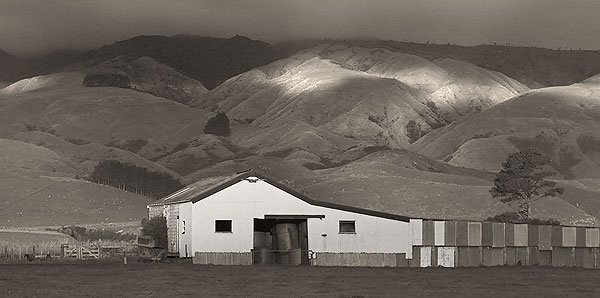
Photo 1: I pass this shed twice, every time I make a trip into town and back.
Photo 2: Posting photos of me seems pretentious, but I'm getting bored with the other photos and I suspect people are vaguely curious by nature. Whatever.

Photos and words © 2006 Pete McGregor

07 April 2006

Being still

A car howls around the downvalley bend, drops a gear as it sweeps through the curl of the bridge, and growls up the hill. I step off the road and wait. The car hurtles around the blind corner, cutting the white line, and flashes up the hill. Red, shiny, trailing a stink of exhaust like a drawn-out, sulphurous fart from its large bore arsehole. I bet the car gets polished every week.

...

I remember Dirk hunting mice. He simply sat, motionless, on the kitchen floor, watching the hole in the wall where the pipe passed behind the refrigerator. Even when he turned his head to look at me, then turned back to the mouse path, he seemed so still, as if the movement emphasised its own absence.

...

Te Awaoteatua Stream rushes to the Pohangina. Always in motion. For all I know, this small stream has never ceased flowing for hundreds of years, perhaps far longer. I watch the water for a while, then look away and the boulders on the bank seem to creep back up the little valley. The distant roar of a stag. Poplar leaves hang perfectly still above the rushing water; one detaches, spirals down, and when it lands there’s a faint scratch and rustle. Then nothing but the sound of water.

No matter how quietly I tread, I sound cacophonous.

...

On the way back down No. 3 Line I stop to listen. I don’t know what I’m listening for—perhaps just the silence itself. It seems to infiltrate; the absence of sound becomes the absence of movement. I realise I’m hardly breathing. Nothing requires effort because everything has paused; the afternoon hesitates, relaxes, waits.

As I stand here, silent, perfectly still, a piwakawaka[1] appears and flits around me, so close I wonder whether it’ll settle on me. It’s so close because I’m so still I’m hardly here at all—I know this; there’s no question the encounter arises from the quality of stillness.

...

I look down from the bridge at the rushing stream, and realise that this flow has the same quality of stillness as the leaf when it settles; as Dirk waiting; as the silence that follows the stag’s roar. I wonder whether that same quality can ever be found in a red car with polished paint and a large exhaust, even when the oil’s run dry.


Notes:
1. Rhipidura fuliginosa, the New Zealand fantail.

Photo 1: Flow: Te Awaoteatua Stream, Pohangina Valley.
Photo 2: Raupo (Typha orientalis); No. 3 Line, Pohangina Valley.


Photos and words © 2006 Pete McGregor

03 April 2006

The long fall into autumn

How long has it been since I’ve done this? To sit on the verandah in the warm sun, windows open, music playing, a bit of cheese, a glass of wine... and the bloody dogs going ape because a sheep’s walked too close to the kennels...

Too long, and I’m not sure why. It’d be easy to blame the weather—particularly the winds, which have seemed so often to come from the wrong quarter—but perhaps it’s simpler than that. Perhaps I’ve been away too much. Out in the evenings, watching films, meeting friends, exploring ideas. Maybe I simply haven’t been here for many of the good evenings when I could have sat out here, doing nothing in particular and so much that matters. In the last 4–5 months, I’ve been elsewhere a good quarter of the time—in the Ruahine; down Wellington way; in the South Island. I regret none of it, but now summer’s gone; autumn’s beginning to stretch its shadow across the land towards winter and it’s likely I’ll have few of these evenings left to enjoy. I’d like to share them with friends; here, squinting across the paddock into the sun, at the backlit trees on the terrace edge—the slow-turning leaves of black locust and the apple, the never changing foliage of manuka. Watching thistledown drift like lost feathers on a sea of light; the flickering flight of swallows; a hawk heading somewhere after another day’s floating and spiralling and scanning, falling and rising.

It’s hard during the week, though. It’s not far to drive from town to here, but far enough; for friends faced with the prospect of work the next day, a relaxed verandah session has to compete with a decent sleep and it’s easy to say, “let’s leave it for the weekend” —usually meaning Saturday. One day of seven. It seems wrong. A life is so precious and so ephemeral that to waste any of it seems an unbearable tragedy. No—it is an unbearable tragedy. Yet so many of us do bear that tragedy; most days getting up reluctantly and heading off to a job we don’t like; a job where we’re stressed; most importantly, a job that seems largely trivial and unimportant, without real meaning.

What can be done? Well, you can either change your circumstances or change the way you think. Occasionally, changing your circumstances—for example, switching jobs, moving elsewhere—can work. Often it doesn’t. Conversely, changing how you think can always work—the catch is that it’s far harder. All I can say, from my own experience, is that it gets easier with practice.

I notice a movement down near my bare feet. A little jumping spider, the house hopper Euophrys, swivels to face me. He lifts his head and the effect is remarkable—I swear he’s looking up at me, staring me in the face. Can he see that far? What does he see? What’s he thinking? How do spiders think; what’s it like to be a spider? These are questions curious kids ask and adults don’t know how to answer. I stay very still, looking back at him, trying not to stare too hard. He moves forward a little, towards my big toe. When he stops, it’s a perfect pause as if time itself has hesitated; only the flicker of his tiny white palps counters the effect. Another slight forward movement, then he jumps, quick and nimble, onto my toe. He’s so small and light I feel nothing; those eight little legs tiptoeing over my huge, clumsy toe don’t even register. He makes a small jump onto the next toe, then, presumably deciding it’s a poor hunting ground, hops back down to the verandah. I feel blessed.

Returning to that sad thought about how so much life gets wasted, I think about the recent sale of the NZ online auction, Trade Me, and the response to that news. Trade Me sold for about $NZ 700 million and the news was full of the story of cofounder Sam Morgan, who, only a few years ago, was a trying to keep warm in a shared flat. Now he’s banked something between $200–300 million and is fielding numerous offers of marriage.

Good luck to him. I have no complaints about Sam—what disturbs me is the sort of thinking (if that’s not too generous a word) the story has encouraged. Suddenly it seems everyone wants to know how he did it so they can do it too. That, or something equally successful. The tragedy is that, yet again, success is measured as money. Sam’s either hailed as a hero to emulate or he’s envied because, well, he got rich quick. That’s what’s considered significant; that’s what we should strive for. What seems to have been ignored or downplayed, even when Sam pointed it out himself, is that he enjoys what he does. To me, that’s his real success.

I wonder: what if we all found a way to make $200 million within a few years? Would we be happier? Would our society be better?

On a terrace on the far side of the river a stag roars: a deep, drawn-out groan full of lust and aggression. They’re at it up in the hills too, wandering about, setting up territories, herding hinds, challenging interlopers. In that state they’re easier to hunt, more vulnerable, and the hills are full of blokes with loaded rifles and adrenaline. Autumn: season of mists and mellow fruitfulness my arse. It’s hormones and testosterone poisoning here.

I sit back in the old chair with its sun-rotted fabric and watch a silhouetted magpie hunched sharp and dark on the power line. It lifts a wing and nibbles its armpit, ruffles its feathers and hunches back down. What’s necessary for success? What does it take to be happy?

Not much, I reckon.


There is no greater sin than desire
No greater curse than discontent,
No greater misfortune than wanting something for oneself.
Therefore he who knows that enough is enough will always have enough
.

— Lao Tsu: Tao te ching (46). Translated by Gia-Fu Feng and Jane English (1972). Vintage Books edition 1989. ISBN 0-679-72434-6.


Photo 1: Amanita muscaria on the bank of Te Awaoteatua Stream, Pohangina Valley.
Photo 2: Keep out. If you know me, you know what symbols like this mean to me.
Photo 3: Writing. Based on a photo of a reflection in double glazed windows, when I was minding a house, two cats, and an indeterminate number of mice, one of which lived in the TV. The string of lights near the bottom isn't a reflection; it's the Hutt motorway, leading to Wellington City on the far side of the harbour.

Photos and words © 2006 Pete McGregor

30 March 2006

Metaphor (poem)

Metaphor

she says everything’s a metaphor
for something else
rooster for dawn
dawn for the new day
the new day for beginnings
for a fresh start another chance
or what’s past endings

I see I say
it’s all progression
one thing to another
parallels and connections
metaphor as paradox
the distance fixed between
two connected things

but she says
it’s all a matter of perspective
and looks through me as if
I’m at the point of vanishing
the appearance of drawing closer
she says
is an illusion.


Words seem elusive, so here's another poem from a few years ago.

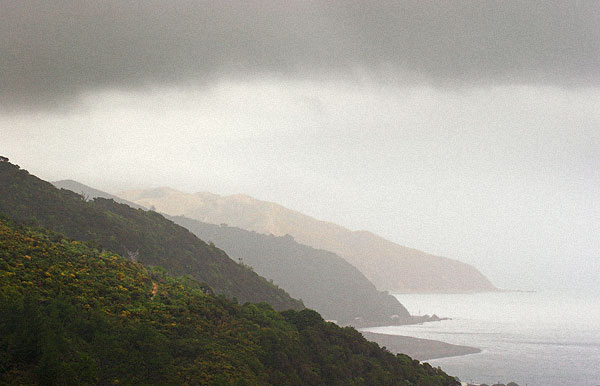
Photo: Looking South over Eastbourne towards the entrance to Wellington Harbour; rain drifting in. If you keep following that coast, you arrive eventually at Baring Head.


Photo and words © 2006 Pete McGregor

24 March 2006

Tales of white-tails

She caught my eye as soon as I walked into the kitchen. Perfect curves; long, slender legs. Poised; athletic. Utterly motionless, yet ready to sprint in an instant. I think what attracted me also was a frisson of danger—treat her without respect and she’d bite back, hurt you.

I found an empty container and encouraged her into it, closed the lid and placed the pottle on the table. She crept up the smooth sides and settled near the lid, apparently not overly disturbed. I left her resting quietly there.

The next day I photographed her, gently, trying not to alarm her. She was quick, though. Several times I had to fence her in as she ran for the edge of the table. Mostly, however, she cooperated, remaining motionless while I composed and focused. I began to grow fond of her.

Late in the afternoon I took her outside and watched her disappear into her new home among the timbers stacked under the lean-to by the shed. It’ll be a good home for her — plenty of places to rest safely, an abundance of food. My kitchen wasn’t really suitable and she would eventually have made her way to other parts of the house. As much as I liked her, I wasn’t ready to share my bed with her or let her get into my pants. I wonder what she was thinking as she left to explore her new home? Perhaps something like, “Typical bloody male — use you then show you the door.”

I hope she wasn’t thinking that.

...

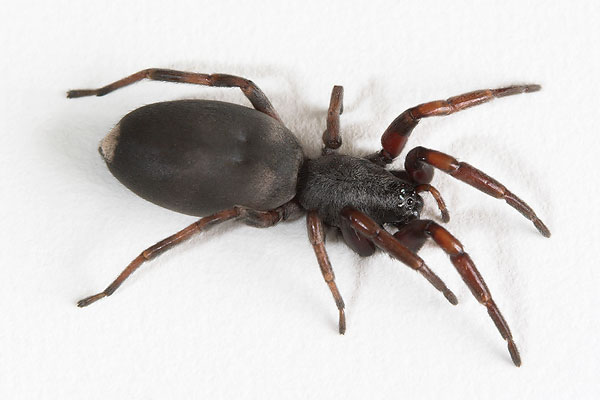
New Zealand has two similar-looking species of white-tailed spiders: Lampona murina, the predominant (perhaps the only) species in the North Island, and L. cylindrata, found in parts of the South Island. Both were unintentionally introduced from Australia in the 19th century.

These spiders don’t build webs; instead, they roam, seeking prey in the form of other spiders. In New Zealand, they prey particularly on the grey house spider, Badumna longinqua, but will take other spiders. Years ago I saw a white-tail kill a grey house spider. I’d noticed the grey house spider crouched in its raggedy web outside the tunnel-like retreat, and I looked closer. Inside the retreat, I saw the front of another spider; enough to see it was a white-tail. Neither spider moved. I shifted a little closer for a better view, but the movement must have alarmed the house spider. It ran back towards its retreat, only to be seized in a flash by the white-tail. The sheer speed was astonishing, but what was more remarkable was the effect on the house spider. On being grabbed and presumably bitten, it must have died instantly. I never saw it move again, from the moment the white-tail captured it.

Ironically, white-tails occasionally fall prey to other spiders. I’ve seen a common daddy long-legs wrapping an unlucky whitetail in swathes of silk; when I returned later in the day, the white-tail was nothing more than a tightly wrapped bundle.

White-tailed spiders have had a bad press, here and in Australia, being blamed for sometimes horrific injuries—putative bites ulcerating, failing to heal, and causing extensive tissue damage which occasionally leads to amputations. The medical term for these injuries is necrotising arachnidism, and media coverage, often sensationalised, has led to a folklore that white-tailed spiders are dangerous and nasty. It’s common now for any substantial infection and necrosis resulting from a minor skin puncture to be attributed to a white-tailed spider bite, regardless of whether the spider was seen biting—or even seen at all. At the local climbing gym a couple of years ago, a young woman told me how she’d had a white-tail bite which had caused nasty symptoms. She hadn’t seen a spider, nor felt the initial wound, just noticed the rapidly spreading ulceration. Apparently, it was the doctor who treated her at the hospital who told her it was a white-tailed spider bite. He also told her the spider lays its eggs under your skin. There’s a word for that sort of information.

Studies in Australia and New Zealand suggest a very different picture, concluding that bites from white-tailed spiders rarely, if ever, cause necrotic ulcers. Moreover, if you are bitten, you’re likely to notice it and probably see the spider, as bites are typically painful—sometimes severely so. By far the most common consequence (other than the pain) is an itchy, reddened lump that lasts a week or two, but in roughly half the cases, this itchiness and swelling lasts only a few days at most.

You can find a good summary about white-tailed spiders in New Zealand, including the consequences of bites, on the Landcare Research page.


Photos 1 & 2: This is her. I forgot to get her vital statistics, but she would've been about 30 mm (±5 mm) from the tip of her front legs to the end of her abdomen.
Photo 2: This is the daddy long-legs, Pholcus phalangioides.

Photos and words © 2006 Pete McGregor

21 March 2006

Wellington: Dead or alive?

Most of the shops I’d wanted to visit in Wellington were closed. Well, two—Unity Books and Bivouac. Perhaps it was a good thing. I checked a few music stores, in all of which I failed to find Talking Timbuktu (and would probably have been unable to afford it anyway); I browsed Dymocks, unsure of which books I wanted to investigate; and I wandered into Mountain Designs to stare pointlessly at the shoes, thinking of the disintegrating Garmonts which had begun to cut into my heels. Faced with a wall arrayed with expensive footwear—all, I assume, made in China or a similar cheap-labour country at the cost of a few dollars and who knows how many workers’ health—I realised I don’t actually need most of the things I was ostensibly shopping for. Unmotivated and uninspired, I walked out and made my way towards Te Papa, the Museum of New Zealand.

I wasn’t sure why my feet took me there, not sure what I wanted to look at. Out of habit I walked up the stairs, across the foyer, into the Awesome Forces hall, and on towards the natural history exhibits. Someone with a little digicam was photographing the great, upraised foot of the enormous moa; above him, poised at the moment of impact, a huge Harpagornis stretched talons down to strike the moa. Nearby, a set of scales balanced three mice against a giant Deinacrida—3 blind mice, the equivalent of a dry weta. At the far end of the glass case I found reconstructions of two extinct birds: the long-billed wren (Dendroscansor decurvirostris) and the Stephens Island wren (Traversia lyalli). I crouched beside the case, reading the text. I’d thought the Stephens Island wren had been known from only a few specimens (that terrible word) brought in by the lighthouse keeper’s cat. Not so, apparently. According to the text, in 1894, Walter Buller looked at what the cat brought in and declared it a new species. Within two months, 15 specimens had been caught and sold to collectors.

No more were seen [1].

...

In the adjacent Mountains to Sea exhibition, a display showed some of the fauna and flora of the Southern Alps. A kea called from above and I recalled the last time I’d heard that sound, just a month ago above Lake Adelaide in the Darrans.

Then I found the rock wrens; male and female. Old and faded, their colours almost gone. Very still. Silent. They refused to look at me—so unlike the attentive, interested little lives I’d met at Sefton Biv, above Lake Adelaide, at Phil’s Biv, and on the yak pastures below Sabre. I moved around, but the female maintained a slightly downwards gaze, as if trying to remember something from long ago. I looked at her for a while, then left the building, walked out into the open where gulls flew and argued along the waterfront, where sparrows fossicked in the tussocks and shrubbery of a rock garden, and a pair of mallards swam out of the darkness into rippling light. I felt as if I’d been kicked in the chest.

What does it matter—what we do with things after they die?

(Click on the photos to get a larger image)


Notes:
1. Other accounts of the Stephens Island wren’s extinction exist. Perhaps the best researched is that of Galbreath & Brown (2004); the authors concluded that 14–17 birds were collected from 1894 until possibly as late as 1899, not all by the same cat. The outcome, of course, was the same. [Galbreath, R.; Brown, D. 2004. The tale of the lighthouse-keeper's cat: Discovery and extinction of the Stephens Island wren (Traversia lyalli). Notornis 51(4): 193-200. (Abstract)]

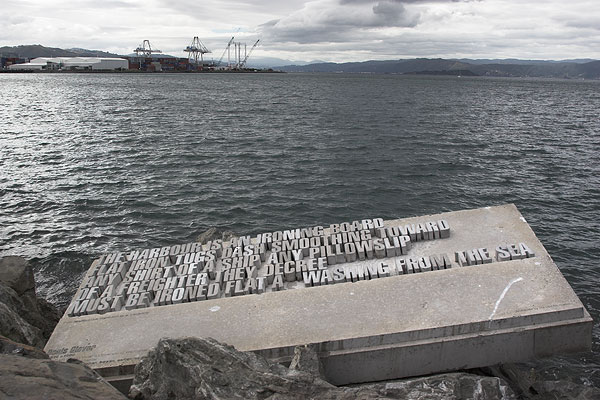
Photo 1: Detail from the Wellington waterfront: an extract from Denis Glover’s Wellington Harbour is a Laundry. Extracts from other poems, by other poets, have been incorporated into the waterfront’s architecture in ways like this. Poem as sculpture; words made concrete.
Photo 2: Dawn over Wellington Harbour, from where I was house sitting last weekend, high on the hills above Eastbourne. Central Wellington directly below the moon.

Photos and words © 2006 Pete McGregor

16 March 2006

Sabre: the Darrans

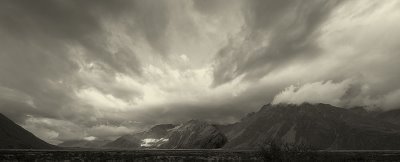
By evening the nor’wester’s in full force—howling wind; hogsbacks; dark cloud piled high and looming, obscuring the Main Divide and Mt Cook Range. Later, rain. I wake during the night and listen for a while to the wind and rain on the iron roof; that wonderful sound when you know you can sleep late and don’t have to be out in the weather. It’s warm and snug in my sleeping bag, but I keep thinking about Sefton Biv. I wonder where the wrens are, and what they’ll do in the rain when daylight arrives.

At dawn it’s still grim. Thwarted by the weather and conditions on the glaciers, which are broken up and shattered to the point of being impassable, we travel South, leaving the rain and hoping to meet the fine days following the front. By the time we reach Omarama, where we stop for lunch, we’re into sun and heat and arid countryside where limp trees rustle and shimmer in the hot breeze as they desiccate and shrivel. I get a pie and a horrible, syrupy, warm milkshake so dire we end up laughing as it goes in the bin. But, at Mossburn later in the day we find real fruit ice creams and wonderful entertainment from a friendly and cheerful woman with the distinctive, rolled-“r”, Southland accent.
“Stand back,” she says, laughing as she starts the machine to mash up my yoghurt and raspberries. We oblige, then sit outside eating, and wondering whether I’d misread the sign that said, “Mossburn: the Beer Capital of NZ.” (I had—it was “Deer Capital”.)

At Te Anau we check the forecast, shop for groceries, buy a map, and try to hire a mountain radio. Jonathan’s on the phone, trying to contact the radio man while I read the information sheet about hiring radios. I glance at a figure on the sheet, and suddenly it registers: 2 kg! These must be a different sort; those we usually carry are only about half a kg. However, we can’t hire one anyway, so we drive on, up the beautiful Eglinton Valley and over into the Hollyford. New country for me; legendary country.

At Gunn’s Camp an H-bomb hangs, nose up, fins down, squat and sinister, by the side of the road. On its black body someone’s painted a big radiation symbol and a warning: “no smoking”; but we’re reassured by the accompanying message in white paint: “Deactivated by the New Zealand Prime Minister”. Brilliant. It sets the tone of the place and as I wander about, enjoying the sight of little cabins roofed with battered corrugated iron, small birds flitting about, the signpost directing you everywhere—the camp office; Invercargill; the end of the road; heaven; upriver; downriver; Milford Sound; many local highlights—I realise everyone else seems full of the same infectious sense of goodwill and irreverence. In the evening we sit down to eat at one of the outside tables with the sandflies and clink beer bottles in a hopeful toast: “To Sabre!” and a Frenchman at the other table calls out, “Bon appetit!” and raises his tumbler of red wine to us. A woman with an Irish accent chats for a while until the sandflies drive her into her cabin, and an American woman looks at our enormous meals, laughs, and says, “Are you going to eat all that?”
“Just watch,” we say.

...

Jonathan lowers his pack at Phil’s Biv and rubs his shoulders. “That’s the hardest day’s tramping I’ve done in a very long time,” he says.
I’m so relieved to hear it. He’s as fit and strong as they come, and to hear he’s felt the effort is a kind of vindication; a justification that I’m not just a wuss; that it really was a hard day. I’m not exhausted—I’m shattered. My feet ache, my legs refuse to acknowledge instructions from my brain, the synovial fluid in my knees has turned to paste, and it takes ten minutes to turn my head because the muscles in my neck and shoulders have seized solid. We’ve walked for 9 ½ hours with 20–25 kg packs, over rough country, ascending well over a thousand metres overall; much more considering the downs and ups. From the outlet of Lake South America we saw what we assumed was Phil’s Biv, apparently just a short distance away. It took us an hour to get there; picking a route too low on the mountainside, we were forever climbing down into then up out of a near endless succession of narrow water courses, thrashing through scrubby ribbonwood and deep, dense snowgrass, stumbling over hidden rocks and into holes, and trying to avoid being perforated by the abundant speargrass. Diabolical.
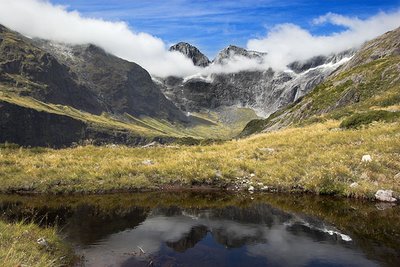
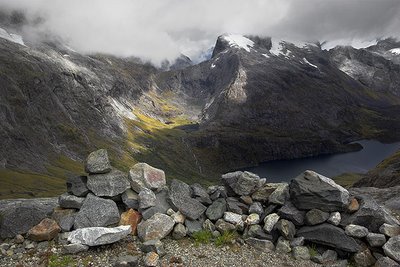
But we’re here now, and the forecast for tomorrow is for rain. Good. We can rest: sleep, eat, recuperate, gather our strength. Cloud strays around The Sentinel, Apirana, Revelation, and the other peaks encircling us. Above the drifting mist, the sky’s overcast, and a couple of hundred metres below, in the dull evening light, Lake Adelaide gleams like polished zinc. After dark I switch off my headlamp and lie cocooned in my sleeping bag inside my bivvy bag, thinking about the rock wrens we’ve met on our way here. Thinking about a few grams of feathers and personality as I drift off to sleep beneath hundreds of tonnes of hard granite—the house sized boulder that forms Phil’s Biv.

A wren visits in the morning; a brief call to check us out and then he’s away doing his bird things. How many people has he met in his life? How many people noticed him?

The light planes and helicopters, which yesterday had constantly yowled and droned and hammered overhead on their scenic flights from Milford Sound, are today silent. Another reason to be grateful for the rain. Jono says it started about 1:30 a.m. and it’s continued, off and on, all morning, with a brief period when it began to clear before closing in again. During the afternoon, dense, dark cloud pours over Adelaide Saddle and fills the valley, eventually blotting out everything beyond the little, snowgrass-topped hummock in front of the biv and bringing heavy, continuous rain. Jono sleeps for a while; I sit, propped up in my bag near the entrance, reading. When the cloud begins to pull back I see yesterday’s route cut by many cascades—white water streaming and frothing in narrow torrents—and realise that walking out in the rain won’t be possible. Anything more than drizzle will cut us off.
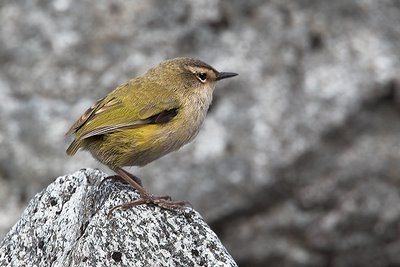
A kea alights nearby, hops around, and sits for a while, hunched up and watching. I watch back, but I’m clearly boring and it flies off.

The day passes. After the rain stops, Jono reconnoitres the route to the bluffs leading to the “yak pastures” and the foot of the climb; he returns, bringing the good news that the access seems less scary than it appears from a distance. Meanwhile, I’ve stayed put, giving my troublesome knee as much chance as possible to recover. At dusk, a big tongue of mist licks down from the cloud above Lake South America, swirls, and disperses; and the roar of the falls below the lake swells, then fades as the wind eddies. Two words come to mind: Wild, and Uncompromising.

...

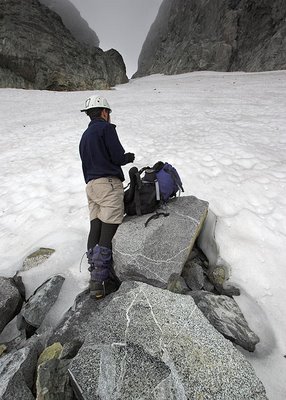
Back at Phil’s Biv after an attempt that was more a reconnoitre than a climb, and the irony—and frustration—is that it’s a beautiful evening. We reached the hardened remains of the snowfield that stretched down from the col below Sabre’s East ridge, with cold, dark cloud swirling and enveloping the upper half of the mountain; there, Jonathan painstakingly hacked rudimentary steps up the icy snow to the col, but could see nothing. I followed a short way, enlarging the steps before realising it was futile and instead huddling at the foot of the ice with our packs, trying to stay warm. From time to time, feathers of clear, fragile ice floated down out of the cloud, sometimes fracturing in mid fall, sometimes shattering on the rocks below. I assumed they’d been set free from the almost sheer rock wall. We’d wanted to climb that. I studied what I could see of it, and eventually noticed two slings suspended on the precipice, one above the other, about a rope length apart. The thought that someone had been up there seemed reassuring—but slings left on a mountainside suggest someone’s abseiled off. Perhaps the climbers who’d left these had found the route too hard, perhaps too psychologically daunting. It looked daunting to me, in these conditions, yet this wall towering above me and disappearing into darkness had been climbed many times, by at least 8 routes, some comfortably within our technical ability.

But not today. Jono returned and we descended delightful granite slabs to a level shelf where someone had camped. Against a small wall of rocks we found a cairn, and under it an old haul bag containing a rope, pitons, rock drills and other paraphernalia. After inspecting it we bundled it up securely and repacked it beneath the cairn, then ate lunch while sheltering from the wind. Below us, small, steep, alpine meadows —the yak pastures (but without yaks)—dropped down to the access bluffs; below those, the head of the cirque sloped down to Lake Adelaide. It seemed tremendously far below.
On the lower yak pastures we met a pair of rock wrens.

...

It’s our last night at Phil’s Biv. I think of its history; in particular, its name. Phil Herron, a young climber described by Hugh Logan in Classic Peaks of New Zealand as “...a bright young star, travelling the knife edge between larceny and fierce high spiritedness”, teamed up with Bill Denz and Murray Judge to make first ascents of several ground-breaking routes here on Sabre and Marian in the mid ‘70s. Soon after, during an attempt on Torre Egger in Patagonia, he fell into a crevasse. He died there, 30 years ago. Phil’s Biv was named in his honour; at Baring Head the wall with the hardest bouldering routes, the Only the Good Die Young wall, is a tribute to him; and in Patagonia, a peak in the Cerro Torre group bears his name: Punta Herron. First climbed in March 1980, it received only its 5th ascent last year (2005).

Outside, the last light’s vanishing and brilliant stars brighten in an infinite sky. To climb mountains you must take risks, and sometimes luck chooses a different route. It did for Phil Herron and Bill Denz. Was it worth it? Did they “lose”? I can’t make those judgements for others, only for myself, and I can’t imagine ever taking the kinds of risks they did—I’m too scared! Besides, there’s too much to live for, too much I want to do and see—too many mountains I want to climb. And, if you avoid risks, you never really live.

(Click on this photo for a larger image)


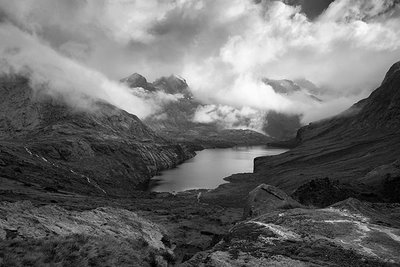
Photo 1: The view from Phil’s Biv: Lake Adelaide and the head of Moraine Creek, in the Darrans.
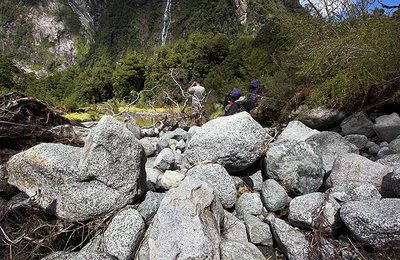
Photo 2: Lunch stop in Moraine Creek, on the walk in to Phil’s Biv.
Photo 3: This was where we were heading. Sabre on the left, partly obscured by cloud; Marian on the right.
Photo 4: You should know her by now—piwauwau, the rock wren, Xenicus gilviventris. She came to check us out in the boulder fields further up the valley.
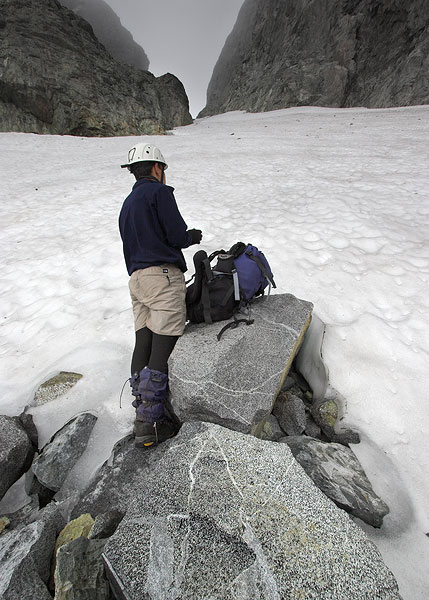
Photo 5: Jonathan prepares to cut his way up to the col to look at the mist.
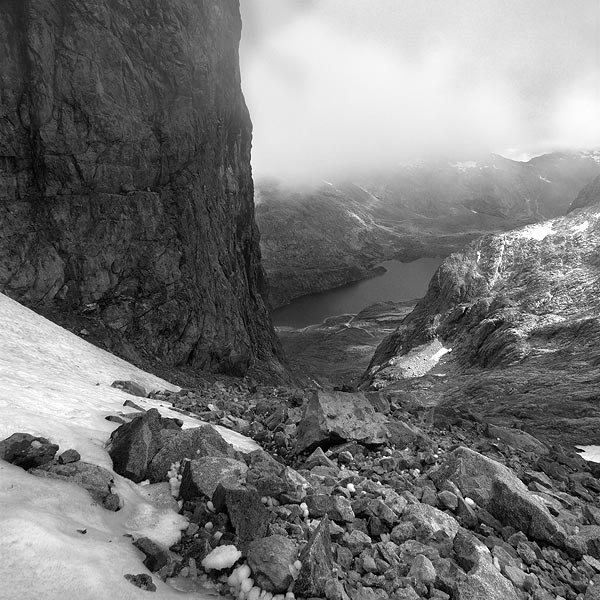
Photo 6: Lake Adelaide from Sabre. The buttress on the left is what we’d hoped to climb.
Photo 7: The cirque at the head of Moraine Creek. Lake South America drains into Lake Adelaide; above the former, The Sentinel disappears into cloud; on the extreme left of the snowgrass slopes, you can’t quite see Phil’s Biv. The lens has flattened the slopes—they’re steeper than they appear in the photo.
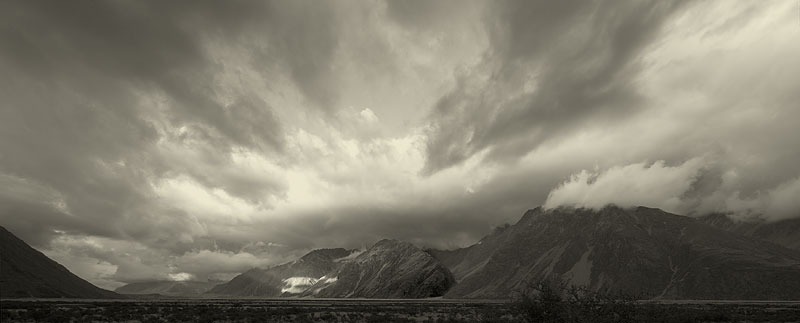
Photo 8: What we left behind at Aoraki Mt Cook—a nor’wester over the Tasman Valley and Liebig Range. You must click on this to appreciate it fully.

Photos and words © 2006 Pete McGregor