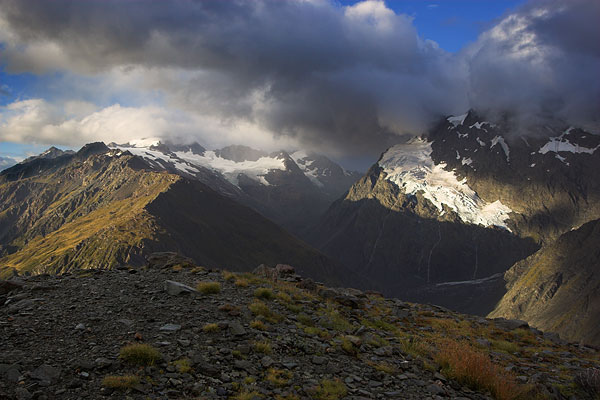
ooming, obscuring the Main Divide and Mt Cook Range. Later, rain. I wake during the night and listen for a while to the wind and rain on the iron roof; that wonderful sound when you know you can sleep late and don’t have to be out in the weather. It’s warm and snug in my sleeping bag, but I keep thinking about Sefton Biv. I wonder where the wrens are, and what they’ll do in the rain when daylight arrives.
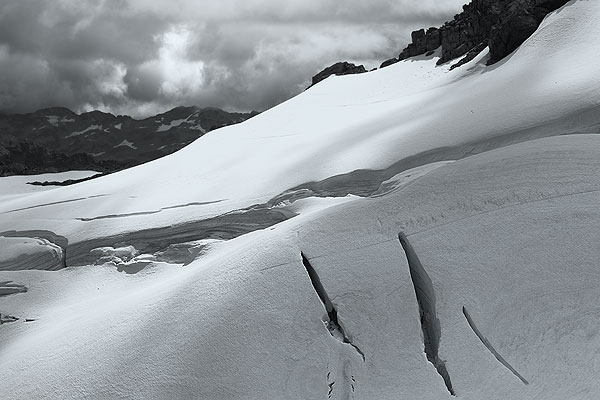
 At dawn it’s still grim. Thwarted by the weather and conditions on the glaciers, which are broken up and shattered to the point of being impassable, we travel South, leaving the rain and hoping to meet the fine days following the front. By the time we reach Omarama, where we stop for lunch, we’re into sun and heat and arid countryside where limp trees rustle and shimmer in the hot breeze as they desiccate and shrivel. I get a pie and a horrible, syrupy, warm milkshake so dire we end up laughing as it goes in the bin. But, at Mossburn later in the day we find real fruit ice creams and wonderful entertainment from a  friendly and cheerful woman with the distinctive, rolled-“r”, Southland accent.
“Stand back,” she says, laughing as she starts the machine to mash up my yoghurt and raspberries. We oblige, then sit outside eating, and wondering whether I’d misread the sign that said, “Mossburn: the Beer Capital of NZ.” (I had—it was “Deer Capital”.)
At Te Anau we check the forecast, shop for groceries, buy a map, and try to hire a mountain radio. Jonathan’s on the phone, trying to contact the radio man while I read the information sheet about hiring radios. I glance at a figure on the sheet, and suddenly it registers: 2 kg! These must be a different sort; those we usually carry are only about half a kg. However, we can’t hire one anyway, so we drive on, up the beautiful Eglinton Valley and over into the Hollyford. New country for me; legendary country.
At Gunn’s Camp an H-bomb hangs, nose up, fins down, squat and sinister, by the side of the road.  On its black body someone’s painted a big radiation symbol and a warning: “no smoking”; but we’re reassured by the accompanying message in white paint: “Deactivated by the New Zealand Prime Minister”. Brilliant. It sets the tone of the place and as I wander about, enjoying the sight of little cabins roofed with battered corrugated iron, small birds flitting about, the signpost directing you everywhere—the camp office; Invercargill; the end of the road; heaven; upriver; downriver; Milford Sound; many local highlights—I realise everyone else seems full of the same infectious sense of goodwill and irreverence. In the evening we sit down to eat at one of the outside tables with the sandflies and clink beer bottles in a hopeful toast: “To Sabre!” and a Frenchman at the other table calls out, “Bon appetit!” and raises his tumbler of red wine to us. A woman with an Irish accent chats for a while until the sandflies drive her into her cabin, and an American woman looks at our enormous meals, laughs, and says, “Are you going to eat all that?”
“Just watch,” we say.
...
Jonathan lowers his pack at Phil’s Biv and rubs his shoulders. “That’s the hardest day’s tramping I’ve done in a very long time,” he says.
I’m so relieved to hear it. He’s as fit and strong as they come, and to hear he’s felt the effort is a kind of vindication; a justification that I’m not just a wuss; that it really was a hard day. I’m not exhausted—I’m shattered. My feet ache, my legs refuse to acknowledge instructions from my brain, the synovial fluid in my knees has turned to paste, and it takes ten minutes to  turn my head because the muscles in my neck and shoulders have seized solid. We’ve walked for 9 ½ hours with 20–25 kg packs, over rough country, ascending well over a thousand metres overall; much more considering the downs and ups. From the outlet of Lake South America we saw what we assumed was Phil’s Biv, apparently just a short distance away. It took us an hour to get there; picking a route too low on the mountainside, we were forever climbing down into then up out of a near endless succession of narrow water courses, thrashing through scrubby ribbonwood and deep, dense snowgrass, stumbling over hidden rocks and into holes, and trying to avoid being perforated by the abundant speargrass. Diabolical.
But we’re here now, and the forecast for tomorrow is for rain. Good. We can rest: sleep, eat, recuperate, gather our strength. Cloud strays around The Sentinel, Apirana, Revelation, and the other peaks encircling us. Above the drifting mist, the sky’s overcast, and a couple of hundred metres below, in the dull evening light, Lake Adelaide gleams like polished zinc. After dark I switch off my headlamp and lie cocooned in my sleeping bag inside my bivvy bag, thinking about the rock wrens we’ve met on our way here. Thinking about a few grams of feathers and personality as I drift off to sleep beneath hundreds of tonnes of hard granite—the house sized boulder that forms Phil’s Biv.
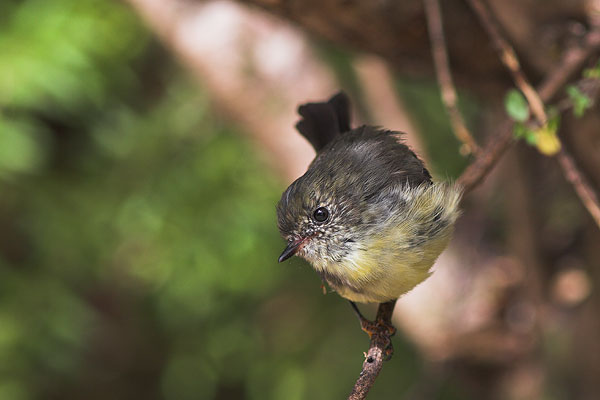
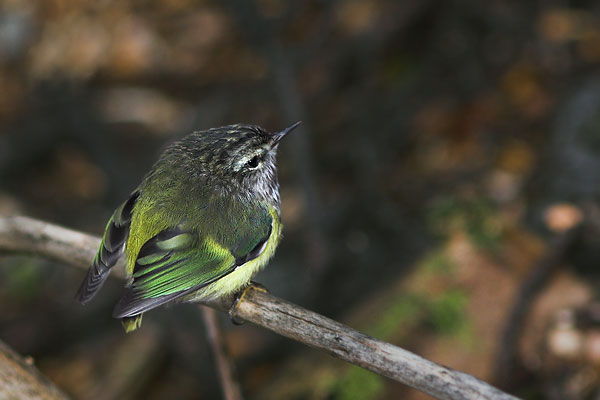
A wren visits in the morning; a brief call to check us out and then he’s away doing his bird things. How many people has he met in his life? How many people noticed him?
The light planes and helicopters, which yesterday had constantly yowled and droned and hammered overhead on their scenic flights from Milford Sound, are today silent. 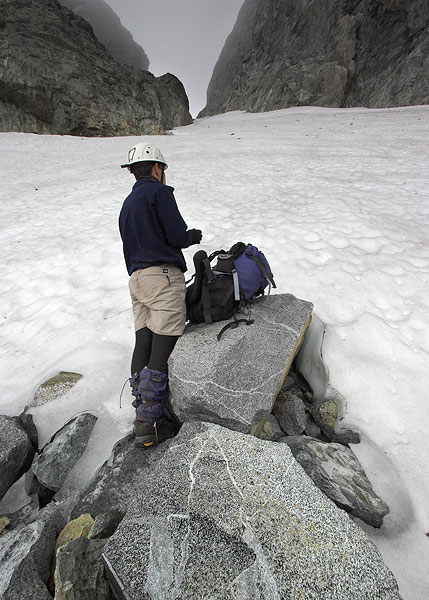 Another reason to be grateful for the rain. Jono says it started about 1:30 a.m. and it’s continued, off and on, all morning, with a brief period when it began to clear before closing in again. During the afternoon, dense, dark cloud pours over Adelaide Saddle and fills the valley, eventually blotting out everything beyond the little, snowgrass-topped hummock in front of the biv and bringing heavy, continuous rain. Jono sleeps for a while; I sit, propped up in my bag near the entrance, reading. When the cloud begins to pull back I see yesterday’s route cut by many cascades—white water streaming and frothing in narrow torrents—and realise that walking out in the rain won’t be possible. Anything more than drizzle will cut us off.
A kea alights nearby, hops around, and sits for a while, hunched up and watching. I watch back, but I’m clearly boring and it flies off.
The day passes. After the rain stops, Jono reconnoitres the route to the bluffs leading to the “yak pastures” and the foot of the climb; he returns, bringing the good news that the access seems less scary than it appears from a distance. Meanwhile, I’ve stayed put, giving my troublesome knee as much chance as possible to recover. At dusk, a big tongue of mist licks down from the cloud above Lake South America, swirls, and disperses; and the roar of the falls below the lake swells, then fades as the wind eddies. Two words come to mind: Wild, and Uncompromising.
...
Back at Phil’s Biv after an attempt that was more a reconnoitre than a climb, and the irony—and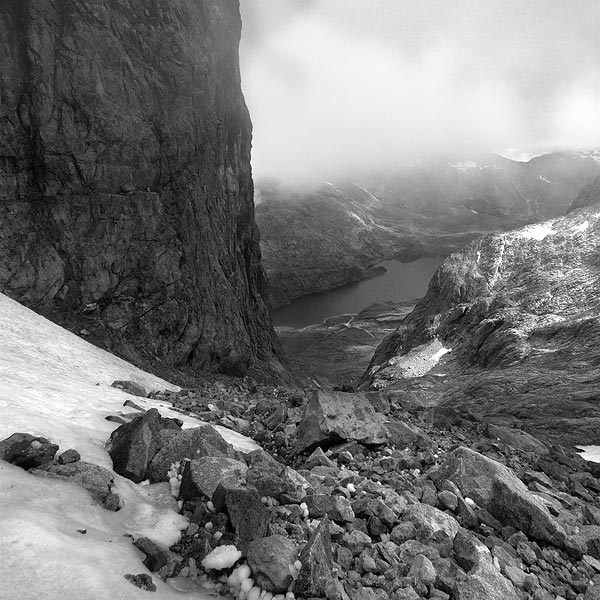 frustration—is that it’s a beautiful evening. We reached the hardened remains of the snowfield that stretched down from the col below Sabre’s East ridge, with cold, dark cloud swirling and enveloping the upper half of the mountain; there, Jonathan painstakingly hacked rudimentary steps up the icy snow to the col, but could see nothing. I followed a short way, enlarging the steps before realising it was futile and instead huddling at the foot of the ice with our packs, trying to stay warm. From time to time, feathers of clear, fragile ice floated down out of the cloud, sometimes fracturing in mid fall, sometimes shattering on the rocks below. I assumed they’d been set free from the almost sheer rock wall. We’d wanted to climb that. I studied what I could see of it, and eventually noticed two slings suspended on the precipice, one above the other, about a rope length apart. The thought that someone had been up there seemed reassuring—but slings left on a mountainside suggest someone’s abseiled off. Perhaps the climbers who’d left these had found the route too hard, perhaps too psychologically daunting. It looked daunting to me, in these conditions, yet this wall towering above me and disappearing into darkness had been climbed many times, by at least 8 routes, some comfortably within our technical ability.
But not today. Jono returned and we descended delightful granite slabs to a level shelf where someone had camped. Against a small wall of rocks we found a cairn, and under it an old haul bag containing a rope, pitons, rock drills and other paraphernalia. After inspecting it we bundled it up securely and repacked it beneath the cairn, then ate lunch while sheltering from the wind. Below us, small, steep, alpine meadows —the yak pastures (but without yaks)—dropped down to the access bluffs; below those, the head of the cirque sloped down to Lake Adelaide. It seemed tremendously far below.
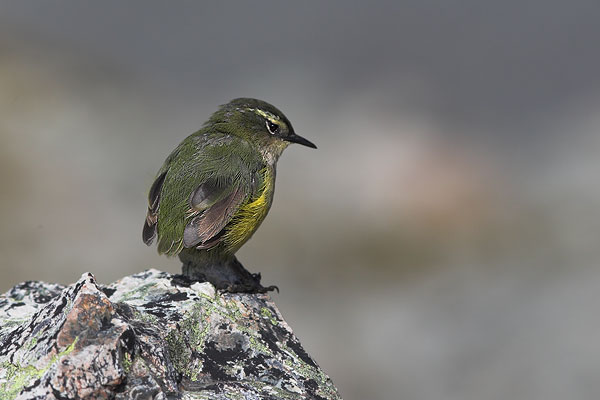
On the lower yak pastures we met a pair of rock wrens.
...
It’s our last night at Phil’s Biv. I think of its history; in particular, its name. Phil Herron, a young climber described by Hugh Logan in Classic Peaks of New Zealand as “...a bright young star, travelling the knife edge between larceny and fierce high spiritedness”, teamed up with Bill Denz and Murray Judge to make first ascents of several ground-breaking routes here on Sabre and Marian in the mid ‘70s. Soon after, during an attempt on Torre Egger in Patagonia, he fell into a crevasse. He died there, 30 years ago. Phil’s Biv was named in his honour; at Baring Head the wall with the hardest bouldering routes, the Only the Good Die Young wall, is a tribute to him; and in Patagonia, a peak in the Cerro Torre group bears his name: Punta Herron. First climbed in March 1980, it received only its 5th ascent last year (2005).
Outside, the last light’s vanishing and brilliant stars brighten in an infinite sky. To climb mountains you must take risks, and sometimes luck chooses a different route. It did for Phil Herron and Bill Denz. Was it worth it? Did they “lose”? I can’t make those judgements for others, only for myself, and I can’t imagine ever taking the kinds of risks they did—I’m too scared! Besides, there’s too much to live for, too much I want to do and see—too many mountains I want to climb. And, if you avoid risks, you never really live.
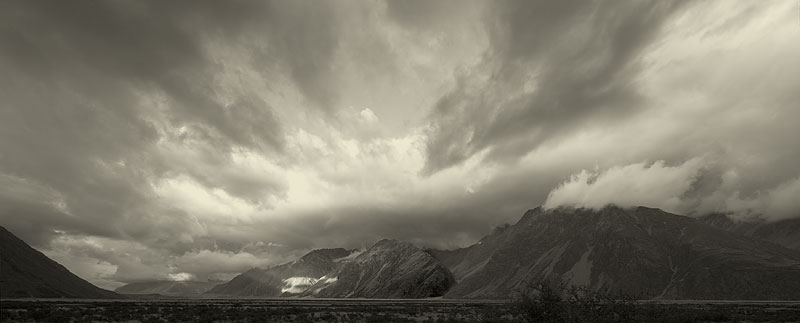
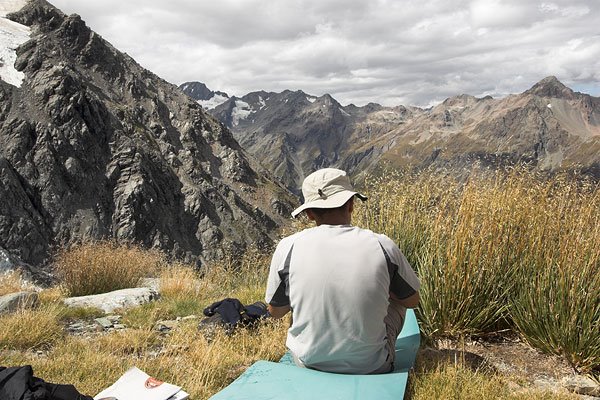
Photo 1: The view from Phil’s Biv: Lake Adelaide and the head of Moraine Creek, in the Darrans.
Photo 2: Lunch stop in Moraine Creek, on the walk in to Phil’s Biv.
Photo 3: This was where we were heading. Sabre on the left, partly obscured by cloud; Marian on the right.
Photo 4: You should know her by now—piwauwau, the rock wren, Xenicus gilviventris. She came to check us out in the boulder fields further up the valley.
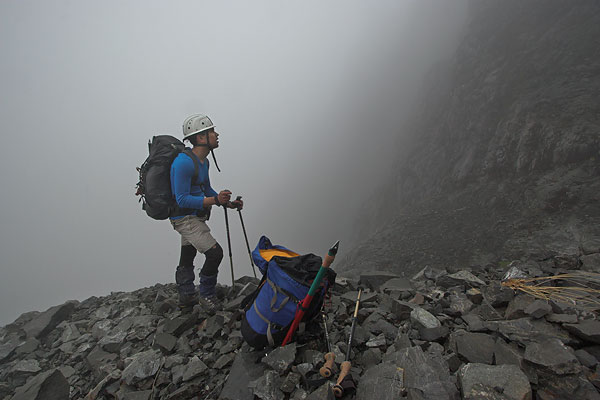
Photo 5: Jonathan prepares to cut his way up to the col to look at the mist.
Photo 6: Lake Adelaide from Sabre. The buttress on the left is what we’d hoped to climb.
Photo 7: The cirque at the head of Moraine Creek. Lake South America drains into Lake Adelaide; above the former, The Sentinel disappears into cloud; on the extreme left of the snowgrass slopes, you can’t quite see Phil’s Biv. The lens has flattened the slopes—they’re steeper than they appear in the photo.
Photo 8: What we left behind at Aoraki Mt Cook—a nor’wester over the Tasman Valley and Liebig Range. You must click on this to appreciate it fully.
Photos and words © 2006 Pete McGregor