08 January 2006

Sleeping with Anna Kournikova

This is an account of a long and eventful day. Some names have been changed, but otherwise it's true, whatever that means. I'm taking a spell from this computer for a few days, so I hope this keeps you satisfied... Oh yes, if you got here by searching for salacious stuff about Anna Kournikova, well... read on... ;^)

Last night I slept with Anna Kournikova.

I’d begun the day by dragging myself out of bed after an uncomfortable night, throwing a few essential items and a hefty collection of camera equipment into a day pack and driving off to collect Pat and Josh. I didn’t even make it onto the main road before having to return to collect my driver’s licence. So much for being on time.

Soon after reaching Palmerston North, I noticed a few drops of rain on the windscreen, and a grey pall advancing across the city from the south. I turned the wipers on to the intermittent setting. A minute later I turned them to continuous; then to fast. By then I’d run out of wiper speeds and was wondering whether I could create an extra-fast setting by forcing the knob to a position it wasn’t designed for. Yes, I thought, a nice day for a walk in the hills. But the rain eased and stopped, and I arrived on time, with the wipers off and still functional. At the door I was greeted by a keen dog and a swarm of enthusiastic small boys.

“Come on in,” Pat said. “Sorry, we’re a bit disorganised.”

That suited me just fine, so I sat in the kitchen, watching in awe as Josh converted an entire loaf of bread into honey and vegemite sandwiches.

“That’d keep me in breakfasts for a week,” I said.

Pat grinned. “You just watch. You’ll be surprised.”

Surprised wasn’t the right word. We drove to the Ballance bridge end of the Manawatu Gorge Track, with Pip sitting happily and quietly in the luggage space and Josh sitting happily and not quietly in the back seat. As we began walking, I realised that one of Josh’s methods of propulsion was talking. I decided to try it, and was pleasantly surprised to find how effective it was. After 20 minutes, Josh indicated that he needed a rest and was getting hungry, so we stopped and he raided the sandwiches, alternating bites of honey sandwich with bouts of talking. The sandwich consumed, we continued walking and talking. He mentioned that his shoulders were uncomfortable because of the weight of his pack, but it wasn’t a complaint, just an observation.

Pat made a rough calculation. “You’ve only got about 3 kg in your pack,” he said.

“How much do you weigh, Josh?” I asked.

He thought briefly. “About 30 stone?” he suggested.

“Let’s see,” I said. “A stone’s 14 pounds. A pound’s 454 grams; roughly half a kilo, so that means about 7 kilos per stone. So, you reckon you weigh a couple of hundred kilos?”

I heard Pat laughing up front. “That’s about two Jonah Lomus,” he said.

Josh realised he’d made a mistake, and began telling us about someone overseas who was four metres wide. I stopped and looked at him. “I’m not even two metres tall,” I said, “so if you stood another one of me on my head and added a bit more, that’s how wide he would be.”

I could see him considering the concept of a four-metre wide person. “Maybe you mean he’s four metres around?” I suggested. “So, if we divide four metres by pi, we’d figure out how wide he is from one side to the other.”

“Mmmm... pie...,” Pat said.

“I like pie,” Josh said. I gave up. Then, “What’s pi?” he asked.

“3.14159...” I began.

“...2654 um...,” Pat continued. Josh looked at us and continued walking. After a few metres he began telling us about 4-leafed clovers and how a friend’s father had found a 48-leafed clover. I showed him pate [1], pointing out the usual pattern of 7 leaflets and the tiny teeth edging them, and kawakawa [2] with its caterpillar-perforated leaves. Later I pointed to a small pate.

“Hey Josh, what’s the name of this one?”

He couldn’t recall the name, but remembered that it was the one with the 7 leaflets. “Hey, this one’s only got 6!” he said. Sure enough, that leaf did only have 6 leaflets. When I asked him to find me a kawakawa he looked about for a few seconds and pointed to a small shrub. “There’s one!” He was right, of course. He then told us all about the structure of the forest; how it had different layers. “The forest floor, the understory, the canopy, and the emergent layer,” he informed us. We discussed the emergent layer for a while; Pat pointing out how awesome it would be to be up there in a South American jungle with all the monkeys and macaws and things, and Josh asking about African jungles.

Partway up an uphill section Pat remarked on how this was getting the heart working.

“I reckon my heart must be beating every half a second,” Josh said. Not a bad estimate for an eight and a half year old (actually, eight and three quarters, as he later told me).

“Your heart’ll be getting strong, doing this,” Pat said.

Josh liked that idea. “We should do this at least once a week,” he said. He was keen on the idea that his muscles would get strong, and—ignoring the fact that the only exercise his arms were doing was providing visual emphasis for the exercise his vocal cords were getting—showed us his biceps. We admired the size of his biceps, then, in response to his query, tried to explain why you’d live longer if your lungs stopped working than if your heart stopped beating, or if you didn’t have a heart at all.
By this time my credibility had begun to erode because I’d kept suggesting we weren’t far from the lookout where we could have lunch. Fortunately, we arrived there before Josh had written me off completely—Pat had done that ages ago, but he doesn’t matter. The Department of Conservation had recently erected a wooden bench seat so we (the Department of Conversation) sat there and ate lunch. At least, Pat and Pip and I sat—Pat and me on the bench, Pip directly in front of me where he could examine in minute detail the bier stick I was eating—while Josh sat, talked, ate, jumped up to take a photo while talking, sat down (also while talking), ate, talked, jumped up to check something, continued talking, and ate (between spells of talking).

“Where are the vegemite sandwiches?” Pat asked.

“I made some. I made honey sandwiches and vegemite sandwiches,” Josh replied.

“You made ONE vegemite sandwich.”

“It’s hard to spread vegemite on butter.”

“Yep, it just skids over the butter. You end up with skid marks on your sandwich,” I said.

“Ewww, gross,” Josh said, and continued eating.

I’m not sure who eventually got the one vegemite sandwich, but Pat’s prediction that I’d be surprised at how the enormous stack of sandwiches would disappear proved correct, albeit understated. Within minutes, they’d all been eaten. In the distance, a kereru soared high above the canopy, stalled, then swooped down. It repeated the manoeuvre several times and I pointed it out to Josh, who immediately spotted another one. Pip snuffled at my pack, tantalised by the aroma of bier stick; across the gorge, a battalion of huge windmills churned like alien invaders in a post-apocalyptic world. We could hear the roar of a nearby windmill on our side of the river: background noise to the rush of the wind-whipped vegetation and the drone of an aeroplane. Pat scanned the lumpy cloud.

“Let’s see who can spot the plane first.” Soon after, he saw it and pointed it out. Josh spotted it shortly after. I kept looking, but couldn’t locate it.

“Over there, next to that mushroom shaped cloud,” Pat said, pointing to a sky full of mushroom shaped clouds.

“I can see it!” Josh yelled, pleased not to be the last. I never did see it.

At the next lookout point, Josh decided he wanted a photograph of the Manawatu gorge with cars and trucks winding along the road. He put his eye to the viewfinder and began composing the shot, so I jumped in front and pulled a face.

“You need people in the photo,” I said.

He laughed and waved me away. “Getoutofit!”

So I got out of it.

He seemed to be having trouble with the composition. “That pine tree’s in the way,” he said.

I looked where he was pointing. “That’s not a pine tree. That’s a horoeka [3]; a lancewood. They’re cool trees; when they get big they get really gnarly. You want one of those in the photo.”

It seemed to do the trick, and he took a photo with the horoeka in the foreground. We walked on, surprised by the lack of windfalls on the track. Josh saw a giant epiphyte high in a big rimu and pointed it out.

“Collospermum [4],” Pat said. Even from a distance, its size—perhaps 1–1.5 metres diameter—suggested something enormously heavy.

“You wouldn’t want that to fall on you,” Josh said.

“Yeah, some of them weigh a tonne or more,” I said. “If it fell on you your eyeballs would shoot 20 metres.”

Josh was intrigued by the concept, and wanted to know whether you’d still be able to see out of them. We discussed diverse scenarios involving eyeballs at various distances from their sockets, attached, or not, or reattached, to their optic nerves and the circumstances under which you might be able to see, or not. Josh considered experimenting but we dissuaded him, pointing out that although it might be a good excuse for not doing your homework—“I’m sorry Mrs Krabapple, but I couldn’t see where my pencil was ‘cos my eyeballs were somewhere else”—it would likely make life difficult if the attempt to reconnect eyes and optic nerves failed.

Near the end of the track, Pat and Pip jogged on ahead to meet Kate and Jack and Lee and reassure them we were ok, as we were running late (it had the opposite effect, when Kate saw Pat running down the track with no sign of Josh and me: she naturally assumed something bad had happened). Josh and I walked on, talking, and eventually decided we’d jog too. We ran downhill, spinning around corners and leaping patches of mud and continuing our conversation, which mostly comprised a discussion of how to run downhill without face-planting. We met the others about 10 minutes from the car and Josh immediately began a detailed description of the day’s events.

Pat looked at me, then grinned at Kate, and said, “I think I’ve at last found someone who talks as much as Josh.”

We negotiated the short section of streambed, Jack and Lee happily scrambling barefooted over the rocks and gravel, climbing the footbridge railing and hanging over to look at the little waterfall. If there was a longer, more difficult route that involved climbing something and getting covered in dirt, they took it. My kind of kids.

Kate drove us back to my car, the kids in the back seat and Pat huddled in the luggage space with Pip. Josh thanked me for coming tramping with them.

“A pleasure, Josh. We’ll do it again.”

“Yeah, once a week!”

...

That evening I took the back road to Palmerston North to meet Dee and Ian. The sun still hung well above the horizon; a kahu circled over a freshly cut hay paddock. A few kilometres beyond Ashhurst, a weasel ran across the road. The Lombardi hadn’t yet reopened for the new year, so we headed for the Celtic but too many loud conversations were already in progress. Eventually we settled at a table outside the Mao Bar and talked over a Monteiths until it got too cold. We moved inside, upstairs, and resumed the discussion—a wide-ranging conversation about how to save the world, about how to influence attitudes, about information and understanding, about noticing things and how to describe them. When someone turned the music up, signifying the start of revelry and the end of meaningful conversation, we drove to Pacha’s to pick up kebabs. He recognised Dee and Ian and began conversing with them in French, then indicated a friend who had stepped outside for a smoke.

“Odile!” he called, and introduced him. I sat there, delighted, understanding nothing except the occasional “oui,” or “vous.” Pacha apologised for my exclusion from the conversation, but I didn’t feel excluded—for me, it was enough to see and hear the enjoyment and animation of the dialogue. People having fun; friends communicating.

After collecting our kebabs I drive us back to where Dee and Ian were house-sitting. We watch Darwin’s Nightmare, a desperately grim, almost savage documentary about an African village surviving—if that’s the right word—on a fishing industry based on Nile perch. Some of the conversation is in Swahili and Russian, with subtitles in French, so Dee translates for me. A man places a basin of food on the ground, and instantly it’s an explosion of hungry children, fighting, grabbing handfuls, running, stuffing the porridge-like food into their mouths, trying to protect what they have, punching, wrestling... A security guard, armed with a bow and poisoned arrows, tells how the previous guard was murdered. A thin young man in camouflage pulls a boy along by his sleeve and punches his face. A woman stacks the filleted remains of fish on racks to dry; she’s surrounded by a sea of racked, rotting, shrivelling fish and she stands in a writhing mass of maggots. The stench must be unimaginable, but she doesn’t complain—she has work, she explains. The ecology of the lake has been destroyed; in its murky, algal depths, the only fish now are the Nile perch. Someone says the perch survive by eating their young. The factory manager says they harvest 500 tons a day, it’s exported on two flights a day but each flight carries only 55 tons. What is true? This is a nightmare; this is Hobbes’ vision: “And the life of man: solitary, poor, nasty, brutish, and short.” What can be done?

It’s half past midnight and I’m shattered. Dee sets me up in a spare room; I toss my sleeping bag on the bed, clean my teeth, take out my lenses, and crawl into the bag. I look up and realise I’m sleeping with Anna Kournikova, but I’m too tired to enjoy it. Besides, I’m also sleeping with a giant Brontosaurus.


Notes:
1. Schefflera digitata
2. Macropiper excelsum
3. Pseudopanax crassifolius
4. Commonly called a “perching lily”.

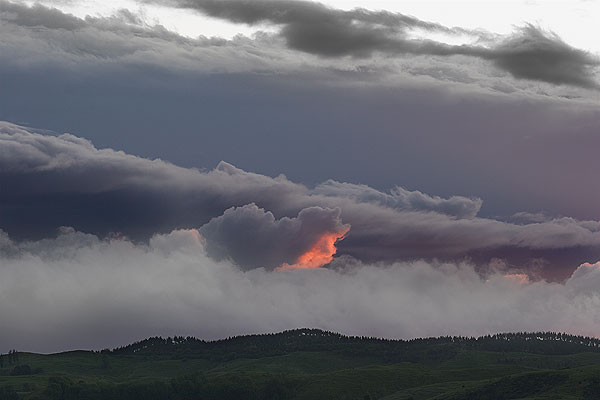
Photos 1 & 2: A few days ago, just on dusk, we had a rain squall so loud I could hardly hear myself think. It stopped suddenly, and this is what the evening looked like.
Photo 3: Spurwinged plover; Vanellus miles novaehollandiae. This is a cropped and resampled image—these birds are very hard to approach.
Photo 4: Yep, it is indeed a house sparrow. Quite an old photo, from Whitewash Head near Christchurch, about this time last year.
Photo 5: This is the peculiarly flattened jumping spider, Holoplatys sp. Photographed on my verandah.

Photos and words © 2006 Pete McGregor


04 January 2006

Every day is a journey

“Every day is a journey, and the journey itself is home.” —Matsuo Bashō

A few years ago a friend told me how, before travelling overseas, she always imagined dying on the journey. As I was about to travel overseas I took this as encouragement because she’d travelled overseas—extensively—and still hadn’t actually died; I also found it encouraging because I was imagining the same thing—my dying, that is; not hers. As far as I’m aware, we’re both still alive, but I was intrigued to discover recently that we were in famous company:

“...as with all long trips,” writes Paul Theroux in Dark Star Safari, “I fantasized I might die there.”

Given how Theroux described some of the people he encountered, I’m sure many wished he had died, but that’s beside the point. Theroux, my friend, and I are about as different in many respects as you’re likely to find among people from affluent, western countries, yet the idea of dying on a journey overseas united us in a way that seemed more than coincidental. This seemed significant despite my general scepticism about coincidence. I began to wonder whether the idea or fantasy is ubiquitous among those about to undertake (an appropriate word) a significant journey, and if so, what prompts it.

Perhaps, I thought, it’s just the realisation that you’re about to leave the comfortable, geographically located place you call home and it will be months or even years before you return—if you ever do. In a flash of insight which quickly proved erroneous, I thought I had a way to test this hypothesis. If it’s as simple as that, then homeless people—and here I’m thinking of home as a much wider concept than as a place—should be much less likely to find themselves fantasizing about dying on a long journey. The problem, of course, is that if you have no home—if you never feel at home—you can’t leave it to go off and die. While my beautiful hypothesis hadn’t been slain by an ugly fact [1], my elegant test had been bumped off by brutal logic.

That got me thinking about two things: the concept of home, and the way science works. Later, I thought about how ideas lead to other ideas; how connections form among ideas. Thinking about thinking, I suppose. Perhaps you could call it metathinking, although I suspect many people would call it confused thinking—not metathinking but messy thinking. By that stage, I was hopelessly confused, so I returned to my original thought, which, it turned out, I’d forgotten. I gave up; abandoned thinking and went for a walk up the No. 1 Line track instead.

I drove up the winding, gravel road, past hay fields where wind swirled shimmering patterns in the long grass—the air apparent to the eye. A kahu [2] twisted and bounced in the turbulent sky, soaring over the hay field, over gullies filled with rushes and thistles and flowering manuka, circling behind a row of unkempt pines and macrocarpas that writhed in the gale. On to where the road narrows, squeezed rough and lumpy between the high bank and a series of washouts that plummet down the steep, scraggy hillside. I opened the gate at the road-end and looked up when a movement caught my eye. On the track ahead, a hare stopped, turned, half-crouched, and looked back at me. I froze, thinking then forgetting about the camera in the car. We looked at each other for several seconds; me caught up in the moment, the hare probably close to freaking out. Finally it jumped from the track to the slope above and disappeared into a thicket of long grass and Californian thistles.

By the time I’d reached the pepperwood zone I’d begun to think again about home, and what it means. Some time ago I’d suggested that home was where you could die without wishing you were somewhere else. I’d said it half-jokingly, but later recognised it was probably truer than I’d realised. If you think of home as a place, the definition fits well; if you think of it as a circumstance, a situation—being with the people or person you love, for example—it fits just as well. Where it fails is that it’s not actually a definition. It enables you to recognise when you’re at home, but it doesn’t tell you why you feel that way. It’s possible, for example, to be with someone you love and yet not feel at home, or vice versa; it’s possible to feel at home in a place you’ve never been before, with people you’re meeting for the first time, and yet you feel at home.

I remember catching the end of a radio interview with Doris Lessing; I was driving home in the evening and turned the car radio on too late to hear more than the last few minutes.

“My home now is in literature,” she said. “All my other homes—all the places I’ve lived—have gone now.”

What she said seemed to confirm for me that home is not a product of geography—at least, not solely—and it reminded me that while my semi-serious suggestion focused on dying as a way of defining home, another, more positive way to think of it is that it’s where you live. Live: in the nontrivial sense—and if I have to explain that, then you’re already dead.

Where the track levels out, not far from where it becomes indistinct—where it could be over there or that way or perhaps straight ahead, and at last you realise you’re no longer on it—I stopped and rested. Grey, wild cloud scudded overhead; occasionally a break revealed a small, powerless patch of blue sky, bright and hopeful before being overwhelmed. The dense, head-high vegetation protected me from the worst of the wind, and I pottered about, nibbling a muesli bar, peering at tiny orchids growing from cracks in long-dead stumps, wondering if I’d be lucky enough to see a falcon arrowing overhead, skimming the canopy. Sunlight lit a distant ridge then vanished. I felt at home, and couldn’t care less about wondering why. I still don’t know why the prospect of travelling seems to foster thoughts of dying, but the thought did occur to me that the longest journey we ever make begins when we first become aware of who we are. At that stage of life, no one fantasises about dying on that journey, yet it’s the only one on which it’s certain we will.


Notes:
1. T.H. Huxley: "The great tragedy of science—the slaying of a beautiful hypothesis by an ugly fact".
2. Australasian harrier; Circus approximans.

Photo 1: Manuka (Leptospermum scoparium); Pohangina Valley. Just down the road.
Photo 2: Not the No. 1 Line hare (Lepus europaeus occidentalis). This one lives in the Wairarapa, next door to where I enjoyed New Year's eve, which was when I photographed him/her.
Photo 3: Welcome swallow (Hirundo tahitica); juvenile.

Photos and words © 2006 Pete McGregor

31 December 2005

A Christmas conversation

Two kereru fly low over the paddock, a slow, powerful flight, silhouettes against a grey sky, a cool wind, traces of thin, fine hogsbacks. The weather’s on the change.


I heard small voices this evening; stepped outside onto the verandah and saw Trev walking slowly along the deck next door, ankle-tapped by two small granddaughters. He was holding a long-handled net. Kylie saw me, and jumped up and down.

“Let’s go and see Pete!” she yelled.

Olive laughed. “You’re popular tonight!” she called.

I sat on the step at the end of the verandah and listened as Kylie told me how she and Jemma were helping Granddad and Grandma vacuum the pool. “We could vacuum your verandah!” she suggested.

I asked her how her Christmas had been.

“Good,” she said, climbing over the short section of lichen-encrusted wooden fence and around the verandah post. She kept circling around it, doing laps over the fence, presumably for the enjoyment of climbing, while she diverted the conversation to favourite toys. Jemma’s, she said, was Melvin the Monkey. She went to some lengths to ensure I understood that Melvin the Monkey had come from Furniture Fair. As for her own favourite, it was a whale. Of all the sea animals, she explained, her favourite was the mermaid, but they weren’t real. Her second favourite was the whale. Hers had a captain’s hat.

“I’ve seen whales,” I told her. “Dolphins too. I’ve seen lots of dolphins.” I wondered whether she knew about dolphins.

“Bottlenose dolphins?” she asked.

“Yes, but mostly dusky dolphins, and I’ve seen the little Hector’s dolphins, the rare ones. They’re only little; they’re cute.”

We talked a bit about dolphins and whales, and about mermaids, which aren’t real. Seahorses, too—she liked seahorses. She asked how big bottlenose dolphins were, and stretched her arms wide.

“This big?”

I extended my arms. “Even bigger than this,” I said. She stood behind me and measured “bigger than this” with her own arms. She could just manage to reach past my elbows. I pointed to the gate post.

“I reckon from there to about here,” I said, pointing to a spot nearby.

“How wide are they?” she asked.

I held my hands apart, trying to estimate honestly. “Maybe this wide?”

We talked some more, and Jemma decided to join us. She padded across the stony driveway in bare feet, stopped, and pointed at the ground.

“Poo,” she said, indicating a nugget of sheep crap.

“Yeah, sheep poo,” I said.

She inspected the ground for more sheep poo, pointing out each lump and pat. Meanwhile, Kylie had realised she was supposed to be making sure Granddad and Grandma were vacuuming properly, so she ran back across the drive.

“We’ll come and see Pete again later,” she told Olive, loudly, so I could hear. I saw Olive smile.


Behind the grey and white clouds, the sky’s the most beautiful pink and mauve I can imagine.


[This is true. Some names have been changed to preserve anonymity.]

Photo 1: Kereru.
Photo 2: Hoherius meinertzhageni again. This male and female were on the underside of a lacebark (Hoheria) branch; a difficult position to photograph, but it does show how well camouflaged they are. I think the female was ovipositing.

Photos and words © 2005 Pete McGregor


29 December 2005

Christmas wildlife

We met at Deb’s for Christmas. A collection of geographical orphans, none of us where our families were: Arne, Deb, Will, Dianne, Dorothée, Yvan, Stephen, and me—as far as I’m aware, the only true orphan. At some stage during the afternoon we seated ourselves around the table and began a meal that lasted until evening. Conversations cruised around the table, bouncing back and forth, diverging, sometimes splitting, then reforming. If my memory’s accurate (a dubious assertion) I managed at one point to direct the discussion to a less lighthearted, more serious exploration, not because I wanted to depress it but purely because these were people whose thoughts I value—I wanted the the buzz, the energy of hearing intelligent, considered viewpoints. It’s one of the joys of having friends like these: people from different cultural backgrounds—on this Christmas day, from Germany, France, the UK, and Aotearoa. People who’ve seen, collectively, most of the world; from Antarctica to Zimbabwe.

At my end of the table we found ourselves discussing altruism and whether it truly exists; whether you ever do anything you don’t believe (at least subconsciously) you’ll benefit from. Will argued it is indeed real.

“Sometimes you just do things,” he said. “You don’t think about whether you’re going to get something out of it.

Dianne agreed. “If you see a child standing in the middle of the road, you don’t think about it, you just rush out and save it.”

True. But what prompts you to do that? Why don’t you think about it? I sensed the discussion was about to veer towards that impossible argument about free will, determinism, and whether—or how—you can reconcile the two, so I coaxed it back to whatever was being discussed at the other end of the table. I don’t remember what it was about at that stage, but it soon focused on dessert and whether to watch Dr Strangelove. We settled for both.

The evening finally finished about half past one in the morning. Dianne had left earlier; Stephen drove off to work (!) to change a tape for a backup that takes three days; and the rest of us retired.

I woke when the room began to lighten, recognised I’d only had about four hours’ sleep, and went back to sleep. I repeated this several times, at one stage hearing blackbirds scolding nearby, clearly agitated. I wondered vaguely whether they were mobbing the stoat Deb and Will had seen recently, but I was too tired to get up and look. I dropped off to sleep again, eventually rising some time after eight to find Deb and Will had been up for an hour or two.

We spent the rest of the morning and much of the afternoon eating, relaxing, talking, and photographing: baby blackbirds, silvereyes, Deb’s flowers, but mostly each other. Will, Arne, and Yvan decided to play petanque, so I joined them, mostly so none would feel bad about being the worst player. I succeeded admirably until I started getting the hang of it and occasionally—and briefly—lost my worst player status. I even won one round, then immediately came last in the next.

After 20 minutes or so of being thrashed at petanque, I became aware that the blackbirds were scolding again. I excused myself from the game, collected my camera and the big lens and edged carefully around to the front of the house where the birds were chink-chink-chink-ing. A thrush flew up from the ground to the top of the netting fence separating neatly mowed lawn from long grass; other birds harangued from nearby shrubs and small trees. I moved forward, slowly and quietly; raised the camera to look at the thrush through the viewfinder. As I did so, I glimpsed something flicker in the grass beneath the camellia. Something brown; another thrush, I thought. Then, no: the arc of a small, long body briefly in sunlight then gone into shadow.

Stoat.

While it was out of sight, I moved quickly and quietly to the fence and raised the camera, readying it. Nothing for a moment, then I saw the stoat, apparently unperturbed, looping over and through the grass. I fired a quick shot, but the stoat was mostly obscured. It flowed through the grass and up among low camellia branches. I managed another photo (blurred, as it turned out) before it dropped back to the ground and ran underneath a shrub in the corner. Easing closer, I waited for it to reappear. The birds were still agitated and calling. I kept hoping the stoat was still under the shrub and hadn’t vanished into the rank paddock on the other side. I’d almost managed a photo, but “almost” is almost the same as “not”. Frustrating. Keyed up, waiting, charged; I’d taken on some of the intensity of the small predator I was hunting.

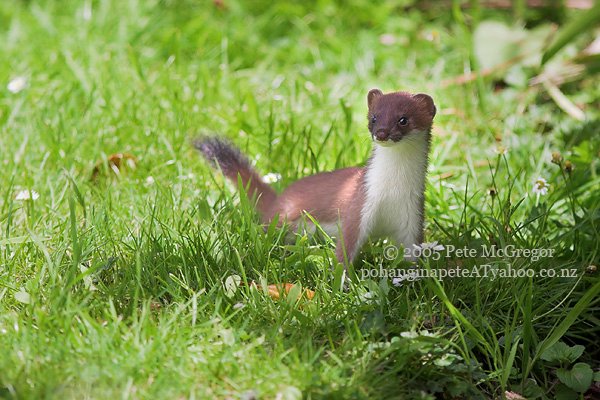
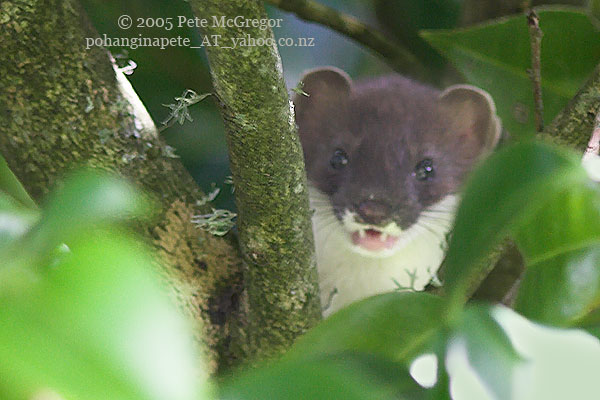
When it emerged, it ran across the lawn in front of the harakeke. I snapped a photo; the stoat turned and ran slightly towards me, then stopped. I managed three more photos before it returned to the longer grass on the far side of the fence. It climbed a tree, snaking up into the canopy. There, it peered out, looking directly at me. I could see only its head. In the shade, there was too little light for photos, although I took several, hoping I might be lucky. The stoat looked around and opened its mouth; a gleam of tiny, white teeth; prominent canines. Who knows what the gesture meant? To me, it looked like a yawn, as if I were being told to hurry up and take my damn photos, it didn’t have all day to hang around being photographed. But it could have been defiance—stop harassing me, I have birds to kill—or perhaps it was uncertainty, indecision? I’ll never know; I can only speculate and wonder. What’s important is that, for a moment, we entered each other’s lives. We existed in each other’s consciousness. It may have been a day late, but as a Christmas present it takes some beating.


Notes:
1. Stoats (Mustela erminea) were introduced into New Zealand in the 19th century to control rabbits. It didn’t work; instead, stoats are now a major threat to New Zealand’s birds. The Department of Conservation claims
about 60% of the North Island brown kiwi born are killed by stoats: about 15,000 kiwi chicks per year. That’s a lot of kiwi chicks, especially for a population currently about 70,000 but declining at almost 6% per year. It’s not just kiwi, either—as well as other birds, including kaka, mohua, and whio, stoats also eat invertebrates, including koura (freshwater crayfish) and weta. However, stoats do kill rats and mice, so removing stoats may, under some circumstances, cause rodent populations to increase—bad news for birds, plants, and invertebrates. Unfortunately, we don’t know enough about these sorts of ecological interactions to be able to exploit them for conservation ends.
2. Stoats are considered such a threat to New Zealand’s indigenous biodiversity that in 1999 the Government committed
$NZ6.6 million over 5 years to stoat research.
3. Sorry about the copyright statement on the photos, but I need to take care with these photos, as I hope they’ll supplement my microscopic income ("income" is actually a misnomer). If you want a larger, clean photo, send me an email.


Photo 1: “...the stoat turned and ran slightly towards me, then stopped.”
Photo 2: “... it ran across the lawn in front of the harakeke.”
Photo 3: “... there was too little light for photos.” In fact, I was able to salvage this: not exactly a world-beater, but you get the impression.
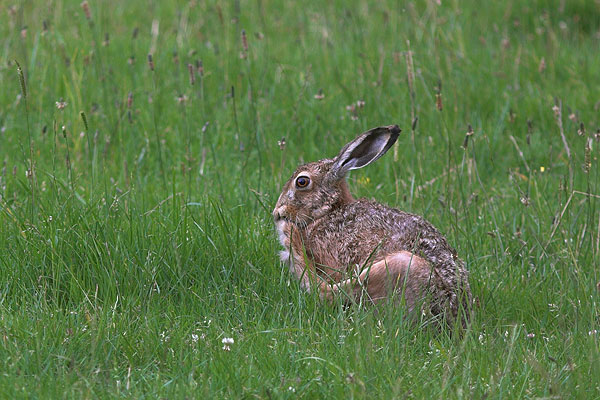
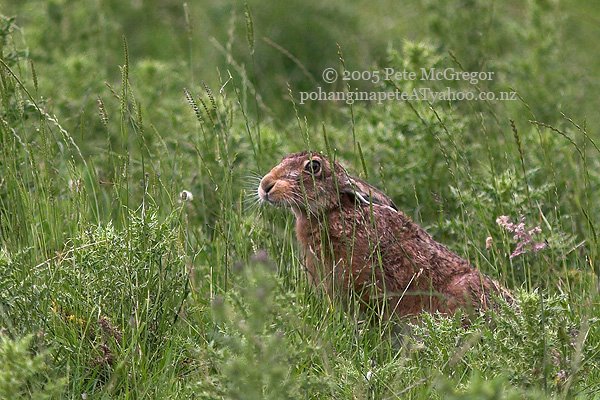
Photo 4: The previous evening (Christmas day), this hare (Lepus europaeus) was feeding in the paddock next to Deb’s house, seemingly not bothered by the music and activity. However, when I tried to stalk closer, it loped off, only to return later. I didn’t disturb it a second time; I like hares, and harassing this one—especially on Christmas day—seemed like a mean thing to do.


Photos and words © 2005 Pete McGregor


21 December 2005

At home with the dragon

Sometimes I’m consumed by restlessness; a nomad’s need to be moving on; the disquiet of being fixed to a place. This usually happens after reading an evocative book about somewhere I haven’t been, or watching a well-presented documentary: something that shows me places, things, birds, animals, landscapes, people—environments, I suppose—new to me. The feeling is summed up by Bruce Chatwin at his best, describing a conversation with a tramp:
“He then said, slowly, and with great seriousness:
‘It’s like the tides was pulling you along the highway. I’m like the Arctic tern, guv’nor. That’s a bird. A beautiful white bird what flies from the North Pole to the South Pole and back again.’”[1]

Sometimes I sit on the verandah watching swallows flicker across an apocalyptic sky, everything dark and angry and the paddock and the terrace-edge trees saturated with stormlight; a korimako[2] rushes across the field in front of me to the harakeke[3] and methodically checks every flower, drinking from each one on the long stalks; the pups emerge from under the house and drift through the short, seeding grass, noses down, checking what’s been there, seeking something stinky to roll in, tails in the air so I’m presented with three arseholes to improve the view; or I get home, tired, and settle down with a glass of wine, slices of crisp apple, and a nice bit of cheese—these things, a million more, and there’s no need to be anywhere else. This feeling is summed up exquisitely by Peter Matthiessen:

“The great Zen Buddhist teacher Eihei Dogen said, ‘Why leave behind the seat that exists in your own home and go off aimlessly to the dusty realms of other lands? Do not be afraid of the true dragon.’ The dragon is the buddha nature, the essence of existence, which is everywhere. You don't have to go anywhere to find it, it's right here, right now. Once you have that sense of life, it doesn't matter where you are. You're always home.”

They seem to be different—poles apart, you might say. Are they?

I walked down the road in the warm evening, in the shadowless, dull light of a nor’wester that hadn’t quite arrived. There wasn’t the slightest breath of wind. For some reason the deer seemed unperturbed although they clearly knew I was there; a few watched me walk by but seemed content to sit chewing their cud. Three fawns now—when they tuck themselves up on the ground they can vanish in grass so short you could see a lizard running. It’s only when they lift their heads that you see them. I have no idea how they manage it. In the hills they’d be utterly invisible.

As I strode down through the cutting I felt fit and lean and strong, the feel of the clean cotton shirt loose and warm, a kind of kinaesthesis making me aware of my whole body. I felt energised; picking a large rock from the road where it had come to rest after falling from the cliff, I heaved it shotput style to the far side of the road. It flew so far through the air that I startled myself.

The sky continued to thicken and grow denser with grey cloud. A few spots of light rain touched my face, and I looked up to see a strange sight. Two swans flying up the valley. They passed almost overhead, silent, methodical; long straight necks stretching towards a destination. I’ve never seen swans in the valley before.

I walked on, past the bulls in the paddock by the bridge. Like the deer, they seemed unconcerned. I walked past one, almost within arm’s length; he lifted his head, momentarily stopped chewing while he inspected me, then continued hauling in the grass that hung from his muzzle like noodles. Beyond the bridge, the sporadic spots of rain became more frequent; a light, sparse, spitting drizzle not yet capable of wetting anything. I turned and began walking back, knowing the inevitable—that it would gradually become denser, heavier, wetter. A ute[4] with a dog on the back passed me and turned into the bull paddock. I realised then—I have no idea what led me to the thought—that I feel most at home where the qualities of wildness, possibility, uncertainty, and complexity are strongest; in places that might be described as ramshackle, rundown, untidy. Conversely, I understood that I have a horror of perfectly neat, tidy, trimmed, organised places—weed-free pastures, well-tensioned fences, freshly-painted buildings; places that people call efficient and productive but I call sterile and exclusive; places with characteristics that say, “I own this, I look after it, keep off, keep out, there’s no place for you, don’t trespass.”

So you go somewhere else; you keep moving, like the tides was pulling you along the highway. Then you feel at home.


[1] On page 310 of The Songlines (1987); London, Picador. 325 p. ISBN 0 330 30082 2.
[2] Anthornis melanura; the bellbird.
[3] Phormium tenax; the New Zealand flax.
[4] In New Zealand idiom, a ute is a pickup truck. It’s derived from “utility vehicle”.

Photo 1: The damselfly Austrolestes colensonis. This is a male. Damselflies and dragonflies comprise the Order Odonata.
Photo 2: ditto.
Photo 3: The mason wasp (usually referred to as the mason bee, but it's a sphecid wasp), Pison spinolae. They're everywhere at the moment, packing spiders into clay cells wherever they can find a suitable crevice. I liberated this one from the laundry windowsill.

Photos and words copyright 2005 Pete McGregor

16 December 2005

A nice day...

I woke suddenly in the wee hours of a hot, humid night, startled by the roar of the house shuddering about me. Instinct told me to throw back the covers, roll out of bed, and hit the floor, but some other part of my brain—the sensible cortex, perhaps—refused to wake. I lay there, the usual earthquake thoughts rolling through my semi-consciousness: how long will it last, how big will it be, should I take cover, is Wellington a pile of rubble? Eventually it stopped. I looked at the clock—2:57 a.m.—and went back to sleep.

The ‘quake was centred about 50km away and 25 km deep; 5 on the Richter scale. Wellington wasn’t a pile of rubble and National Radio even appeared unaware the ‘quake had happened. Here in Aotearoa, on the Pacific rim of fire, you get used to earthquakes. From an early age you’re taught what to do—stand in a doorway, get under a table, and so on—but after years of surviving them and having nothing actually falling on you, you become complacent. You know what you should do, but when it requires getting out of bed you lie there instead, trying to decide just how bad it has to get before you move. It’s as if the land has been crying “Wolf!” all your life.

But one day we’ll get the big one.

At breakfast I listened to Jakob’s Subsets of Sets, compelled by the title of the brilliant 3rd track: “Nice day for an earthquake”. The day had an oppressive, brooding feel; a sense of tension; of something about to happen. If anything, the humidity had increased despite a hot, blustery wind from the North-East. I kept expecting a storm, another earthquake, maybe an eruption from Ruapehu or Ngauruhoe; but the sky remained quiet and strewn with patternless cloud, the ground remained firm and immobile beneath my feet, and Ruapehu, according to the GNS website, was doing nothing more than simmer at level 1. By mid afternoon I’d decided to release some of my own tension, so I wheeled the mountainbike out and set off for No. 2 Line.

I’d expected to feel exhausted, enervated by the weather, but the feel of doing something physical and energetic revitalised me. I won’t say I raced up the steep and dusty gravel road—I was less like a racing sardine than a jogging flounder (a floundering jogger?)—but a steady effort took me to the end of the road without shattering me. From the end of the road I could see out across the Pohangina Valley and over the hill country towards Wanganui; South to the Tararua; North along the line of the Ruahine to the Ngamoko Range where the tops were hidden by cloud rolling over from the East and dissolving down deep gullies, silhouetting ridgelines. In the West, at last, a thunderstorm had formed over the hills, its borders hazy with dark rain, its upper region a mountain of wild, white and black and grey cumulus. I released the brakes and began the descent. No more floundering; now I felt even quicker than that racing sardine, maybe even as fast as a Pohangina Valley blowfly. It’s one of the most accessible ways to get a buzz—powering down a gravel road on a mountainbike on the edge of control, eyes showing more white than a hard-boiled egg, imagination switched off, and the smell of fear in your nostrils after you feel the back wheel twitch on a bend. Despite the wind generated by my speed, I could still feel the nor’easter’s buffeting. I shot around a corner, lifted my head slightly to check the road and BANG!—the wind tore the sun visor from my helmet. Bummer. By the time I’d managed to stop, I was faced with an unwelcome grind back up the road to retrieve it. More exercise than I’d intended, but I’m sure it did me good. It also gave me the opportunity to realise there was a truck speeding up the single lane road.

The highlight of the ride came as I accelerated up out of a dip in the road and rounded a bend where the road levels off for a short way. Up ahead, something crossed the road. Lithe, quick, a ripple of agile energy—then another, a body’s length behind the first. Stoats! A few seconds’ glimpse, then they were gone, vanished into the long, wind-whipped grass on the roadside. I pulled up, swung off the saddle and peered into the dense grass; scanned the close-cropped paddock on the other side of the fence. A sheep stared back at me. Distant thunder growled, a long rumble reverberating around the valley. The image of the stoats seemed to fit the sound—intensely charged and ephemeral, like a strange form of lightning. Nothing moved other than the grasses. No sign of stoats.

I drove into town that evening. Beyond Ashhurst I saw railway lines, deeply rusted but, on top, polished clean and gleaming, forming perfect lines of light; sunlight through the shimmer of a starling’s wings as it arced away from the car. I returned after dark, late, with the headlight beams full of erratic moths and wisps and ghosts of mist rising from the warm tarmac. A bird rose from the side of the road, straight up and into darkness. Over everything—the valley, the Ruahine, the western hills, to every horizon—long clouds stretched in moonlight. Pure drama; the essence of legend. A nice day for an earthquake.


Photo 1: Inspired by the Urban Dragon Hunters, I fossicked through some old photos and found some I'd taken last year at little tarn on the summit of the Ngamoko Range. These are Austrolestes colensonis.
Photo 2: ...and these are Xanthocnemis zealandica.
Photo 3: Thundercloud and rain, Pohangina Valley.

Photos and words copyright 2005 Pete McGregor


12 December 2005

We save the world (tomorrow)

This is mostly true. If it were to be filmed, it would be called a dramatised documentary, or “based on true events” (and possibly many other things also—“dog’s breakfast” springs to mind). The names of the characters have been changed, but I am me. Some of the conversation actually occurred.

Pubs are where the world’s problems are solved1. At the Celtic on Tuesday evening we addressed the problem of how to save the world: an exploration of the question, “What on Earth makes us act in ways that will ruin it?”

It had begun with the assertion that because we know we’re going to die—and (relatively speaking) soon—only altruistic people give a toss about securing a reasonable future; in other words, because our actions are so far removed from their consequences, we’re mostly free to act irresponsibly.

“Perhaps,” I argued, “if we thought we weren’t going to die—if we thought we’d live indefinitely—we’d look after the planet much better.”

There was general agreement that we were all going to die.

“Not me,” I said, “I’m not.”

Art looked at me, his expression half amused, half scared. “Everyone’s going to die,” he said.

“Prove it.” I could say this confidently, knowing his veganism prevented the taking of life—mine at least, I hoped. “Just because 99 point something of the world’s humans have died doesn’t prove I’m going to. It’s inductive reasoning. Besides, look at all these people,” I said, gesturing at the other patrons and passers-by. “They’re not dead.”

“You’re in denial. You’re afraid of dying.”

To avoid the accusation of inductive reasoning, I resorted instead to wild, sweeping generalisations. “Most people are afraid of dying,” I said.

Wal disagreed. “No,” he said, “most people are afraid of living.”

He went on to explain how most of us live half afraid, insecure, not pursuing our passions. Not taking risks. Not living. But, although he had disagreed, there was no real contradiction. People can be afraid of dying and also afraid of living. I suspect they’re afraid of living because it’s risky and they’re scared it might kill them.

By now some of my friends were laughing nervously and studying their beers. Dee, however, was interested in the original proposition and wasn’t put off that easily. She’d seen a flaw in my argument. “ What about your kids?” she said, referring to children as a concept rather than as real individuals—the fleeting wish of harassed parents the world over. “People do things so their kids will have a good place to live.”

“The time frame’s too long,” I said, although I didn’t believe it, “and you have to imagine the consequences vividly enough to want to save your kids from them, but most people,”—that incomparably useful generalisation—“have no imagination.”

There was general disagreement that people in general have no imagination.

A boy racer prowled past, panels pulsing, neons glowing. He changed gears—a sound like glass being smashed—and accelerated down the street in a squeal of tyres.

“There, see?” I said, “—no imagination. He can’t imagine the consequences of driving like that.”

“Inductive reasoning,” Art said, “—generalising from one kid to everyone. Your argument’s shit. Most people have some imagination.”

I had to admit it was true—my argument was shit. “But the principle’s true. If he can’t imagine ending up like train smash even when he’s driving like that, how seriously will he think about the consequences for his kids?”

“Maybe if he had kids he’d think about it?” Dee suggested. “He might drive more responsibly, too.”

“There’s an idea,” Andrew said. “Perhaps we could save the planet by encouraging everyone to have more kids?”

There was general agreement that his proposition was flawed.

I thought about Dee’s argument. Perhaps she had a point. When you have kids, you’re more likely to consider the consequences of your actions—at least, I imagine this is what happens. But even then, so many consequences seem remote, abstract, doubtful: faced with the immediate, definite fallout of forgetting to buy batteries for the animatronic Christmas raptor, a special trip to town in the SUV means nothing.

“Immediacy always trumps consequence,” I said, out loud, ending the conversation. We walked across the road to the Downtown complex to watch Harry Potter and the Goblet of Fire, a long film rescued by its humour.

...

I stopped at the gate and got out to open it. The half moon hung bright in an almost perfect sky; a few tatters of luminous cloud glowed along the Ruahine; the night glittered with stars. Despite the steady murmur of the idling engine, a deep silence infused everything—the clang of the metal tubing gate, the hack of a coughing sheep, the slam of a door in the distance: those brief sounds accentuated rather than diminished the silence. I paused, looked up at the immense sky and across to the faint shapes of deer moving in moonlight. What would all this be like a hundred years from now? What will our children see? Where will they find wildness?

I parked the car and walked across to the back door, trying to remember where the puppy shit was so I didn’t step on it. A ruru began calling. It sounded like a message from the present, to the unknowable future.


1 I was going to add, “...and cafes”, but then realised it’s not true. Cafes are where the world’s problems are generated. They’re where we buy coffee, thus supporting the giant pesticide corporations and compounding the problems of the desperately exploited people who grow the beans; they’re where we eat cake and cultivate obesity; they’re where we incubate our affluenza.

Photo 1: Yes, I have a new set of neighbours. Three, in fact. Here are two.
Photo 2: Possibly my favourite... but they're working dogs, not pets [sigh]...
Photo 3: Southern hemisphere half moon. If you're in the northern hemisphere, have a look at the moon one night and see if you can spot the difference.
Photo 4: If your monitor's brightness is set too low, this might be a bit hard to appreciate. As with all the photos, click on it to get a larger view.

Photos and words copyright 2005 Pete McGregor