31 October 2010

Eardrum of a lion


A few days ago I finished reading Colin Thubron’s Behind the Wall for the second time, and began re-reading Bruce Chatwin’s In Patagonia. Yesterday, in one of those peculiar coincidences that leave one wondering whether synchronicity amounts to more than mere peculiar coincidence, I came across William Dalrymple’s review of Under the sun: the letters of Bruce Chatwin. Fascinated, and drawn in by Dalrymple’s excellent writing, I read the whole thing and noted several passages that stood out for various reasons — for example, Chatwin’s assertion that, “The function of an artist is to work for a) himself b) to leave something memorable, for the future, to shore up the ruins”, caused me to wonder whether “shore up the ruins” reflected an idea similar to that underlying The Ruins of the Moment.[1]

But one quotation struck me with a particular force. In a note to his wife Elizabeth, Chatwin mentions a consignment containing “...a number of highly precious possessions, including a dried chameleon and the eardrum of a lion”.

Although never intended for publication, that phrase seems to me to sum up much of the quality of Chatwin’s writing — the eccentric, particular noticing that recognises the importance of seemingly random and insignificant things; the awareness of the artefacts, qualities and ostensibly peripheral things that give places their substance and moments their flavour.

The phrase keeps working on me. Driving back from town early yesterday afternoon I kept thinking about the last sounds heard by that eardrum. The drip of blood from the body it shared onto the dusty ground? The gurgle of its ruined lungs? The approaching footsteps then the momentary explosion of sound before the silence of oblivion? I thought about all the sounds heard by that eardrum: the rasp of a mother lion’s tongue on a cub’s fur — the fur on its shared body? The giggling of gathering hyaenas; the roaring at night across savannah; the strangled choking of an impala as its eyes fail; the crack of bone and the knock of a dead dragged hoof against a miombo trunk? All that history, all those sounds, gone.

Who would remove and save the eardrum of a lion, and for what purpose?

The best purpose for the eardrum of a lion is indisputably to allow a lion, alive and wild, to hear. Everything else is at best ancillary. But perhaps, among all those ancillary purposes for this eardrum, the best is to have allowed Chatwin to recognise its significance so those who read his phrase could remember and wonder — not just about Chatwin, but a particular, now immortal lion.

Classics

Notes:
1. I did find it curious that Dalrymple quoted several features of the book that had been noted almost two months earlier in a shorter review by Olivia Lang in The New Statesman. (Dalrymple's review was published on 27 October; Lang's had been published on 7 September.) Coincidence? Cryptomnesia? Or were these the only stand-outs in an otherwise humdrum miscellania?

Photos:
1. This lioness was one of two hunting an impala at night in South Luangwa National Park, Zambia. She walked by our open jeep, so close she seemed almost within arm's reach.
2. My copies of the books.


Photos and original text © 2010 Pete McGregor

27 October 2010

The meaning of hawks and apples

The old apple tree grows more beautiful each day, its petals still tinged with pink as it approaches the peak of its flowering. On mornings like this, the light flat and grey, hazy with misty drizzle, the colours become more apparent yet they still retain a refined, subtle elegance, so different from the brash spectacular show of the same tree lit by sunlight against the dark hills, yet no less affecting. Yesterday a pale kahu cruised low over the edge of the terrace behind the apple; it banked steeply, dropping down to land out of sight in the channel of the old, abandoned road. The pale bird echoed the pale flowers; the coincidence of colour seemed no coincidence at all, as if through some ineffable communication bird and tree had conspired to reward me simply for noticing.

Many rationalists would rubbish this, I suspect. Coincidence and nothing more, they'd say; this talk of trees and birds conspiring is at best metaphor but more likely nonsense. I wonder. Of course they don't conspire (but note I said "as if" they conspired); however, to dismiss the metaphor as meaningless nonsense seems, well, irrational. I'm far from an expert on Wittgenstein, but when he said, "Whereof one cannot speak, thereof one must pass over in silence," [1] I'm pretty sure he wasn't saying everything that can't be expressed in words is meaningless, but that words — language, in other words — can't express everything meaningful.

Language does not merely describe and explain: it evokes, and sometimes the point of saying something is precisely to evoke a feeling rather than explain an event. Something heard (or read) can be felt as much as logically understood, and sometimes what's heard or read can be felt more than it can be logically understood. I’m no expert on T.S. Eliot, either, but this, I think, is what he meant when he coined the phrase "objective correlative". Moreover, feeling, in the sense of intuition or emotional response, and logic aren't mutually exclusive: both are approaches to understanding.

But I suspect the most important point is that meaning probably isn't inherent in any event; instead, it's conferred on the event by the observer or participant. As far as I’m aware, humans are the only animals able to invest an event with meaning [2]; perhaps, therefore, an important part of being human consists in the creation of meaning, and one of the functions of meaning is to engender respect and appreciation.

Meaning, too, cannot always be explained, even in theory — in fact, I suspect we understand the meaning of many events intuitively, and the attempt to explain what something means destroys the meaning. I've long noticed my own aversion to hearing someone say of a poem, "But what does it mean?" — a question that for most good poems is usually the least useful, most inappropriate question one could ask; a question second in pointlessness and potential destructiveness only to an attempt to answer it. As the poet Archibald MacLeish said so succinctly (and to my ear, unpoetically), “A poem should not mean/But be”.

So, I don't doubt the pale hawk circling the flowering apple on that grey morning had some kind of powerful meaning, but it too remains as ineffable as the metaphorical communication I alluded to. I can respect and appreciate it, but I can't explain it — certainly not in words. Forgive me for not passing over it in silence.

Notes:
[1] Proposition 7 of Wittgenstein's Tractatus Logico-Philosophicus.
[2] ...which might mean our understanding of the concept of meaning is as poor as our understanding of the consciousness of animals.

Photos:
1.Evening in the valley, from the edge of the terrace. 26 October 2010.
2. Adventitious shoots on one of the old poplars near the edge of the terrace.
3. A kahu's always somewhere nearby — not in this photo, but perhaps that's how it should be.

Photos and original text © 2009 Pete McGregor

18 October 2010

Beating the beast of procrastination in 666 days

The fire of change

Procrastination seems to be occupying my attention lately, not because I'm doing it more than usual — in fact, since beginning this post I've been better than usual at putting off procrastination — but because I've been wondering why I find it so difficult to overcome. The renewed interest arose partly from reading James Surowiecki’s article about procrastination in the New Yorker, but also because lately I've been trying harder to get important things done, promptly. I've also been motivated by disgust with myself over occasional wasted days (like the day before I began this post, when all I accomplished from my long list was to mail my local government voting paper — at the last minute, of course); so disgusted, in fact, that I've felt motivated to prove I'm actually not as hopeless as those days suggest. I've also been intrigued by a recent article about psychologist Ellen Langer, who describes herself as an "anticrastinator" and whose main thesis seems to focus on how mindset influences not just behaviour, but physical change.

That struck a chord with me. The suggestion that thoughts affect physiology as well as behaviour doesn't sound novel, but when she first proposed it she apparently met huge opposition — and still does from some quarters, probably with some justification given the problems with her modus operandi. But the essence of her argument has been said before, for thousands of years; it's been said by people like Buddha, Jesus, Marcus Aurelius, Kierkegaard, Gandhi and many other famous and sometimes wise people. In short — actually, in Buddha's words [1] — we are what we think; the corollary is that if we change what we think, we change who we are. If I think of myself as a procrastinator, I become a procrastinator (if I'm not already); if I think of myself as efficient, effective and productive, I become efficient, effective and productive. That’s the theory.

The problem is that the effect also works the other way: if I procrastinate, I think of myself as a procrastinator; the process is cyclical. As any procrastinator will confirm, it's also difficult to break the cycle. Pigeons at the Jama Masjid in New Delhi, November 2007Merely thinking of myself as efficient, effective and productive won't immediately effect the desired change, nor will just a few days of efficient, effective and productive behaviour. Ingrained patterns of thought and behaviour need persistent effort to change. Conversely, and ironically, the encouraging thought is identical: the process is cyclical, so working on thoughts and actions provides positive feedback — if I work well today this confirms my belief I work well, and if I believe I work well I'm more likely to to work well today.

It sounds easy, but it's not (ask the procrastinator). Procrastination's a habit, and recent research suggests the average time to form a simple habit is slightly more than two months (66 days, apparently). That's two months of near-daily practice. I suspect more complex habits take longer to form, and those that require changing an existing, complex habit will take even longer — given their intransigence, I suspect the average for changing these tasks will turn out to be 666 days. Procrastination’s that kind of beast.

So, I began thinking about how I might change from a chronic procrastinator to someone who gets the important things done — someone who seems comfortably on top of things. Two things seemed important, perhaps essential, for overcoming procrastination in the long term: to start small and to persist, because persistence is necessary and starting small makes persistence more likely. More specifically, I decided to work on five things:
  1. Replacing negative self-talk. I find it easy to lapse into thinking, "Here I go, procrastinating again," so when I catch myself thinking that, I replace it with a pre-prepared phrase —  currently, "I'm getting better at getting things done."
  2. Initially, completing just one important but comfortably achievable task a day.[2] After practising what I'm preaching, I've realised the important point is that the task should be something I don't have to do. For example, I'd booked an eye examination, so all I had to do was turn up for it; I could easily have procrastinated on booking the appointment, but making sure I turned up for it was largely out of my control; procrastination wasn't an issue. In short, I need to do things that could comfortably be delayed. The point at this stage is to succeed: succeeding when the tasks are difficult or unpleasant can come later, when I’m (even) better.
  3. Not worrying if I bomb out occasionally — the recent research mentioned above showed occasionally missing a day's practice, or even two days in a row, seemed not to affect the forming of the habit.
  4. Keeping a simple tally of how many days in a row I've succeeded. The sight of a long row of ticks, with only an occasional gap, must surely help confirm my belief I’m getting better at getting things done.
  5. Putting into practice the adage that the best form of self-control is to put yourself in a situation where self-control isn't necessary. I've forgotten where I read that recently, but it's brilliant — possibly the single most effective piece of advice I've heard on overcoming procrastination. When computer work’s involved, the obvious example is to disconnect from the Internet; the problem is the ease with which one can reconnect. Switching off the wireless adapter or modem isn't particularly effective because it's so easy to power them up again. The New Yorker article mentioned Freedom, a simple (cheap, not free) program that blocks Internet access for up to eight hours and requires a reboot to override, but I find working in the public library or a cafe, where I'd have to pay for a wireless connection, just as effective. At home, the temptation to check e-mail or look up a reference or simply visit a favourite blog or website can be much harder to resist, which is one of the reasons I like to write by hand, with a pen on paper, first thing in the morning. I don't turn the computer on until the writing's done. (That, at least, has become a habit).

But one of the best ways I've found to avoid the need for self-control is simply to set an alarm. I'd been procrastinating on an editing contract recently, but finally finished it in four hour-long sessions by setting an alarm to signal the start of each session. I set a warning alarm for 5–10 minutes beforehand, with the message, "Wrap up what you're doing".[3] Why did this work so well? My guess is that it provided an external imperative rather than requiring me to make a decision at the time; in other words, I'd already made the decision earlier, when it's easier to make these kinds of decisions (the New Yorker article explains that it's called "hyperbolic discounting", but it could be called "beans on toast" for all I care — the point is that it works). To have ignored the alarm would have taken a conscious decision on my part to sabotage my predetermined intention to start working. The warning alarm helped by disabling the excuse "I just need to finish this first" — as we know, those wrappings-up have a remarkable ability to turn into extended explorations of something we hadn't intended to explore. Instead, the warning gave me a short, predefined period to complete what I was doing. I found it enlightening to discover how quickly I could finish scanning my RSS feeds when I knew I had to start editing within five minutes.

So, this is my plan for turning myself from a procrastinator into a paragon of effectiveness, or at least into less of a hopeless case. Could these suggestions work for you? I don't know. They seem to make sense to me, they seem to be working for me, and they're backed by evidence, but I can't guarantee they'll work for anyone else. Moreover, I don't even know if they'll eventually work even for me — I'm still a long way short of even 66 days — but at least I've made a start. For an ex-procrastinator, that's a mighty big deal.


Notes:
1. “We are what we think. All that we are arises from our thoughts. With our thoughts we make the world.” Gautama Buddha, on Wikiquote, retrieved 18 October 2010. 
2. Finishing this post was my task for today. It's by no means the only thing I'll be doing, but anything else is extra.
3. I'm currently using the free version of TimeLeft, which only allows one alarm at a time (the paid version allows more). It's good enough for me; a bit fiddly to set up, but the warning alarm makes it worthwhile.

Photos:
1. In the Lotus Sutra’s Parable of the Burning House,  the house represents our day-to-day world; the fire, suffering. Escape from the burning house can be achieved. But a burning house, one of the most affecting of sights, can be seen as a metaphor in many other ways. (This was a local farmer’s way of dealing with a derelict house on his property, two years ago almost to the day).
2. As far as I know, pigeons and other animals don’t procrastinate. (At the Jama Masjid in New Delhi, just short of three years ago. A lot of water under the bridge since then.)
3. This clock is older than me. It’s right twice a day. Sometimes I’d be happy with an average as good as that.

Photos and original text © 2009 Pete McGregor

26 September 2010

The Spring wind

Clearing after the flood

Outside in the dark as the rain eases and stops, a sheep coughs. The barking has a note of desperation, as if the sheep's lungs have been choked with worms and the poor creature will asphyxiate if it fails to cough them up. As I listen I feel my own lungs beginning to wither and fail and I feel, too, the frightened sheep's sense of its own mortality.

This, of course, is my own fear projected onto the sheep, which, having coughed enough, begins to scratch itself on a verandah pile. Already, it has probably forgotten its fit of hacking.

...

The first stag cast both antlers nine days ago; today the other stag cast his. Without antlers the big animals seem odd, out of proportion, as if all that powerful body seems pointless, casting about for a purpose long gone. Already they'll be starting to grow new sets so six months from now, crowned once again, they can fight over the hinds.

The futility of this seems absurd, yet, in a sense, this is all there is — fail in the competition to leave progeny and you might as well never have existed. Perhaps this is why we, the evolutionary dead ends, the dinosaurs, write so desperately: so we won't be forgotten, so we might influence the world in which we will no longer live, so something of us might survive.

...

A cold wind knocks pink and white petals from the magnolia, scatters white clouds across a blue sky, piles them up over the ranges. Winter's casualties continue their slow collapse — one hind, skin stretched and cracking over disarticulating bones; a ewe or two sinking into the wriggling ground; somewhere the old cat in a place only he knows.

But the tree lucerne bustles with tauhou and the low roar of feeding bees. I walk on, down through the cutting, looking out over the valley, down to Te Awaoteatua Stream, its grey-trunked poplars already hung with yellow-green catkins. At the bridge I lean over the parapet and stare at the swift, shallow water. I think of Pooh sticks, but it's pointless now. I walk on, further than I'd intended; I walk on because my legs keep carrying me down the road in the pale, silvery light and cold wind; I walk on because I can't stop, can't make the decision to turn around. I want to walk on forever, out of the world.

But I stop at Tokeawa Stream and lean over again, gazing at the water rushing white over algal-brown boulders. I look down, remembering, and the water begins to mutter questions I can't quite make out.

After a long time I begin walking back up the quiet road.


Notes:
1. Various hypotheses have been proposed for the function of antlers (see Clutton-Brock, T. H. (1982). The functions of antlers. Behaviour, 79(2/4), 108–125), but why do red deer retain their antlers throughout the winter, i.e. for 4–5 months after the roar (rut; breeding/fighting season)?
2.Tree lucerne — tagasaste, Chamaecytisus palmensis.
3. Tauhou — the silvereye, Zosterops lateralis


Photos:
1. Boulders, Te Awaoteatua Stream.
2. Te Awaoteatua Stream running high after rain. "What might have been is an abstraction/Remaining a perpetual possibility/Only in a world of speculation." — T.S. Eliot, Four Quartets: Burnt Norton.

Photos and original text © 2010 Pete McGregor

15 September 2010

Wild lives matter


A few nights ago I watched an episode of the Australian program Outback Wildlife Rescue, in which one of the events centred on an operation to remedy the deformed tail of a young eastern grey kangaroo. The program pointed out that Australia has about 50 million kangaroos and I recalled how in some areas they're considered pests and professional shooters make a living killing them. The cost of fixing the tail of this young animal must have been enormous, even if the vet and his staff donated their time (I don't know how the centre's funded — probably from donations and grants?), and I found myself asking the inevitable question: "Why spend so much effort rescuing one kangaroo?" Surely the most sensible and practical option would have been to euthanase the kangaroo?

Then I started thinking harder, and some benefits of this huge effort became apparent.

First, the operation wasn't standard: not only had the vet never attempted it before, it's unlikely anyone had, and he had to work out much of what he had to do as he went along. The benefits are that the vet developed his skills and also added to the fund of knowledge about these kinds of operations — not just fixing kangaroos' tails, but operations on the tails of other animals, operations to correct the shape and position of vertebrae and other bones, operations to correct muscular imbalances and so on. Once we've repeated a procedure of any sort more than a few times, we learn better not by repeating the same procedure over and over, but by carrying out similar but not identical procedures. It's like rock climbing — once you know the sequence of moves, repeated ascents of the same climb don't improve your skills as much as working out the sequence of moves on other, different but similar climbs.

Another argument is that if we simply euthanased all injured kangaroos we wouldn't develop the same degree of knowledge about how to treat injured kangaroos when an important need arises — say, for example, when the marsupial star of a wildlife park falls lame. Moreover, as I've already pointed out, much of that knowledge will be transferable to other animals and, I suppose, in theory to humans, although I don't know the extent to which that kind of cross-over occurs (that knowledge comes far more from deliberate experiments on animals — and that, in the context of this discussion, is both acutely ironic and an entirely different, ethical issue).

But these arguments are practical, and although they're persuasive, the most compelling argument for me is simply that those seemingly extraordinary efforts to save the lives of common wild animals remind us that it's not just human lives that have value — and by "lives", I mean individual lives, not just species. This might be difficult to justify logically — the argument is not about instrumental value (how useful that life is to us) but about intrinsic value (the life is valuable simply because it's a life), which is inordinately difficult to "prove" — but logic is beside the point. We understand the true value of other lives not by being convinced through logical argument, but through that slightly choked-up feeling we get when we see a hawksbill turtle, successfully treated for pneumonia after swallowing a plastic bag, released into the ocean and swimming out to sea; when we see a kite, brought back to health after being rescued from a snare, finally flying off into the Australian outback; or when we see a young eastern grey kangaroo beginning to use its tail normally after ground-breaking surgery. We know these lives are vital not because we've been convinced by argument: we know it because our empathy leaves no doubt.


Photo: 
1.Bushbuck (Tragelaphus scriptus), Nyika Plateau, Malawi.


Photo and original text © 2010 Pete McGregor

06 September 2010

Last days


It's been a rough month. Ming slept all day on the verandah seats, curled or crouched on the old folded sheet I'd arranged as a nest for him; something more comfortable than the vinyl upholstery. He kept half-standing, turning slowly and settling down, constantly searching for a better position. I put a bowl of biscuits and another of water near him; he ate a few biscuits and lapped a little water then curled up again.

I sat next to him several times during the day when the sun broke through. I sipped tea and tried to understand what it meant to sit next to Ming during what might be the last hours of his life, what it would mean to sit there in the days that followed, looking at the world, the lambs lying on green grass, white clouds in a blue sky, plum blossoms profuse on the tree next to the dog kennels, tui fighting in the poplars, a korimako calling from the Grevillea next door — looking at the world and knowing Ming was no longer part of it. Yeah, sure, he'll still be here, re-entering it in a different form, as diffuse processes, as memory — but all that wise, enlightened bullshit can't compensate for his actual absence, the joy of hearing rustling in the kitchen and finding him with his head shoved in the rubbish, trying to hook out some morsel; can't compensate for the yowls of protest when I took his dead rat from him (in case it had a sublethal dose of poison); can't compensate for his selective deafness when told off. We know the world mostly through our senses — even our ability to imagine arises from what we've learned from our senses — and the loss of something, or someone, we can see and hear and touch is bearable only insofar as we can rationalise the loss. For those we love, this seems impossible. I have no idea how we manage it.

I sit next to him in the Spring sun, sipping tea and gazing out over the paddock, sensing his slow breathing. A kahu circles, calling. It's been a rough month, and it's a long way from over. Every time I blink the world seems to go slightly blurry. 


Photo: Ming in better times

Update (12 September 2010): Ming has not been seen since early last week. The conclusion is inevitable.

Photos and original text © 2010 Pete McGregor

28 July 2010

Being a bird


Outside in the dim light of another grey, damp dawn, the tui sings — or calls. What's the difference between singing and calling? As I wonder about this, the korimako calls — and that seems the appropriate word for the scolding, the slightly harsh "yak yak yak yak" which I assume (perhaps wrongly) is an alarm call. But I also hear a riroriro singing, and that, too, seems the unassailably correct word — melodious, easy on the ear, with a complex, definite structure in which each note seems to follow naturally from its predecessor.

This, of course, is a human interpretation, but what does a bird hear when it hears another of its own species singing (or calling)? What if the singer and the listener belong to different species; what does the riroriro hear when it hears the tui's astonishingly complex vocalisation (there, I've found another term, one that subsumes singing and calling — a dry, scientific, apparently objective term, but a useful one)? The best we can do to answer these questions is to use a combination of science andI see you long, engaged observation to help us imagine the answers, recognising as we do that we can never truly know, that we can never hear like any bird even if our ears could capture precisely the same range of frequencies. Much of the time we guess wrong when we try to understand what one of our own species hears — a song, for example, or a sound in the night. I hear boring, toneless, puerile, repetitive chanting; you hear complex, clever, rhythmic insight into the modern condition. You hear unexplained footsteps; I hear the house releasing the heat of the day. Sometimes, admittedly, we claim to hear the same thing or, by some comment or gesture, suggest it, but always the inescapable truth remains: we are trapped inside ourselves.

I look up. The clouds in the west have turned pastel orange with a faint hint of mauve in the grey; blackbirds hop about the paddock and sparrows cheep (that, at least, is accurate — it's neither song nor call, and "vocalisation" tells us nothing about the quality of a sparrow's cheep). As I gaze outside, a kahu sails past, a long, low, even glide right across the window-framed view.

What is it like to be a kahu, a hawk on the morning wind?

Photos:
1.Tauhou
; silvereye or waxeye (Zosterops lateralis).
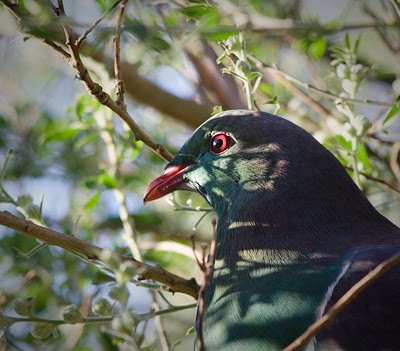
2. Kereru (New Zealand pigeon; Hemiphaga novaeseelandiae).


Photos and original text © 2009 Pete McGregor