30 April 2009

Questions, knowing, risk: thirteen thoughts about thinking

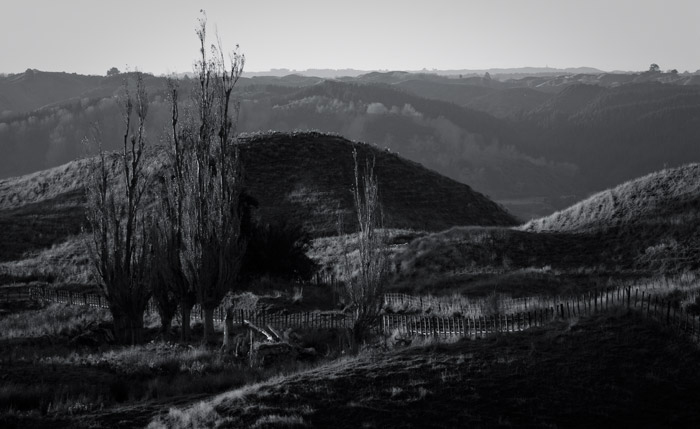
The Pohangina Valley from No. 2 Line

1

The grader's been up No. 2 Line in the last day or so, leaving the road covered in small rocks, mounds and long ridges of gravel, and furrows full of soft, silty soil—a nightmare on which to bike. The knobbly tyres slip and skid; once, the rear wheel shoots sideways on a sloping ridge of gravel and I only just manage to stay upright. I feel as if I'm pedalling uphill through sand, but I grind on, slow and dogged, glad I've no intention of setting personal records. All I want is to feel my legs and lungs working the way they’re supposed to work, not the way they’ve been hardly working most of the day.
So I pedal on up the road, trying to pick the hard surfaces, the tracks where the grader’s giant tyres have compressed the dirt into a reasonable surface mostly free from loose stones. Trying to pick a safe line. Much like life, I suppose—perhaps too much like my own.
How much risk is reasonable?

2

As I begin to heat up I pull down the front zip of my jacket to let the wind cool me—true, natural, air conditioning. The jacket is a generous gift; My hair looks mental, she saysNew Zealand made, and an item too expensive for me to have bought. If I hadn’t been the lucky recipient I suppose I’d have continued to use one of my other jackets or perhaps bought something cheaper — and, inevitably, made in China.
The thought prompts me to think about the ethics of buying Chinese made goods. Some say it puts workers here in Aotearoa out of jobs (they’re correct); others argue it provides Chinese workers with jobs (they’re correct too). Some say it perpetuates what amounts to slavery and oppression in China (a convincing argument); others say those Chinese workers would be worse off without the jobs (similarly convincing). The arguments for and against buying Chinese made goods go on.
It’s like that with many questions. Should we allow private companies to run our prisons? Should all New Zealanders be taxed to pay for Auckland’s transport system to be fixed? Is it wrong to eat meat? Is there a god?
Questions like these—so-called “closed” questions because they can be answered (and usually are) with a simple “yes” or “no”—nearly always develop into arguments between the yeas and the nays, each camp attempting to demonstrate the strength of its own position and the error of the other's. At its most constructive, this kind of to-and-fro supposedly delivers a better understanding of what's being discussed; it (again supposedly) leads to one or both sides modifying their original positions or perhaps even abandoning an untenable position; in a related view, it homes in on “the truth”—the best known, most formal example being the legal system where prosecution and defence lawyers attempt to convince a jury that the accused is or is not guilty.
Do these apparently incisive questions, does this impressively methodical way of arguing, really deliver such wonderful results? I have my doubts. Convincing someone to change an opinion—a rare outcome, in any case—too often seems less a matter of truth and logic than of rhetorical skill and facility with the selection of facts. Consider this: if you were on trial, which lawyer would you prefer as your defence counsel: a superb orator or one who speaks in a dry monotone of incomplete sentences punctuated by ums and ahs?

3

I negotiate another steeply cambered, gravel-slippery corner and change up a couple of gears as the road levels out. I think of the road ahead, the steep climb; I feel like an old dog confronted by happy kids. Perhaps I’ve had enough exercise already. Should I turn around at the dam and skip that long uphill grind? Will I be a wuss if I don’t struggle all the way to the end of the road?

4

But questions can be asked in ways that encourage exploration rather than conflict. How might we run our prisons most effectively and efficiently? What systems of funding would be most equitable and efficient for ameliorating Auckland’s transport problems? What are the consequences of eating meat—or believing in a god? Questions framed like this often have no set answers, which is why they’re called “open-ended”.Dawn moon over the Pohangina Valley They can lead in all kinds of directions and beyond anything you might have guessed. Don’t ask questions like these unless you have time to listen. And time to think. Lots of time.
How far should I bike today?

5

Rationalisations.
Questions don’t have to involve two or more people, nor does the kind of dialectical conflict—I mean “argument”—I’ve described above. We do it in our heads, all the time. But, if we’re conscious of mentally debating a question, it’s often (I suspect) less a rational exercise than a rationalisation enabling us to choose the conclusion we always wanted, whether we knew it or not.
“That new camera isn’t really necessary,” Reasonable Pete says. “Your old camera still does the job”.
“Yes,” Evil Pete says, “yes, but think of the photos you could get in really dim light”.
And there it is: “Yes but”—the defining phrase of the tendentious.
“Yes, but what are you going to do with those photos?” Reasonable Pete counters. “You can still get them with the old camera—they’ll just have a bit more noise”.
“Yes but,” Evil Pete says, “yes, but you’ll be able to crop more heavily with all those additional megapixels. Go on, you know you want it”.
And you’d get it if you thought you wouldn’t have to buy food and pay rent and get the car and your teeth fixed and never wanted to visit India again.

6

Rain, the forecasters say; rain by tomorrow afternoon, but the sky over the western hills burns the bellies of the clouds crimson and orange. Up No. 2 Line a few hours ago the light seemed to have been sucked from the land and sky, leaving the world in a kind of apocalyptic gloom. Was it a glimpse of the future, rushing towards us while we quibble and bicker? One feels an overwhelming urge to say something profound about evenings like this but their defining characteristic is their power to insist there have been no other evenings like this: this is the moment the world changes forever.
Revelations.

7

How do you assess an argument; how do you know the convincing argument you’ve just heard really is as convincing as it sounds? Even if it’s logically flawless, the conclusion’s only true if all the premises are also true. What worries me is the frequencyJacket, inhabited with which I hear a convincing argument—logically correct, with believable premises—only to learn later that additional information would turn the conclusion upside down. Making the wearing of bicycle helmets compulsory seems like a good way to reduce the costs associated with bicycle accidents: costs like hospital treatment, rehabilitation and time off work. Then someone points out that because such a law would discourage cycling, it would actually be more costly—perhaps greatly so. In this example, the researcher and the proponents of compulsory helmet-wearing continue to argue. Who's right? How do you decide?
And what about your own logic? You explore an idea and arrive at a surprising—perhaps unpalatable—conclusion. How do you decide whether the conclusion is right or your reasoning wrong?

8

The air's alive with aphids, the tiny insects spattering the arms and shoulders of the jacket and tapping against my sunglasses, which are needed not because of the sun—there's none to be seen—but because I don't want corneas studded with small corpses, don't want eyeballs like pomanders. The tiny insects embed themselves in my eyebrows and beard as I bike, tight-lipped, breathing as much as possible through my nose to avoid inhaling insects. From experience, I know aphids in the alveoli are not to be recommended.

9

Rain, the forecasters say; fine, say the crimson clouds. Who will be right: the forecasters or the old wives?

10

Emma runs back to the house next door, yelling at me to wait. She returns soon after, clutching a small book which we inspect for words she might recognise while we sit swinging our legs in the late afternoon sun on the edge of the verandah.Autumn leaves and the daylight moon The sheep ignore us from a comfortable distance as they crop the grass. Her three-year-old brother yells and waves from beside the ute in the driveway, but evidently his mum and dad and the packing to leave are more interesting than the sedentary inspection of books, or his sister, or me. Emma's mum calls to her to come and pack her things. Emma rolls her eyes.
“Oh, no”, she says, in a perfectly adult-inflected, exasperated voice, and turns back to the book.
The sun burns, hot and glaring, through brown and gold leaves on the far side of the paddock at the terrace edge; it stretches over the oblivious sheep and directly onto the man and the small girl sitting on the edge of the verandah, swinging their legs and searching for words.

11

What to do, what to do? What should I think about buying cheap Chinese goods? What should I think of the idea that economic salvation lies in increasing consumption? Intuition tells me to buy less, thus avoiding the first question and denying the answer implicit in the second—but intuition, the rationalists tell us, is not to be trusted. On the other hand, logical analysis seems to mire us in never-ending argument. Perhaps these difficulties are inescapable? However, while the retreat into scepticism—the idea that we can know nothing—might have been a solution for Pyrrho, for me it seems utterly impractical (besides, I remain Evening on the Ngamoko Range, looking east over the Pohangina headwaterssceptical whether Pyrrho was, in his day-to-day life, as sceptical as the anecdotes claim). In practice, in real life, questions suffuse our lives and, put simply, for a great many questions, we must decide.
So, what to do? Two things, perhaps. First—and this should be obvious to the point of being trivial— answering a question often doesn't matter. Not all questions are important enough to agonise over. The consequences of choosing the wrong flavour of icecream are never likely to be serious (parents of small children might disagree), but the consequences of switching jobs can be life-changing. Then, if any of the possible answers do strike you as important, ask yourself, “How likely is that particular outcome?”.
Risk: consequence, weighted by likelihood.

12

Second, think again about the question. What is it really asking? What problem does it try to solve? Too many questions are like that proverbial ladder leaning against the wrong wall: at the top you see the view but find you're looking the wrong way, or gazing into someone's rubbish dump. So, the second, and more important, suggestion.
If you think a question's worth thinking about in any depth, ask yourself the most important question: “Is this the right question?”.

13

This evening I can't decide how far to go, so I keep pedalling. Eventually I reach the end of the Line, where the world out west falls away into a blue, darkening haze of valleys and hills. Up north the mountains encircling the Oroua headwaters loom on the horizon, grey and tinged with blue and older than anything alive. Who knows what might have lived there, what strange animals trod forgotten forests? But one thing remains certain: those mountains will remain when we have gone; they will remain when the world has erased us; they will remain when all our questions, answered or not, have been forgotten.
Poplars above Te Awaoteatua Stream

Photos (click to enlarge them):
1. The Pohangina Valley and northern Manawatu hill country, looking north-west from No. 2 Line.
2. The bestower of jackets, on Kapiti Island last Sunday.
3. Harvest. Not mine.
4. Dawn, Good Friday, from the verandah.
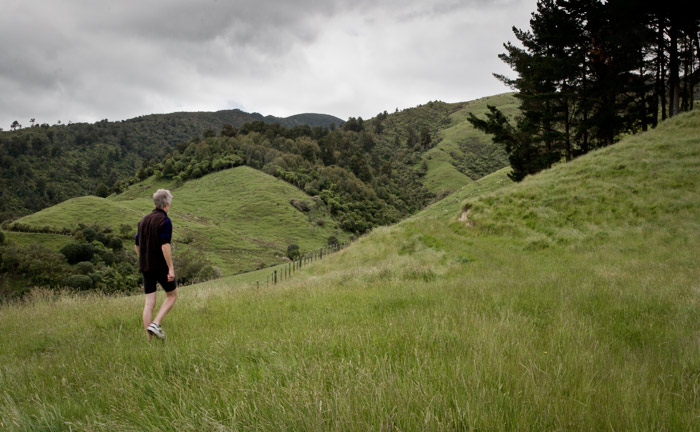
5. The jacket.
6. Robinia leaves and the autumn moon half gone.
7. Evening on the Ngamoko Range.
8. Autumn poplars above Te Awaoteatua Stream.

Photos and words © 2009 Pete McGregor

17 February 2009

Forty percent of real life

Fly, vine, twine

A smell contains worlds.

This morning the kitchen smells of jasmine and sandalwood and lapsang souchong tea, smoke tinged with piney resin, a glimpse of a mountainside in a strange land, in a time alive in a stranger's deep memory. Old, crazy poets drinking alone in cloud forests, laughing at reflections in mountain streams, waiting to follow the fast flight of birds as they disappear around the mountain, beyond those great, mist-wreathed cliffs, on beyond knowledge into oblivion.

Outside, the quiet dawn smells of dry grass with the night still in it. Of deep summer, a promise of heat, a memory of years long gone, an old hare running through long dry grass over an empty skyline; yellowhammers rising from lichen-covered fence posts and slipping sideways on the wind, off towards some small peninsula bay Nor'wester over Godley Headwhere the surge heaves up mats of writhing kelp and smacks against old volcanic rock. Among the boulders on the small beach one finds a washed up float bleached almost white, a scrap of fishing net tangled in dried wrack, a cloud of shore flies rising from the shrivelled corpse of a kahawai. No one lives here and few visit. A sway-backed horse on an empty hill; a line of broken macrocarpas where sheep camp in the dust and cough in the night like old men with ruined lungs; where possums hack and hiss. At night, the gibbous moon shines on the sea and ghosts sleep on the shingle beach.

A smell contains worlds. I step into a pantry, into the smell of apples, and I'm eight again; a woman walks by on a Wellington street and a wisp of perfume wraps around the past and hauls up an ache I thought I'd released years ago.

Yet, for all its power to evoke and recall, it's the forgotten sense. You who read this do so using your vision; a few might listen with the aid of a text-to-speech program. What your computer can't do is deliver the smell of this kitchen or of the ground outside, damp from new rain. Nor, for that matter, can it convey the feel of the keys under my fingers and the humid warmth of that sub-tropical air on my skin ( a strange, complex system of fronts is swamping much of Aotearoa right now). Nor can I share over the Internet the utterly distinctive taste of that slice of watermelon, cold and crisp and sweet.

The number of our senses is disputed, but the traditional five will do for now. Five, and the Internet delivers two. Forty percent of real life? Perhaps. The detail could be disputed, but the point remains — life cannot be lived fully online.

I walk away from the computer, pick up an apple and go outside to sit on the verandah. Jimmy saunters over and brushes against my leg; I run a hand along his fur and it feels warm and soft beneath my palm. He puts his front paws on my knee and when I bend towards him he dabs his nose on mine — a momentary touch, a greeting. He smells of fresh hay. He licks my hand; Blue baler twineI feel the soft, rough tongue rasp my skin. The apple crunches crisp and juicy between my teeth.

I suppose one could argue books suffer the same sensory shortcomings as the Internet — even more, perhaps, because a book (generally speaking) utters no sound. Moreover, many books lack photos or other graphics; the reality those books attempt to convey relies on fewer senses than perhaps any other form of communication. Even vision, the only sense with which they reach out to us, reveals on the face of it a strange, complex pattern of black and white lines and arcs, a geometry from which we somehow make not mere sense, but meaning. How is it then, that the best books convey reality at least as adroitly and often better than media that offer more sensation?

Perhaps books achieve this by forcing us to engage imagination. With no real sensory input we must turn to our own experience, our knowledge of our senses — what it's like to drink lapsang souchong tea on a humid, misty morning or stroke a cat. What an apple tastes like; or a slice of cold watermelon. Show us those things in a photo and we relax, we let vision take over, but if we could do that with a book, “watermelon” and “cat” would be hieroglyphics. Having learned to read, we automatically imagine the melon and the cat; the words instantly invoke our imagination, which responds and creates the objects.

I overstate the case, of course. Exceptions can be found — for example, powerful films rely strongly on vision and sound, and can transport and transform us; and books, no matter how strongly they conjure worlds, are no more real life than is the virtual reality of some regions of the Internet — but here's my challenge. Find a photo you like and try to smell it. Touch it. If you're game and don't mind ruining your monitor, you could even try tasting it. I guarantee none of those sensations will correspond to the smell, feel, or taste of what you see in the photo.

So, just for a while, step away from that screen. Remember this when you're reading that book, and close it (mark the page, though). Then make a cup of tea (real tea with leaves), or stroke the cat (or pat the dog) or step outside, or do the whole damn lot, and pay attention to all your senses.

Particularly the sixty percent you've just been neglecting.

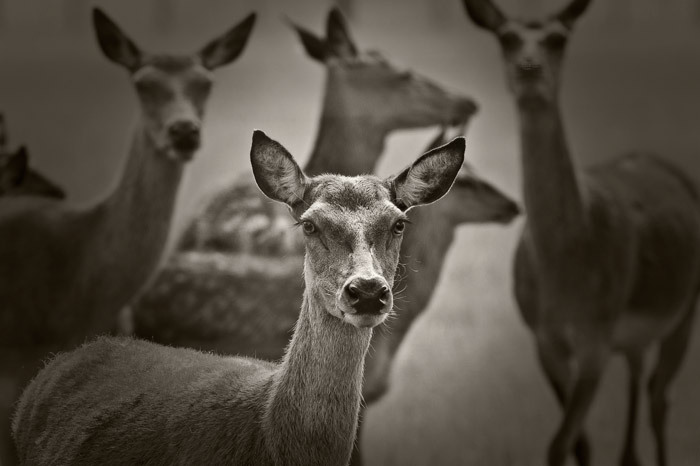
Red deer


Notes:
Writing seems to have been particularly difficult lately. However, I have no intention of giving up.
Photos (click to enlarge them):
1. Vine and twine; textures from a garden fence.
2. Nor'wester over Godley Head, Banks Peninsula, Canterbury. January 2009.
3. More selective vision from the same garden.
4. Deer have poor vision, although they're good at detecting movement. Their hearing, however, is phenomenal, and their sense of smell is beyond comprehension. While walking to mid Pohangina hut on the first day of the whio survey just before last Christmas, I heard something moving in the forest. I stayed perfectly still and waited, knowing the wind was blowing from the sound towards me. A hind stepped out of the bush, browsed slowly past me and wandered off up the track. I paced out the distance. She'd walked within ten metres of me. If the wind had been going the other way, she'd have known I was there if I'd been a kilometre away. [These are captive deer; one of the delights of living here.]

Photos and words © 2009 Pete McGregor

18 December 2008

The man in the corner

Wineglass

In the corner at one of the long tables the man sits, alone, slumped on the plum-coloured plush seating, staring at the remaining inch of beer in his glass. He looks as if he's struggling with something too difficult to accept. He seems undecided whether to burst into laughter or tears. From time to time he heaves his substantial bulk into another position or wipes a large hand over his face, muttering something to himself as he does so. All the while he grins with his eyes screwed up so tight he must be incapable of seeing anything beyond arms reach. Anything beyond the glass, sitting on the table in front of him with just an inch of beer remaining.

Is he trying to squeeze back the tears, or is he simply too drunk to remember to look around. From what, or whom, might he be hiding, there in the corner behind those screwed up lids?

He grunts—something between a yawn and a groan; an utterance as if he's come to a conclusion—and Jam session at the Celticstruggles to his feet, shuffles off towards the gents. Upright, he seems almost amorphous; the way he heaves himself along, awkward and rippling, suggests a trace of sea elephant in his heritage. When he returns he eases down onto the seat, flows outward over the plum plush, and resumes his contemplation of the dregs on the table. The logo on the glass identifies it as Fuller's London Pride.
...

It seems increasingly probable that he's drunk himself to the brink of collapse. But what drove him to that? Was it the long, slow entrapment by alcohol, genes, and the culture of pubs; the harmless habit tightening its grip pint by pint, session by session? Or is this an exception, the result of some trauma, some pain too hard to bear alone, too hard to bear without the solace of inebriation?

“I'm sorry,” she says. “I need more than you can offer. I've met someone...” She doesn't look at him.
“It's this recession,” he says. “We're going backwards.” He shrugs and looks uncomfortable. “I'm sorry. We can't keep you on.”
He answers the door and the policeman asks his name and suggests they go inside. “I'm sorry to have to tell you this,” he says.
“I'm sorry,” the doctor says. “When it's this far advanced there's nothing we can do.”

It's easy to believe he's been crushed by some traumatic event, but perhaps he's simply accepted his life, accepted he'll never be an All Black, never win an Olympic medal or make it big in the movies, never foot it with the high flying currency traders, never be of the slightest interest to paparazzi or reporters from Time or Woman's Weekly. Perhaps he's at ease knowing he'll never earn enough to benefit from the latest tax cuts, and although he'd like kids of his own to love and cherish (he'd be a wonderful dad), he's comfortable Jamming at The Celticknowing that'll never happen. Maybe he's just happy with his life, happy to sit in a corner on his own and enjoy a pint and then another. And then another, as the haze of contentment and goodwill thickens and settles over him. The world is fine, really—all that constant striving just makes a body anxious and highly strung.
...

The barman buzzes around, quick and efficient, clearing the empties. Everything about him seems the antithesis of the man in the corner. The barman is small and agile; he looks strong; he looks like someone who'd take out an opponent before the other guy had even drawn back his fist. Most of all, he seems alert; utterly present, aware of where he is.

But he doesn't look at the man in the corner.
...

The man in the corner might be happy or sad, euphoric or distraught. He might be three sheets under the wind or a couple of cans short of a six pack. Tonight might be a regular part of his life or an aberration. If he's drunk, is it because his genes and habits have trapped him; or is it out of character and he's trying to deal with great and sudden pain; or does he enjoy his life, including these bouts, so much he wants nothing more? Which of these is the worst to believe?
...

He finishes that inch of beer and stands unsteadily. He edges sideways from behind the table, drags his feet towards the door. His pants have slipped halfway down his arse but he catches them in time and hitches them up.

The barman glides around, whisks away the glass now empty of Fullers London Pride. The man in the corner no longer exists.

Monteiths Golden Lager

Notes:
1. The man in the corner does not exist, although he can be found readily enough in pubs (or elsewhere) throughout the world. Often he's the woman in the corner, too.


Photos (click to enlarge them):
1. Wineglass.
2 & 3. Tuesday night jamming at The Celtic. Over on The Ruins of the Moment I've posted another photo from the same session.
4. Here in Aotearoa a 330 ml bottle's called a stubby. This is one — for the record, it's Monteith's Golden Lager.

Photos and words © 2008 Pete McGregor

14 December 2008

Lives on the Line

No. 2 Line, Pohangina Valley

I took the usual route, biking up the valley a short distance before turning off the tarmac onto the rough dirt and gravel of No. 2 Line. A few hundred metres of level ground, then the climb began. Perhaps it was the slight tailwind, or perhaps the crackers and tomato had fueled me better than I'd expected, or perhaps I'd just struck a good day, physically and mentally; whatever the reason, the result was a quick ride up the steep, winding road in a gear at least one cog higher than usual. At the top I circled a few times; the usual slow, tight circles; time to let the burn in my legs begin to subside; time to gaze out over the valley, up towards the Oroua headwaters, out northwest to where hard hill country receded into the distance under heavy grey cloud. Somewhere out there, Ruapehu slept under that dense blanket. One day he'll awaken fully and remind us of our true powerlessness View down No. 2 Line, Pohangina Valleyand insignificance. Or, maybe Taupo will wake first, and if that eruption proves anything like that of 1800 years ago — one of the largest in recorded history — let alone like the Oruanui eruption which, 26,500 years ago, spewed out 300 cubic kilometres of ignimbrite and 500 cubic kilometres of pumice and ash, ...well, no one anywhere near here will survive to reflect on his powerlessness and insignificance.

I sped back down the road, taking the corners carefully. Too much loose gravel on hard-packed dirt; too much chance of being ripped to bits in a spill. Blood and skin and pain, and maybe a broken bone or two. Maybe worse. I lost a wonderful friend in a bike crash a few years ago, and now find the fierce joy of careening down these rough roads tempered by the memory of his accident. I honour him in three ways: by remembering him, by delighting in the biking, and by staying alive. I think he'd appreciate all of those.
But where the road's straight or the corners gentle, it's hard to resist that thrill, that urge to cut loose, especially when it's been earned not by pumping fossil fuel into an engine's tank, but by the hard work of muscles and lungs,View up No. 2 Line, Pohangina Valley blood and willpower. I leaned slightly into a gradual corner, straightened as the road dipped, and readied myself to start pedalling again when the road rose once more.

And something ran out from the roadside grass and across the road in front of me. An instant of astonishment, then I recognised it.

A stoat.

I could have run it over. It seemed curiously slow, although its legs were working furiously. I saw the black-tipped tail, the cream-coloured belly.

I heard it, clearly, distinctly, a high-pitched chittering as if the small beast was swearing at me, telling me to eff off, to mind where I was going. I heard it and understood the message as I sped past and it vanished into the grass on the other side of the road.

I could have run it over. Perhaps I should have, but I'm glad I didn't. I veered slightly and shot past it. I couldn't crush something so wild, so fierce, so alive.

I biked on, buzzing with adrenaline and delight, realising I'd called out as the stoat disappeared behind me. I should have exclaimed something profound or enlightened, but all I'd uttered was an inane, although vehement, “Ah! Fantastic!”

But the words didn't matter. What mattered was the encounter, a moment when nothing mattered but that moment, when being alive was more important than anything. What mattered was that one intense, small, electric life, disappearing into the long grass and swearing at me as it ran.

Beyond the roadend, No. 2 Line

Notes:
1. For anyone wondering why running over the stoat might have been a good idea, I added a few notes (with links) to a post I wrote a few years ago. That post includes several photos of a wild stoat.
Photos (click to enlarge them):
1 & 3. Looking up No. 2 Line; about three quarters of the way to the road end.
2. The view down the road from the same spot. Loggers had been working there for the last week or so.
4. Beyond the road end, No. 2 Line. A poled route leads a short distance over farmland to the edge of the Ruahine Forest Park, and to the "Ashurst boulder" (300 Kb pdf) — actually about 20 km from Ashhurst (it has two "h"s); it's a group of boulders with a few reasonable problems.

Photos and words © 2008 Pete McGregor

27 November 2008

The migrants

Jesse at Foxton
A cold wind sweeps the Manawatu estuary, bringing a few light spots of rain from the overcast sky. The tide rises visibly, creeping across the mud flats, beginning to encircle the flock of bar-tailed godwits. A handful of birds lifts into the air, then more join them, then all but a few stragglers take to the wing and fly towards their high tide roost on the beach on the far side of the flats. As they recede into the grey distance the individuals disappear into the collective movement of wingbeats and the arc of flight; the cloud and the flock begin to merge.
Jesse Conklin looks up from the spotting scope. He seems thoughtful, slightly pensive, somewhere in the nebulous region between puzzled and concerned.

“A lot of birds are missing,” he says.

He's counted 178 birds, but last week more than 200 had occupied the estuary. The usual places small groups or stragglers might be hiding are devoid of birds. Jesse should know where to look—barring midwinter, he's here every week; he was waiting when the first godwits arrived in spring after their astonishing 11,500 km non-stopJesse inspects the godwits flight from Alaska; he watched them all last summer until the last birds rose into the air and headed north-west to a stop-over on the shores of the Yellow Sea and eventually on to their breeding grounds back in Alaska.

The spring flight from Alaska to New Zealand is the longest recorded non-stop flight of any bird. The flight takes about nine days; not bad for a bird that averages about the weight of a can of beer (roughly 350 g). Elite human athletes can maintain an equivalent effort for only about one hour; you or I might manage 10–15 minutes before collapsing. The birds do have a singular advantage, though. Shortly before they take to the air their digestive system begins to shrivel—anything not essential for the flight atrophies; every gram might make the difference between a safe arrival and death.

Why do they do it? At first the answer seems obvious—during winter, Alaska's locked under ice and snow. Stay late and if the cold doesn't kill you starvation will. But why not fly to the Tropics? Why fly to the other end of the Earth—New Zealand?

Jesse shrugs.

“Good question,” he says. “We have a few theories, but we don't know for sure. The Tropics are dangerous places — lots of predators, parasites, diseases, and competition. It might simply be safer, despite the effort, for them to fly all the way here. Or, their adaptations for the Arctic cold might make it too difficult for them to survive tropical heat.”

It's the usual story. The more we learn, the more questions the knowledge raises. For example, bands on the birds' legs showed individuals returned to the same place each year.

“We now know they have very high site fidelity,” Jesse says. “Manawatu estuary birds return to the Manawatu estuary; Miranda birds return to Miranda, and so on. But we don't know if there's a genetic component. We don't knowBlackbacked gull, Pencarrow head if the offspring of Miranda birds migrate to Miranda, for example, or whether they choose somewhere else—and if they do choose somewhere else, why, and how?”

A group of godwits appears from somewhere and circles the roosting flock before settling down with them. Jesse turns back to the spotting scope and resumes counting, the clicking of the mechanical counter sounding like another kind of bird. There's no shortage of those, either. Red knots mingle with the godwits; a few of the ubiquitous black-backed and red-billed gulls fly overhead, the larger black-backs spreading a flutter of agitation through the godwit flock. White-fronted and Caspian terns cluster near the water's edge, the big, powerfully built caspians looking like rugby players among a group of dancers. A spoonbill flies upriver and skylarks hang, fluttering and singing above the marram and lupins from where a pheasant calls repeatedly. A kahu cruises on the far side of the river where tight, gnarled, wind-shorn trees rise beyond a patchwork of mud flats and rushes.

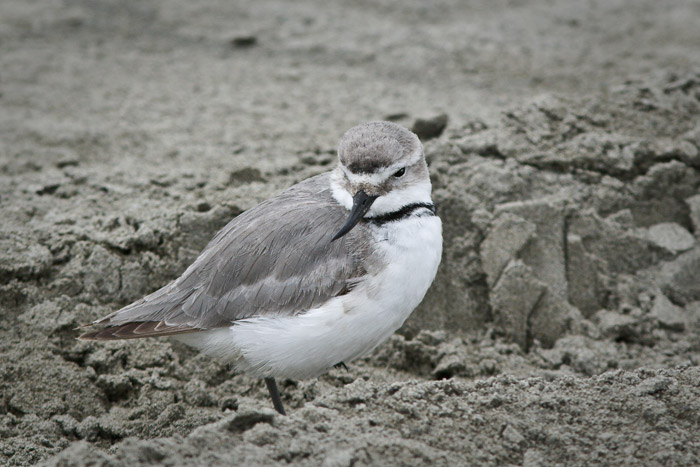
The rarest bird here is also the least conspicuous. Five thrush-sized wrybills rest in the shelter of a vehicle track in the sand, each bird resting on one leg, each with its unique, sideways-curved bill tucked under a wing. Soon they'll migrate back to the South Island. A few non-breeding birds remain in the North Island, but most return to the wide, braided Canterbury and Otago riverbeds to breed. New Zealand's—and therefore the world's—entire population totals just 4–5000 birds. But Canterbury farmers are clamouring for more water for dairying and to irrigate crops which, as droughts become more frequent and more severe, are harder to grow. Expanded irrigation schemes might keep these types of agriculture viable for a while longer, giving farmers the chance to find forms better suited to the changing climate, but not all farmers are willing or able to adapt, preferring to demand still more water from the rivers—the only home the wrybills have to rear their young.

Right here, though, there's no shortage of water. The tide nears its peak; the sea fights the relentless flow of the evil olive-brown Manawatu with its shameful load of agricultural run-off and effluent dumped daily from the Fonterra factory not far upstream. This is not water one would swim in, let alone drink. What impact does it have on the birds and other wildlife living in and on the estuary? Sometimes one prefers not to know, but the thought arises: what we do here affects birds that spend half their lives in Alaska; our choices in Aotearoa directly influence the Alaskan environment.

...

How do the godwits know when to leave? Timing is especially crucial on the return journey from New Zealand to Alaska—leave too soon and the breeding grounds might still be covered in snow; too late and other godwits might have taken the best sites.

Researchers noticed that some male birds left early, still largely in their pale, non-breeding plumage, while others left later but with more developed, redder breeding plumage. Which birds might be more successful—those leaving early and claiming the best breeding sites, or those leaving later and arriving later but with more attractive plumage? And what about birds that leave early but take a break in Asia, eventually arriving in Alaska in similar breeding condition to the late-leaving birds?

“It gets even more complicated,” Jesse says. “Birds in southwest Alaska can start breeding up to 3–4 weeks earlier than those on the North Slope, which thaws later. Birds heading for the northern sites have to wait an extra monthWhite-fronted tern with fish for their breeding grounds to thaw, so why not go later and grow more breeding plumage? In other words, the late-leaving, redder males may simply be northern breeders.”

Although he's still a month short of one full year of collecting data, Jesse already has some insights into these and other questions. He's confirmed that male birds do vary greatly in the state of their breeding plumage at the time they depart. More information comes from tiny dataloggers fitted to some birds; these record changing daylight levels, and from the estimated times of sunrise and sunset, latitude and longitude can be estimated to within roughly 150 km—accurate enough to determine how long a bird stayed at the Yellow Sea feeding grounds, and roughly where it settles to breed. As the data accumulate, he might finally be able to say whether or not the late-departing, redder birds do indeed breed further north.

...

In the pub a few days later, Jesse grins.

“Saturday was one of the best days ever for recording data,” he says. “When the flock took off I got photos showing full wingtips in 31 colour-banded birds.”

Photography, as well as other recent technological developments like the miniscule dataloggers, is vital for Jesse's study. Beautiful photos aren't his aim (although he has plenty of those)—it's the information in the photos that's important. Wingtips let him gauge the stage of the bird's moult, but shots in flight are seldom useful because the legs are tucked up so the bands are hidden and the individual can't be identified. It's that moment Godwits & red knots flyingwhere they're stretching their wings to take flight, or lowering their legs to land—when leg bands and wingtips are visible in the same photo—that delivers the data. Given the total number of colour-banded godwits on the estuary is about 55–60, his high spirits are understandable. Information on half the birds in just one session seems worth celebrating.

Photos record that crucial information about the degree of development of breeding plumage. He can also score the condition of the bird from a side-on photo by comparing the area of the bird's body to the length of the lower leg (the tarsus); the length of the tarsus doesn't change, and it's known from measurements taken when the bird was banded. This lets Jesse determine the bird's condition when it leaves New Zealand — in other words, how well prepared it is for its migration. Between January and mid March, they'll add 60–70% to their body weight.

“A study like this wouldn't have been possible even a few years ago,” he says. “The recent advances in digital photography let me shoot hundreds of photos and extract the information from them in a way that just wouldn't have been feasible with film. The cost would have been prohibitive.”

...

A man and a woman with two small children come over to ask about the spotting scope and the birds. The small boy offers treasure in his hand — a small, dead crab. Places like this, with animals that fly and scuttle and burrow and swim; with the excitement of what might be under that driftwood log, still fascinate most children despite the temptations of TV and CGI. Maybe one day that small boy will carry on Jesse's work, helping us understand more about the astoundingly complex and beautiful world we share with these other lives—and on which we depend.

The man asks how many godwits live on the estuary.

“Do you know them by name?” he asks, in jest.

“I can identify most of them individually,”Jesse replies, and the man laughs and shakes his head. The couple and their children wander off, and Jesse returns to his counting. He looks up.

“That's it,” he says. “They're all here.”
Wrybill at Foxton

Acknowledgements:I'm grateful to Jesse for most of the information and for taking the time to check over a draft of the post; and to Anne-Marie for guidance on the style. Any errors of fact, misrepresentations, typos, and failures of style are inadvertent and mine alone.

Notes:
1. Four subspecies of bar-tailed godwit (kuaka, Limosa lapponica) are now recognised, with the subspecies baueri migrating to New Zealand.
2. Other birds mentioned: Red knots (Calidrus canutus); black-backed gull (Larus dominicanus);
red-billed gull (tarapunga; Larus novaehollandiae); white-fronted tern (tara; Sterna striata); Caspian tern (taranui; Sterna caspia); spoonbill (Platalea regia); skylark (Alauda arvensis); pheasant (Phasianus colchicus); kahu (Australasian harrier, Circus approximans); wrybill (Anarhynchus frontalis).
Photos (click the smaller photos to enlarge them):
1, 2. Jesse at work on the Manawatu estuary near Foxton, Manawatu, New Zealand (all photos from the Manawatu estuary are dated
15 November 2008).
3. Black-backed gull near Pencarrow Head, eastern shore of Wellington harbour.
4. Lupins and some other unidentified flowering plant among the marram, Manawatu estuary.
5. White-fronted tern with fish, Waipapa Point, Southland, New Zealand.
6. Godwits and red knots in flight, Manawatu estuary.
7. Wrybill, Manawatu estuary.

Photos and words © 2008 Pete McGregor

09 November 2008

Ngamoko hut

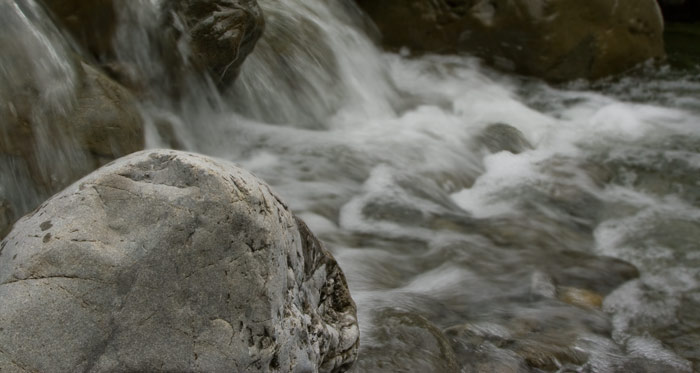
A small waterfall below Ngamoko hut

As the light fades, the sound of the wind mingles with the rush of the rapids, the soft rattle of toetoe, the creak of an old dead branch somewhere up the track behind the hut. Overhead scraps of cloud tinged with pink race across the sky from West to East and a little later the first star appears. Then another, and soon they're everywhere, revealed then hidden then revealed again as the ragged clouds speed past. A wild night, and you're alone there, far from reminders of the 21st century, far from wars and elections and grasping consumerism, far from Das Man and the mindless mediocrity of pop culture; you could be the last human alive on the planet.
Then a whio whistles, right in front of you, from the big pool.
...
It's a long walk by any route to Ngamoko. Most visitors come down the Pohangina from Leon Kinvig hut. Just a few hours of wading and boulder-hopping; in summer maybe a couple of pack-floats Gorge in the Pohangina between Leon Kinvig and Ngamokothrough the deepest pools if you're that way inclined. But you have to get to Kinvig first.
From the other direction it's a couple of hours or so up the river from mid Pohangina hut, which is in turn 3–4 hours or more from the road. A few keen souls come from the Hawkes Bay via Apiti Saddle and occasionally someone crosses over from Piripiri Stream, as I once did, years ago.
The other main route—my preferred one if the weather permits—is over the Ngamoko Range from Limestone Road. Up Shorts Track, South along the tops, then the steep drop down the track to the hut, first through dense, thigh-deep snowgrass and leatherwood with enough speargrass to keep you alert, then into the kaikawaka and finally down through gnarled beech. You might startle a deer here, and it's always worth listening for the high- frequency tzeep of a titipounamu [1], our smallest bird (but not our least feisty). If you're reasonably fit, this route should take only 4–6 hours, but when the weather's foul—which it often is, up there on the open tops—you need to know how to look after yourself and how to navigate accurately when you can see only a hundred metres or so. It's harder than it sounds.
In short, the only easy way in is by helicopter.[2]
The rewards are worth it, though. Mostly, I think it's that sense of remoteness, of solitude; just the wind and the river, the purr of the stove as water heats in the billy, maybe a miromiro [3] or a small flock of popokatea [4] gleaning insects Ngamoko hut, Pohangina Riverin the tangle of shrubbery behind the hut. The smell of cold ash and woodsmoke, sunwarmed wood, and damp socks. When the water boils you make a brew and take it outside onto the little verandah where you hang your socks to dry slowly in the afternoon sun and wind. You sit with your back to the wall, legs stretched out in the sun, and you sip your tea, eat a few fly cemeteries [5] and read the hut book, wondering how many names you'll recognise. You find your own written there, just a few pages separating the entries spanning several years. Other than a few recent visitors, no one's been here since early April. All winter—half the year—Ngamoko has remained silent, the door unopened, the fire unlit, the patient spiders undisturbed. Over summer you might find someone else here on a weekend, but come during the week or at any time over winter and you're almost certain to have the place to yourself. It's a good feeling.
You see other names you know. Robb, who had to abort his exit over the tops because of vile weather—a good call. RHS, who seems to be in all the Ruahine hut books, regularly in some. I've never met RHS in person, but hope to one day. Pohangina river below Ngamoko hutThe inimitable Mr Gates, keeper of arcane knowledge of secret tracks and hidden huts and gear caches, provider of gourmet surprises like avocado, pistachios, and goose shit.[6] The DOC guys from the Pohangina Field Centre.
You tip back the last of the tea and go inside because your bum's numb from sitting on the wooden decking and besides, the sun's gone from the verandah so you're getting cold. It's warm inside the hut, though.
As you cut up a bier stick for the couscous you think about what this hut represents. Huts like Ngamoko are more than just shelter, more than just stage markers on a journey. They represent histories—personal histories, collective histories, cultural histories. Personal because you, the person standing at the bench cutting up salami and keeping an eye on the billy, have created a history here; your successive visits become part of the hut's history and the hut has become part of yours. You form a connection; the hut comes alive in your thoughts even when you're far away, part of that other world. You wonder whether the hut and its place might reciprocate; whether it might remember you in some strange, non-human way. Rational, western thought would sneer at the idea, but other cultures would be less quick to scoff. Moreover, it was rational, western thought that led Berkeley to argue that things exist only insofar as they're perceived [7], and, weird as that idea seems, rational western thought has not only failed to show it's wrong but now seems to support it.[8]
Collective because these huts appear in the histories of tramping clubs (you note the PNTMC [9] trip here not long ago); of the mid twentieth century deer cullers (for whom many of the huts were erected) and their successors, the DOC workers who maintain the huts and tracks; of the parties from the NZDA [10]; of schools who organise class trips to places like Daphne; the list goes on. Looking down the Pohangina from below Ngamoko hutIndividuals come and go, but these organisations have a kind of collective consciousness in which a hut like Ngamoko (where you now peer out the grimy window at the wind-whipped forest) maintains a presence, an identity.
And cultural because Ngamoko, like other mountain huts, has a literature and art of its own; it appears in magazine articles, newsletters, photos, and in less public form, emails, private letters, journals, conversations, perhaps some works of art; it appears as prose and poems—of diverse quality—and images. And, of course, Ngamoko has its collection of hut books which, although the literary quality might be disputed, make fascinating reading and are cultural artefacts every bit as important as old bones and well-groomed historic buildings in cities.
You spoon out the couscous onto an old, battered, aluminium frying pan that belonged to your father, the same pan he used on trips into the hills before you were born, and as you eat, another thought comes. Yes, Ngamoko occupies a cultural space most strongly in the histories of the trampers, hunters, and others who've been here, but it also belongs in the cultures of people who have never visited it and almost certainly never will. (You who read this now, many of you on the other side of the world, I think of you now.)
As long as Ngamoko hut remains, its contribution to this diffuse and diverse cultural space continues to grow; if the hut is destroyed, the space it occupies Whio and chicks in the Waikamaka Riverwithin these cultures is diminished [11] although if the hut is replaced, that space will continue to grow. The old hut at Ruahine Corner has been replaced by a more modern version, many of the Ruahine huts have been relined and their fireplaces replaced with woodburning cookers. But Ruahine Corner is still Ruahine Corner; the revamped huts retain their names and their histories grow. The axe with the handle replaced three times and head twice is still the same axe; Varanasi, occupied for 3000 years or more, is still Varanasi; Moscow, burned to the ground in one conflagration or many over the last 800 years or so, is still Moscow. Ngamoko hut, despite the addition of the verandah, its new cooker, and its relined walls, is still Ngamoko hut. The building changes and its cultural space expands.
...
You take the billy, the old frying pan/plate, and your utensils down to the river and wash them with coarse sand and rushing, icy water. Already the light's faded enough to send the sandflies [12] to roost, letting you linger. You look up at the sky, the first star, theSwift water not far upstream from Ngamoko hut clouds racing. It's cold but you're well rugged up and the hut's just up there on the little terrace, out of sight in its clearing, and it'll still have the day's warmth in it when you return. You linger, not yet ready to leave behind the brisk cold.
Huts like these should be valued not according to the number of visitors per year, but on what they mean—to individuals, organisations, cultures. The value of Chomolungma [13] (other than its intrinsic value) resides not in the number of people who attempt to climb it, but because, to greater or lesser degrees, it's part of the history of everyone who's ever heard of it (meaning almost everyone on earth) and occupies a cultural space far greater than that of any other mountain. The same can be said about many of the world's great wilderness areas—Antarctica, the Amazon, the Siberian taiga, and others. Ngamoko hut may not be in the same league as Chomolungma or the Amazon, but the principle's the same. Some of us have personal histories that include Ngamoko; it in turn incorporates us into its history; individually and collectively we provide the cultural space within which Ngamoko exists, and we are the richer for it.
...
You think about these things as you linger in the cold by the river, under the stars and the racing clouds.
Then a whio whistles, right in front of you, in the big pool.

Whio at Ngamoko hut

Notes:
1.
The rifleman, Acanthisitta chloris. 
2. An option taken up each autumn by at least one party of hunters. It's why I stay out of the hills during the roar (the rutting season for red deer).
3.
The tomtit, Petroica macrocephala.
4.The whitehead, Mohoua albicilla.
5.The colloquial term for Griffin's Golden Fruits, which look like badly disguised patties of squashed housefly but taste very much better (I imagine).
6. His name for grainy mustard. 
7. Flage, D. E. 2006. George Berkeley (1685–1753). Internet Encyclopedia of Philosophy.
8. Brooks, M. 2007. Reality check.
New Scientist 2609: 30–33. (23 June 2007). [“To track down a theory of everything, we might have to accept that the universe only exists when we're looking at it”].

9. The Palmerston North Tramping and Mountaineering Club

10. The New Zealand Deerstalkers' Association.

11. However, the cultural space occupied by a mountain hut could only be destroyed completely if all records, traces and memories—conscious or not—of the hut were also to be destroyed irretrievably: a process unlikely to be completed within even a few human generations. Nevertheless, even the diminishing of such a cultural space seems poignant at best, tragic at worst.

12. In Aotearoa we call them sandflies, but elsewhere they're better known as blackflies—Simuliidae.

13. More widely known internationally as Everest. Chomolungma is the Tibetan name; in Nepali it's Sagarmatha.


Photos (click to enlarge them):
1. A low waterfall — more like a natural weir, in fact — in the Pohangina directly below Ngamoko hut.
2. The small gorge in the Pohangina between Leon Kinvig and Ngamoko. If you're game, you can pack-float it; otherwise, an overgrown track climbs steeply through the bush on the true left before descending just as steeply to the riverbed, the exact spot of the photograph.
3. Ngamoko hut, November 2007.
4. River detail below Ngamoko hut.
5. The Pohangina river looking downstream from below Ngamoko hut.
6. Whio and chicks in the Waikamaka river about 20 minutes downstream from Wakelings hut; December 2007.
7. Swift water on a brilliant March day in the Pohangina, not far upstream from Ngamoko hut.
8. Whio in the big pool directly below Ngamoko hut, March 2008.

Photos and words © 2008 Pete McGregor

27 October 2008

A new (photo)blog

I've created a new blog to present some photos in a better format. If you're interested, check out:


...and feel free to comment on the photos. To see the site at its best, press the F11 key — this maximises the window and hides much of the junk at the top of the screen, like the menu bar. Just press F11 again to reveal the hidden junk and restore the window to its former size. The photos are 1024 pixels wide or 750 pixels high, so you're out of luck if your screen's smaller.

Depending on the size of your monitor, you might need to scroll down to get the "Previous photo"/"Next photo" links, and the link to the comments.


A suggestion: before you click on the comments link, consider whether you've thought enough about the photo. Some responses offer intriguing and thoughtful insights, but they'll inevitably influence your own thoughts and feelings, and sometimes you might prefer to ruminate on your own awhile. (Do come back and share the results, though!)

My intention is to post a new photo roughly once per day. In general, I'll avoid posting photos that appear here on PohanginaPete — The Ruins of the Moment is intended to supplement (or complement) PohanginaPete, not replace it.

"But perhaps this is how this moment should be remembered. A sharp, clear, well-lit photo would create its own memory, a fragment which in time would replace the actual memory of the moment. Perhaps this is the way with all photos. And perhaps it's also the way with all memories—that they're fragmentary: memories are the ruins of the moment."

© 2008 Pete McGregor