17 June 2008

Nepal: towards Annapurna (Part II)

Cloud forest near Doban

If the Himalaya hotel is, in a sense, abandoned, it will be only for a matter of hours. On the way down we meet several trekkers coming up the the trail. One asks whether we've been to ABC. No, I tell him, bad weather, too much snow, too dangerous because of the avalanches.
“F**k!” he says. A New Zealand accent [1].
We chat briefly, then Kamal and I continue hurrying on down, passing all the trekkers we recognise—the Korean woman with the great, cheerful sense of humour; the young Korean couple; the woman from the US and her guide; the two young Japanese men from Kyoto—and others who must have stayed elsewhere at Himalaya or lower down in Doban or Bamboo. At Sinuwa where we stop for lunch, a French woman and man arrive. I remember meeting them somewhere but can't recall where, and although I don't know it now, I'll meet them again later in Pokhara. They, too, stop for lunch. They're on their way up to Himalaya; they're good company, as is the little boy who lives here. He's about two years old, I'd guess. I'd photographed him the previous day as he practised breaking rocks with a hammer, but today, with the rain falling outside, he collects the squabs from the bench seating, piles them in one corner, climbs on top, and takes great delight in deliberately falling off. If he grows up to be a mountain guide, I don't think I'll hire him.

The rain, which has become heavy and persistent after we left Bamboo, eases as we finish lunch, and we Rufous sibia at Chhomronghaven't been gone long before I can fold my umbrella. It's worked far more effectively than a parka, but even so, because we're moving fast and the sun comes out for the last section, I arrive at Chhomrong substantially damp from sweat.

In the evening I chat with Zack, a thoughtful, quietly spoken young man from the US Virgin Islands. He and his guide plan to go to Doban the next day and eventually on to ABC. The prospects for getting even as far as Macchapuchare Base Camp appear slight, but Zack's philosophical. As far as possible, he says, he'll be trying to enjoy whatever happens. Just focusing on where he is; appreciating the present. We sit outside while the weather tries to decide what it'll do, and we talk about many things, finding we share similar attitudes to almost everything we discuss, from photography to Buddhism, and tourism to the weirdness of subatomic physics. Conversations like this, and meeting people like Zack, I think, are among the delights of travelling.

Wednesday 14 March 2007
Today will take us from Chhomrong to Tadapani [2]. I've slept, warm and undisturbed, although I woke often. But the waking merely gave me the opportunity to enjoy the knowledge I was warm and undisturbed, and I knew the walk from Chhomrong to Tadapani wouldn't be a big day, so we didn't need an early start. Even the sound of rain on the roof hadn't worried me.

At breakfast the woman from the US joins Zack and me in the dining room. She seems more communicative than she'd been here and at Himalaya. I ask where she's been on her trek.
“Jonsom,” she says.
I ask if she'd flown there to start the trek.
“Oh yeah,” she says. Apparently it's one of the most amazing things she's ever done. “We flew really close to the mountains. My dad's a pilot and he'd have loved it.”
She and her Brahmin guide are walking out today, returning to Pokhara. Zack and his guide are leaving for Doban; Kamal and I heading for Tadapani. The only other trekkers at the guest house are a Korean couple, but I don't know where, or even in which direction, they're going. I say goodbye to Zack and we set off soon after.

“Pani”, in “Tadapani” means water. It's the same word in India.

Here in the dining hall at Tadapani it's warm and noisy, with the largest contingent of trekkers I've encountered in one place so far. Kamal and I have arrived early in the afternoon before the crowds; after showering I settle down in the dining hall to write. A man from Holland reads a book in English about Putin's Russia. Four other trekkers settle in at the other Ridge to Annapurna Southend of the table, three from Britain, the other apparently of mixed European/American origin. He and one of the Englishmen are experienced travellers. The Englishman tries to bargain with the woman manager over the price of a pot of tea, and then points out with some amusement that the menu clearly states, “Please do not bargain.”

Late in the afternoon rain arrives, then a brief shower of hail. The cloud begins to break. Annapurna South gleams, glimpsed through gaps; then it comes more into view behind ragged wisps of cloud. The mountain shines, immense in the evening light, draped with its khata [3] of cloud, framed above by a patchy blue sky and fluttering prayer flags, below by rhododendron forest, a rusted corrugated iron roof, and a faintly smoking chimney. I stay outside in the cold, photographing, changing lenses, watching the changing light, seeing Macchapuchare finally come into view. A long way downriver, over the lower country, brilliant white thundercloud rises in a black sky. Evening develops, and the sky and clouds in the distance begin to take on colour, a faint tinge of orange washing the big mountains around the Sanctuary. As the last sunlight slips up and away, leaving Tadapani in fading light and encroaching cold, I return to the dining hall to try to warm up.

I talk with the young Dutch guy who's been reading the book about Putin. Several other conversations occupy the table—at the far end, a middle aged, long haired man from Holland chats with the older couple from Kenya; a British couple at my end of the table talk with each other, and the experienced travellers talk with their friends and advise another young Englishman about his travels.
“You've got to go to Laos,” one experienced traveller says, and begins listing other places the young man has to go.
The other Englishman wants to know how big the pizzas are. The woman taking his order thinks for a moment.
“Enough for one person,” she says.

After my dahl baht I order a cup of hot chocolate, then return to my room. I sleep comfortably but fitfully, with strange dreams, and wake to a clear sky.

Thursday 15 March 2007
We arrive at Ghorapani soon after 11 a.m., having left Tadapani at 7:30. The plan had been to stop for lunch along the way, but we've made good time. Evening over the Kali Gandaki valleyIt's comfortable here; the room's warm, with big windows looking out over the valley. Earlier I could look down to the Kali Gandaki Valley, the gradually fading slopes leading eventually to Dhaulagiri; on in the direction of Jonsom, and Mustang. Mustang, The Forbidden Kingdom. Now, a heavy snow shower begins to ease and the slopes on the far side of the valley reappear, tentatively, as if shy. Here and there, a patch of weak sunlight. A wonderful sense of height and distance, yet here the mountainsides are less steep than some parts of the Ruahine Range—higher, of course, but no more fierce and perhaps less wild. Certainly less remote, because I'm in what amounts to a small town—there's even a police checkpost, as I discovered when I wandered around earlier and came upon the sign and a group of men in their grey and slate-blue camouflage-patterned uniforms.

Three crows glide across an ominous sky, tilting and soaring, banking to turn down towards the rhododendron forest. A fourth crow sweeps in to join them. The dark birds seem like products of the weather, the sky, the immense landscape, rather than separate beings.

The gleam of battered, wet, corrugated iron; the texture of ancient, weathered wood; a pile of angular, broken rocks which might be the remains of a shed or its potential. Everyone seems to hope for clear weather.
“In the morning, maybe it will be clear.”
I try to explain that this weather's great for photographs but they just nod and say nothing. To attempt to explain how a glimpse of a mountain beyond wild cloud might reveal the mountain better than an unimpeded view under a clear sky would be even more futile.
“In the morning, maybe it will be clear, and we will see the mountains.”

But I see them now.

The stove in the middle of the massive dining room throws out enough heat to keep me comfortable even though I'm sitting right next to the window. Kamal understands the implications.
“Ghorapani has many guest houses,” he says. “They have these,” he says, gesturing at the stove. “They use a lot of wood.”
At Tadapani the heating in the dining hall comprised pans of glowing coals placed under the big table, with blankets suspended from the edges of the table. Effective, and far more efficient than here, but still contributing to deforestation. At Chhomrong and Himalaya, the same under-the-table system used a kerosene cooker.

Snow begins to fall again, gradually getting heavier. A crow sits in the naked branches of a small tree about 10 metres away, then drops like a springboard diver. Two white fowls climb a line of stone steps, the snow falling on hens, stone, a blue tarpaulin.

So much depends upon
a blue tarpaulin glazed with snow
beside the white chickens
[4]


Friday 16 March 2007
Up at 5 a.m., we're on the way to Poon Hill about a quarter of an hour later. Kamal and I walk steadily, passing almost everyone as we ascend, to arrive as the sky begins to colour in the East. A steady stream of people arrives; scraps of cloud around Macchapuchare turn orange. The cloud over Dhaulagiri turns salmon-pink, then the summit of that great mountain turns the same orange-pink and everything—the early Beasts of burden, Ghorapanirise, the knifing, bitterly cold wind, the lack of solitude as people everywhere mill around photographing each other and the sunrise and the mountains—becomes worthwhile. My fingers, exposed by my old, tattered, well-worn, fingerless gloves, begin to turn numb; my face pinches with cold; my nose starts to drip. When the dawn colour fades into the flat light of morning I call it quits and we descend for breakfast.

Then the long walk from Ghorapani to Naya Pul; about 6 hours, give or take half an hour, and including generous stops for lunch and tea. The middle section comprises a long descent, down stone steps that seem never-ending, and I feel a hot spot developing on my left big toe. I've been lucky with the boots, but when we stop for lunch I change back into the running shoes I wore for the first 3 days, apologising to Kamal as I do so, because the boots will weigh his pack down. He grins and seems not to mind. I guess it's a light pack anyway—I've carried all my camera equipment and a few odds and ends, so even with his astonishingly light and small bag added, his load's hardly heavier than my own.

On the descent, a lammergeier soars past, low and close, the best view I've had of these gorgeous birds, huge and powerful. I point it out to Kamal.

“It is looking for chicken,” he says.

Two strong young German men stride past as I'm enjoying lunch, and soon after, a tall, dark haired young woman walks past. I say hello; she replies, then asks if I've seen 2 men go past.
“German guys?”
“Yes!” she says, and sets off after them.
I meet her again at Naya Pul, with the slower of the 2 men. All 3, with 2 guides/porters have just completed the Annapurna Circuit. I'd met the men at Ghorapani yesterday afternoon and laughed with them as they told me how they were running out of money.
“We've spent 40,000 rupees on beer!” one of them said gleefully.
No wonder they were running out of money. They'd claimed to have been still hungover from the previous night, but their wonderful enthusiasm and cheerfulness impressed me nevertheless.

At Naya Pul I negotiate a taxi down to 700 rupees for the 40 km trip back to Pokhara—a much better deal than the 500 I'd paid to get us to Phedi. Our journey among mountains draws to a close; I realise how, the closer we'd got to Naya Pul the more reserved the local people had seemed—slower to smile, more reticent, less willing to let me catch an eye. Commercialism more overt; more stalls lining the path. Perhaps I've been expecting this. At Ghorapani yesterday evening I'd felt strangely low. Quiet, reserved, lacking the energy to be sociable, although Chooks at GhorapaniI'd sat around the woodstove with the other trekkers and guides. The feeling wasn't bad, just enough to be noticeable. I remembered Matthiessen's depression towards the end of his journey. He'd attributed it, possibly, to the descent to lower altitudes, but perhaps for him, and for me also, the primary cause might have been the realisation that time among mountains was coming to an end. For me, Ghorapani, although ostensibly still a mountain environment, was like a return to so-called civilisation, with shops and street vendors trying to sell woven belts and hats and necklaces and miniature prayer wheels and other tourist paraphernalia. You could even phone home from Ghorapani. Yet, if I'd bought up large, if I'd spent freely on material things I didn't want, perhaps I'd have been a far better tourist; I'd have contributed more to the economy. This is one of the paradoxes of travelling in places like this—those for whom the larger environment means most—and “stuff” means least—are those who are least suited to supporting those who live there. When it comes to supporting local lives, stuff and the buying of it is more important than empathy for the place and its people.

...

Strange dreams. I'm entrusted with 2 gorgeous kittens; in another I'm hugged hard by a small woman I seem to have known but can't recognise. There's joy in these dreams. But in another, I'm responsible for a shed full of fowls and I've neglected them; they're dying of starvation, thirst, and disease. A vivid image of one bird breathing heavily and laboriously through a grotesquely swollen face; a bird struggling to live just a little longer. Birds dying—yet in the midst of this suffering, for which I alone am completely responsible, eggs are hatching, chicks are born into this world where there is nothing to eat, no water to drink, and where they will soon die among the squalid straw and dung and diseased corpses of other fowls. The cruelty of my neglect appalls and horrifies me.

I realise I've had this dream before, several times. What does it mean?

What, or who, am I neglecting?

..o0o..

Annapurna South from Tadapani


Notes:
1. I met him twice later—in Kathmandu, and at Kathmandu airport on the return to Delhi.
2. Tadapani is pronounced “Tarapani”.
3. Khata are ceremonial scarves.
4. Inspired by William Carlos Williams' famous Red Wheelbarrow.

Photos (click to enlarge them):
1. Forest in rain, near Doban on the return from Himalaya to Chhomrong.
2. Rufous sibia, Heterophasia capistrata, on rhododendron at Chhomrong. The white flecks on its head are pollen.
3. Ridge to Annapurna South, from Tadapani.
4. Evening over the valley of the Kali Gandaki, looking in the direction of Jonsom and Mustang.
5. Pack ponies, Ghorapani.
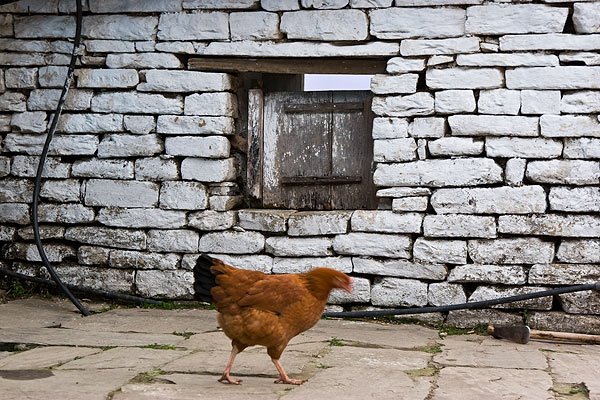
6. Chooks at Ghorapani. This breaks almost every rule of composition but I still like it.
7. Annapurna South in clearing weather.


Photos and words © 2008 Pete McGregor

07 June 2008

Nepal: towards Annapurna

I suppose I should continue writing up my notes from my overseas travel in 2006–7. So, here, in much abbreviated form, are sketches from my time in Nepal.Chook at Tolka


Thursday 8 March 2007
At Kanti Path bus stand the hawker tries hard to sell me things I've already bought from someone else. He drops his price for a Snickers bar to 80 Nepalese rupees.
“You have 100?” he asks. “I give you change.”
Of course, he doesn't have 20 rupees.
“Okay,” I say, “I give you back the Snickers and you give me back my 100 rupees.”
Immediately, he discovers a 20 rupee note folded and slipped in among the larger denominations.
“Oh, look! I find 20.”
The bus journey from Kathmandu to Pokhara takes about 7 hours. I look out the window, at a dark brown face in a dark doorway; thePhewa Lake, Pokhara brilliant white of even, gleaming teeth, almost disembodied. A woman nurses her child in the morning sun; another raises her arms to drape a shawl across her shoulders. Moments transformed into memories. Like all moments—gone the instant they happen, but existing eternally. For us, they're gone until we remember them.
A ute drives past the other way, “UN” in large letters on the bonnet, “Human Rights” on the side. Buses overtake us, Maoist flags thrashing in the slipstreams. Vermillion, with a simple white hammer-and-sickle—the tools so common here; women wielding sickles and carrying giant loads of cut foliage; men breaking rock or cutting iron rod with sledgehammer and steel cutter. At Pokhara a huge collection of buses crowds the stand, the vermillion-and-white flags everywhere; some distance away, around a corner and out of view, a squad of police sits, waiting. Flak jackets, batons, riot shields emblazoned with “Armed Police”. Grim faces.
The Dutch woman with dark hair and sea-green eyes looks at me.
“I think you are a lucky man to live in New Zealand,” she says.

Friday 9 March 2007
Perhaps memory is an act of recreation—re-creation. If something, someone, some event, has been forgotten by everyone and everything, can it be said it still exists? The thought strikes me as strongly resembling Berkeley's philosophy, which says nothing exists unless perceived; perhaps also, because we seldom if ever know Kamal & friend at Tolkawhat we're about to remember, it might be one interpretation of the Russian saying, “The past is unpredictable.”
I go walking at 6:30 in the morning and see the legendary peaks for the first time. Annapurna; Macchapuchare, still tinged with pink, rising from the morning haze, behind the town, behind the power lines, the rooftops, the signs advertising pizza and trekking equipment and adventures. Down at the boats, rafts of ducks float on faintly wrinkled water beyond the coloured craft. A reflected fragment of Annapurna near the shore. Already the North end of the lake has begun to fade, the haze conferring an exaggerated sense of distance. By the time I return to the hotel, Macchapuchare has almost disappeared and turbulent cloud has begun to form.

Saturday 10 March 2007
At Tolka the day darkens; clouds turn from white to grey to the colour of portent. Thunder rumbles in the distance. Finally the first drops arrive, heavy and deliberate, and everything scurries for cover—the fowls, the women clutching laundry, the trekkers. Now the rain's steady on the iron roof and for the first time in ages I'm cold. Well, I was, and my fingers are still numb as I write, but I'm warming up now the fire's going in the dining hall. We walked for roughly five and a half to six hours, stopping some time Rain arriving; Tolkabetween 2:30 and 3:00 p.m. The shower was just warm enough to splash over important areas, and I relaxed afterwards with a cup of milky tea. Soon after, the rain arrived.
I speak with the big, young Japanese guy returning after having reached Annapurna Base Camp (ABC). I ask him where he's from.
“Sapporo,” he says.
I remember Ino's Place and those few days in Sapporo; the time at Abashiri; the evening at Sawa after which I'd walked back to my hotel utterly unable to think of anything that could have added to the joy I felt, everything perfect, even the enormous distance between me and my friends and family in Aotearoa something to be relished because it conferred the delight of expectation, of eventual reunion. Now, here, high in the Himalaya, this Japanese man from Sapporo with his marvellous sense of humour and almost no English links me to those places where I might never return but hope I will. He looks as if he could be a son of John Lennon and Yoko Ono, and his journal's a work of art—a beautifully hand-drawn map of the Sanctuary Trail, in several colours, the lettering clear and exact. We talk, stumbling over our lack of shared language, communicating mostly by intonation and place names and laughter. Later in the evening, after the rain had arrived and the deep cold had enveloped everything but the room where we gathered around the stove, he nods off to sleep in a chair, his feet propped on the lukewarm fireplace. But someone stokes it. I smell burning rubber and we Toilet block at the Himalaya Hotelwake him—he checks the soles of his shoes and yelps when he touches the hot spot. Then he laughs with us.
A delightful little dog, small and healthy followed us for some distance along the last section of trail. Now it sleeps curled up on the lap of a young Scottish woman, each warming the other.

Sunday 11 March 2007
Breakfast comprises excellent porridge with milk, Tibetan bread with honey, a cup of tea, and marvellous views of the Annapurna massif and Hiunchuli. Clear sky, clouds moving fast over the summits. We leave at 8 o'clock. The walking begins easily, mostly a gentle downhill which eventually takes us to the river, a river strongly reminiscent of New Zealand—in fact, the whole environment resembles parts of New Zealand except in three respects: the vegetation, which here is more sparse and lacks the southern beech I'd associate with this kind of landscape; the terraced hillsides; and, of course, the settlements. In New Zealand, no one lives in this kind of country; while many of us feel at home there high on huge mountainsides, in wild country far from roads, no one makes of those places a permanent home; no one is born there, no one grows up, lives, and raises a family there, and one dies there as a visitor, not as a resident.
Soon after starting out, we stop for tea. A pint of it in a big glass handle; the best tea I've had for a very long time. Kamal seems very much at ease with the woman, as if he knows her well. I suppose the guides get to know all the locals along the trail, and Kamal seems always to be well received wherever we stop. Is it just a matter of bringing customers? Certainly that would be part of it, but not all — he seems to be welcomed because of who he is, and the more I get to know him, the more I understand how this is entirely to be expected. Something about his quiet, almost slightly shy manner seems to encourage those he meets to relax and enjoy his company. Perhaps people like this allow you to be yourself At the Himalaya Hotelbecause their gentle manner presents no threat, particularly to the ego; free from the lurking fear of being somehow considered of inferior status, competitiveness simply vanishes and is replaced by simple enjoyment of your friend's company.

Monday 12 March 2007
Two things surprise me about this region—the number of people who look more Indian than Nepali, and the apparent dominance of Hinduism over Buddhism. Other than the faded, fluttering prayer flags, I've seen no obvious signs of Buddhist influence. The British women at the guesthouse in Chomrong had also noticed it, and the thin young British man points out how different this is from the Everest Base Camp trek, where stupas and Buddhist monasteries abound. The women are from Bristol; the young man has, or is doing, a degree in marine biology and flies remote-controlled sailplanes for fun. Buzzards often check out his planes, he says, and sometimes crows attack them.
Andy and Rachel from Australia, the other guests at our hotel, have reunited after Rachel had been forced to descend from higher along the trail because she'd suffered Acute Mountain Sickness (AMS). Andy had carried on to ABC. They've visited Nepal several times, but this is proving to be the trip from hell. Apart from Rachel's AMS, they've been dogged by misadventure: Andy's well-worn boots have blistered his heels, they've miscalculated the amount of money needed for the trek Himalaya Hoteland must watch their expenditure carefully; things like that. Still, they seem able to joke about it, able to shrug and, if not enjoy it, at least accept that sometimes things don't go the way you wish.
We leave at 7:30 and make good time, stopping for lunch at Bamboo—an omelette on gurung (Tibetan bread); a big cup of hot lemon and another of milk tea. As we leave, I stroke the affectionate cat and it leans against my hand; I scratch its chin and it rolls its head around in ecstasy.
Beyond Bamboo the rain begins. Kamal quickens his pace and we reach the Himalaya Hotel at 1:45, as a large contingent of trekkers from ABC set off downhill. Soon after, heavy snow begins to fall.

Tuesday 13 March 2007
Lightning—a flash of brilliance through closed eyes in the middle of the night; seconds later the huge roar of thunder reverberating from immense mountainsides. It continues for much of the night, and once I hear rain on the roof. When I step outside in the morning I see snow falling—big, wet, heavy flakes—and a Himalayan forestlayer a couple of inches thick over everything. Annapurna Base Camp is out of the question, and, like all the other trekkers, we decide to head back down the valley.
One of the guides comes in to the dining room.
“Avalanche,” he says, nodding in the direction of the downhill trail.
I follow him and stand with several other guides, trying to locate the sound. Finally the guide who'd alerted us points at the nearby mountainside and I see a river of snow pouring steadily over a bluff and down towards the trail—the trail we'll have to cross on our way down. Still, I think, I'd rather it avalanched now than while we were crossing.
Kamal and I leave last, mostly because I've been busy photographing rather than packing. Monochrome patterns of bare foliage; a crow sitting hunched in a tree; backdrops of mountainsides, rock and snow, disappearing into cloud. A line of footprints in snow.
The staff at the Himalaya Hotel remain, of course, but as we, the last of the visitors, leave, I'm struck by an air of strangeness; as if nothing exists beyond the small area around the hotel, beyond the enveloping snow, the drifting mist. An air of abandonment, of emptiness; all that remains are the mountains and the snow. And, perhaps the staff who remain are, in one sense, mountains and snow.

Looking towards the entrance to the Annapurna Sanctuary

Notes:
... to be continued...
Photos (click to enlarge them):
1. Chook at Tolka.
2. Boats at Phewa Tal (lake), Pokhara.
3. Kamal, my guide/porter (seated), and one of the other guides at Tolka.
4. Rain arriving; Tolka.
5. The toilet block at the Himalaya.
6. Kamal, the Korean woman with a wicked sense of humour, and another guide lark about in the snow just before we headed back down the valley.
7. Morning at the Himalaya Hotel.
8. The way into the Annapurna Sanctuary. Not a safe route in this kind of weather.

Photos and words © 2008 Pete McGregor
16 May 2008

The end of the world as we know it

Praying mantisAmelie looks out the window, at the ominous cloud, the strengthening wind, the spray whipped back from the breaking surf.
“It's looking threatening,” she says.
A few minutes later the rain begins; a squall, a wild wind from the South. The last surfers scurry from the beach back to their car; a fisherman joins them, rod and bucket in hand. The beach is left to the birds, the surf, the weather, the cast-up logs and shells and kelp.

When the rain passes, moving up the coast, we cross the creek on the pontoon, pulling ourselves across the slow flow on a simple, effective contraption of empty oil drums and steel grating, and walk to the beach. Sand after rain seems like hope or the promise Gymnopilus junonius at Farewell Spitof forgiveness—a reminder that after we've gone, when the last human passes, the world will continue, and will begin to erase the signs of our time on Earth. Like the maze of footprints on the beach and the excavations and constructions of small children with plastic spades and buckets, the traces of our activities will be erased by weather and time and non-human lives.

When and how this will happen, I don't know. I do suspect it will happen not catastrophically and globally but gradually and patchily. Human existence, already grim in much of the world, will become grimmer, then desperate, and the expansion of regions where humans cannot live will accelerate. There, in those deserted and ruined places, the record of human life will begin to fade. Most probably, little else will replace us because those areas will be too arid.

But sun and wind can erase as effectively as rain.

...

It's not that no one cares. Plenty of people care. But not enough people care, and most people don't care enough. When Green Party M.P. Nandor Tanczos spoke at Massey University a couple of weeks ago, he began by playing a clip from the R.E.M. song, “It's the end of the world as we know it (and I feel fine)”. It wasn't entirely in jest. Climate change, he said, is just one symptom of what he called “our abusive relationship with the planet”. Our accelerating demand for energy won't be solved by biofuels—already accused of causing famines—nor nuclear solutions, which face intransigent problems of how to dispose of the waste and of security [1], and, Nandor Tanczosfor New Zealand, the lack of infrastructure and other support for nuclear power generation and the unmanageable size of any nuclear power plant [2].

Pointing out that human populations face the same constraints as other animals, in particular being limited by food, he noted that the world's fisheries “are in free fall.” On current trends, he claimed, this is the last century in which wild seafood will be readily available.

Sources of easily extracted metals are also diminishing rapidly, and while the metals are not actually “used up”, the economic and environmental costs of extracting them from less convenient sources are likely to increase hugely.

The list goes on. To his credit, Nandor offered suggestions for what he described as a gradual descent rather than a crash landing. What he didn't offer—because, I believe, no one can—was the prospect of future in which we can sustain our present way of life, our standard of living. Yet where's the evidence that enough people care enough about the crisis to avert it, or even soften it? New Zealand's Green Party garners roughly 5% of the polls (give or take a few percent, and depending on which survey one chooses), and the Parliamentary election later this year will be fought on who promises the largest tax cuts, the state of the economy, and fear of a lowered, or even static, standard of living.

Buy (into the spin) now; pay (the environmental and social consequences) later.

Of course we all care about the environment. But if caring for the environment means driving our cars less, or more carefully, or—god forbid—paying a miniscule tax to mitigate the damage we do, no thanks. If I recycle my empty bottles and replace my conventional light bulbs with CFLs I'm doing my bit; I can justifiably complain about the price of petrol. In short, we all care about the environment, but too many of us care only as long as it costs us nothing.

Snowboarder on Turoa skifield, Mt Ruapehu


After Nandor's speech I listened to one of my friends talking about some of the rarified research being conducted at Massey. He seemed frustrated, not by what he’d just heard, but because for him it put that rarified research into perspective—and not a particularly favourable perspective.
“We’re facing these crises; all these crucial questions we need to answer,” he said, “and they’re fluffing about investigating the mating habits of Indian ants [3].”

The comment reminded me of Henri Cartier-Bresson's famous remark, “The world is going to pieces and people like Adams and Weston are photographing rocks.”[4]

I thought about the justification for comments like these, and my own pessimism about where we're headed; our apparent failure to convert concern into action. Should we abandon esoteric research; should I stop photographing rocks?

It's a hard one. It's tempting to think we “should” act responsibly, but how happy would we be if we insisted on acting responsibly? Sure, some of us would—and do—feel satisfied and happy knowing (or thinking) we're doing the right thing, but what about the rest of us who, if we sacrificed ourselves for the greater good, would spend our lives feeling thwarted by our sense of duty—in effect, resenting the conscience that denied us the right to pursue what we most wanted? Enough, I guess, to make the world a less happy place than it would otherwise have been.

On the other hand, if we all chased our dreams and abandoned any sense of social or environmental responsibility, the result would be an enormous increase in the number of people who, because of the agonising circumstances they'd find themselves in as a result of our self-interested inaction, would be unable to chase their dreams.

...

At dawn we walk the track past the monstrous new house squatting where it can watch the entire beach. Everything that happens on the beach falls, potentially, under the gaze of the house's occupants; every life on the beach can be scrutinised from the enormous glass windows. I wonder if the occupants considered this a price to pay for their vista or whether, instead, they enjoy the feeling of dominance? Maybe they never even considered it; maybe they were blinded by the prospect of the view. Sometimes we can't (or don't, or refuse to) foresee the consequences of our actions, but the consequences arise anyway. When they're no more serious than sometimes seeing what you'd White-faced heron at Flounder Bayrather not see, like “your” beach swarming with people, it's no big deal, but it's a different matter if your actions contribute to the extinction of species, poverty and starvation, and oil-motivated wars—to name a few examples.

So what am I doing wandering this beach, photographing gulls and waves, water and the light, when the world is going to pieces? Writing and photographing are ways I share, ways I show, ways I encourage others to look, see, and think. Is this justifiable? I trust, or at least hope sincerely, that these things make the world a better place, but to that end, am I making the best use of my abilities? The problem is that even if I were making the best use of my abilities, those abilities might not be particularly useful for making the world a better place. Maybe other things, things I'm neither good at nor enjoy, would contribute more to saving snow leopards or wild places or human lives. Logic in that form suggests I should try to get the best-paying job I can and donate all my non-essential income to organisations like the snow leopard conservancy or the snow leopard trust [5], the yellow-eyed penguin trust, Conservation International, Oxfam, or Amnesty International.

But, I can't say I'm happy with the idea of sacrificing my own happiness to make the world better. It feels wrong, although I don't know if that feeling arises from the universal ability of human beings to rationalise what we do. And counter-arguments have been proposed; for example, it's hard to predict whether or to what degree esoteric research will eventually lead to “practically” useful applications, and, would a world without artists and people who make us laugh really be a better world?

Further along the beach, two oystercatchers run towards the lagoon, their swift, pattering feet leaving long lines of tracks in the rain-cleaned sand. A red-billed gull sidles towards us as we rest on a driftwood log. Those gulls are ever the opportunists, always ready to exploit us. It makes a change, I suppose, but when we've gone—when all of us have gone, and the beaches remain unmarked by our footprints from one rain to the next—red-billed gulls will survive, perhaps finding life a little less easy but still managing. Verbascum thapsusShould that thought be a comfort? Perhaps, but it can also be an inducement to apathy: why bother trying, when we'll be gone soon and the wildlife—what's left of it—can take over?

So, I find myself once again in that state of not knowing, of uncertainty—but not the delicious uncertainty of great possibility. It's more a feeling that time's running out; that our options are becoming more and more limited; a feeling that possibility has begun to contract, and I'm not sure how to reconcile the desire to make the most of what's left with the urge to fight to protect what I love. Perhaps, out of that tension, I'll find a way of going about my life that works, but I doubt it. Meanwhile, I'll carry on doing what I can—at least some of it—and trusting that where I'm doing better than most I'll be seen as an example, and where I'm not doing so well, I'll be treated with enough understanding and compassion to encourage me to do better. And if I treat others that way, and if enough of us do the same, we might just make a difference.


Sastrugi above Turoa, looking across to Girdlestone


Notes:
1. He also mentioned rapidly diminishing stockpiles of uranium, but there are good reasons to question whether uranium reserves really will disappear as quickly as some (including Nandor) claim.
The IAEA doesn't think so.
2. Even a small plant would supply a substantial proportion of New Zealand's power, so the backup when such a plant has to switch off would have to be correspondingly large. Moreover, nuclear power production doesn't follow load (demand), meaning the non-nuclear power plants would have to compensate for the fluctuating load; this would have serious economic consequences for some of those plants.
The Chair of New Zealand's Electricity Commission explains these points clearly.
3. I’ve changed the example to something hypothetical. Apologies to anyone studying the mating habits of Indian ants.
4. Dyer, Geoff 2005. The Ongoing Moment. London: Abacus. 285 pp. ISBN 0 349 11888 4. [P. 97: “'The world is going to pieces,' Cartier-Bresson chided in the 1930s, 'and people like [Ansel] Adams and Weston are photographing rocks.'”]
5. Don't ask me about the difference between these two organisations. I have no idea, nor do I know why they haven't pooled their resources.

Photos (click to enlarge the smaller photos):
1. One of those who might inherit the Earth.
2. And another:
Gymnopilus junonius, commonly called "big laughing gym (or Jim)" at Farewell Spit. Identified for me by Dr Peter Buchanan, Landcare Research. Peter says, "This probably introduced species is fairly common on a range of hosts (esp. pines, eucalypts, but also pohutukawa), typically fruiting at the base of stumps, dying trees, or on pruned live trunks. Although bitter and inedible it is reported to be hallucinogenic—hence the common name above (also known as giant flame-cap)."
3. Green party M.P. Nandor Tanczos at Massey University, Palmerston North, 30 April 2008.
4. Turoa skifield, Mt Ruapehu.
5. White-faced heron, April 2008. One of a pair living on and around the beach beneath the enormous windows.
6. The common weed, woolly mullein, Verbascum thapsus. No. 3 Line, Pohangina Valley, May 2008.
7. Sastrugi and Girdlestone, Mt Ruapehu; winter 2005.


Photos and words © 2008 Pete McGregor

09 May 2008

Thinking about squid (poem)

Live squid for sale, Hakodate, JapanCephalopod

Called spineless
but the structure
of your eye’s like ours
the brain too
complex admittedly
alien with other
solutions. You speak
in colours but we
refuse to listen deny
the sense of kin though
we too communicate
with the sense
of skin. Few touch
you and you
touch few. For
the most part your
parts serve us as
we serve you. We
consider you

a delicacy.


Notes:
1. A poem from 2001. It seems topical now.
2. "You speak in colours..."

Photo:
1. Live squid for sale, Hakodate market, Hokkaido, 2004. Smaller, but just as wonderful as the colossal squid. These are the only live squid I remember seeing, although I've seen octopus—including some rather substantial individuals—several times in the ocean. The photo, from a little Pentax Optio 555 digicam, has been modified using the technique mentioned in the last post. I don't want to overuse this, but it salvaged what I considered a nondescript photo — and given it was one of only a handful of cephalod photos I had to hand, I think it's justified. (I confess: I also used it to update the Emergence post.)


Photo and words © 2008 Pete McGregor

07 May 2008

Not gone yet

Contrary to what you might have believed, neither the blog nor I have terminated. I trust we'll both be around for some time yet (and not with the Oates connotations).

My knee's slowly coming right; it's nothing serious, but I have no intention of aggravating the injury by doing too much too soon. The hills have been out of bounds, but they'd have been infested with people (many with rifles) for the last month or two so the incentive to get shot spend time there has been low. Besides, a few weeks ago summer ran out as if the last bus was leaving, so I'm less tempted by the prospect of long walks down swift Ruahine rivers—beautifully refreshing in the heat of mid summer, but numbingly cold in winter; in any case, they're currently running too high to traverse safely. Fortunately, I can still get on the mountain bike; in fact, the physio has instructed me to do just that.

Otherwise, it's all good. I hope it is for you too.

Pourangaki River; woodcut


Notes:
1. I bet that picture will get Ruahines Robb out of the woodwork.

Photo:
1. The Pourangaki River, Ruahine Range, in early March this year. I've used the Photoshop technique described by Clare; an effect he likens (aptly) to a woodcut. I think the effect appeals to me largely because it reminds me of the sort of illustrations that fired my imagination as a small boy.
[Speaking of Clare, he put up a gem of a post just a short time ago. Check it out—it's an insight into life in the Arctic as well as being highly entertaining.]


Photos and words © 2008 Pete McGregor

31 March 2008

The colours of the world

Lagoon, sand, sky

Paua[1], alive, hide beneath their camouflage; the brilliant, swirling blues and greens and purples pressed against that wet, black body on the inside of the shell are revealed only after the animal dies, when only that shell remains, stripped of the living animal. In life, the iridescence has no function—at least, none known to us. But who, on picking up the empty shell for the first time, could fail to be arrested by those colours?

...

Some years ago, Tony Bridge visited for a few days and, after exploring the Pohangina Valley and much discussion about photography and other matters, he suggested my way of seeing (photographically speaking) was in black and white rather than colour. Until then I hadn't thought much about how I see, so I wasn't sure whether I agreed or not. I still don't know, although I suspect he might have been right at the time, but the comment encouraged me to look harder, to pay attention not just to what I happened to be looking at, but how I looked at it. I began paying particular attention to noticing colours, to identifying what I found attractive or discordant in a scene—colours, forms, tones, textures, and so on.
On the coast earlier this year, it even turned into a kind of game.
“How would you describe the colour of the sea?” I asked her.
She looked hard for a minute or two. “I'd say..., blue-green,” she said.
“With a hint of silver?”
“Hmmm... maybe more grey-green?”
And we'd argue about it. Rarely, we'd agree. Usually, we realised how difficult it can be not just to find the right words for a colour, but even to recognise the colour. Try it sometime. Try describing the colour of the sea, or look at the sky on a clear evening, after the sun's dipped below the hills; look at that light just above Gull doing yoga, waiting ternthe hills and try to identify the colour. It's not blue, it's not silver, it's not white. The closest I've been able to get is to say it's the colour of light—apparently nonsensical but somehow more accurate than anything else.

...

At dawn, as I struggle with these words, light from the sky illuminates the land; it glows, soft mauve and pink. Starlings rush across the paddock where sheep the colour of old, weathered straw graze among dry grass and crisp, brown thistles. The starlings, black and swift, continue to speed past, too quick to make out details; the impression is of movement and the absence of colour, as if they're shapes cut from the world to reveal the nothing beyond. As mauve fades from the sky the land begins to take on a faint golden hue, a promise of warmth despite the lingering cool night air.

...

I want to believe the whole world is beautiful; that I can feel at home everywhere. But I drive home in the middle of the afternoon in a light that leaches life from colours, leaving them pale and insipid, without even the character of being weathered, yet in perverse contrast, the dense, dark shadows lack detail and subtlety of tone. I can't escape the feeling that these colours, the way they don't work together, the grey roads and muddy olive-yellow foliage, the jumble of discordant power lines and hedges that truncate abruptly in the middle of a paddock—all these visual blows—result in a simply ugly chaos, like a world bruised. The world outside the window of the car as I drive is a mess, not even complex but merely complicated and jarring; the feeling is dismay: “This is not how The World should be!”

Are beauty and ugliness purely human concepts? Our response to the colours of dusk reflected on a wet beach, or cloud swirling around a sunlit mountain ridge, needs no label for us to appreciate the sight at a deeply emotional level—we would know these things are beautiful even if we had no language. A fly, however, responds in a Evening at Himatangifar less complex but essentially similar way to a delicious mound of steaming shit, and most dogs I know seem to view a roadkill with the same sense of appreciation and desire with which we humans view a limpid pool in a river on a sweltering day. How then might concepts like beauty exist independently from what perceives the beauty? To put it simply, is beauty only in the eye of the beholder?

And what causes me to see the world in the middle of this dry and hollow afternoon as dissonant and bruised? But if I somehow developed the ability to appreciate it all as beautiful, would I therefore have lost all ability to discriminate?

...

Colours and light. So often over these last few months I've been astonished and awed by the sheer power of the light. Elegiac light on distant mountains at dusk as the last sun breaks through rain cloud; evening sun on the hill behind the house, a hill so dry it's the yellow-grey colour of a lion, and behind it the deep blue-black of storm cloud. An angry sky, great clouds piled high into the evening, a thunderstorm in the South-West, black and green, its edges a luminous mist of rain. The car turns a bend in the road and ahead Russell at John & Sam's weddingthe sun's shining through heavy rain, everything behind that glowing gradient of light obscured but in front, the gnarled shapes of old macrocarpas. Near Ohakea a squall drives rain against the windscreen, turns the tarmac into a welter of foaming water, but a minute later it's gone, just a few heavy drops spattering the car, the smell of rain rising from the hot asphalt. Wheat fields, waiting for the harvester, glow bright in drifting sunlight, brilliant against dark clouds. A small flock of finches rises then falls back into the crop, black motes against the ripe yellow. Further West, a more distant but much larger flock rises and swirls like an eddy of wind-stirred dust. They too disappear, down again into the wheat; the impression is more one of movement and grace than individual birds.

...

In October last year on The Online Photographer, Ctein [2] posted a short article about how the camera he happens to be holding influences the way he sees. If the camera's loaded with black and white film, he says, he “sees” black and white compositions; if it's colour film, the photographer in his mind finds colour photos. The article provoked a good discussion, mostly about whether anyone has ever proved equally adroit with both colour and black and white photography [3], but as I looked at the two photos Ctein used to illustrate his post, I realised neither he nor any of the commenters had mentioned what seemed to me to be an important distinction: that between seeing black and white and seeing in black and white.

Seeing black and white is akin to recognising when colour is unimportant, or at least secondary to other elements like form and movement. SeeingMy driveway at dusk in black and white comprises recognising what something might look like if the colours were replaced by shades of grey. Ctein's photos showed snow chains on the tyre of a large vehicle. The first, a closeup, would have contained little or no colour; in effect, Ctein had seen the black and white composition, in the same way someone else might recognise the graphic possibilities of the shadow of a cat on a white wall (emphasising form) or a handful of shiny nuts and bolts on an old sack (emphasising tone and texture). The second photo, from further out, included the orange-yellow hub and part of the vehicle; this, I assume, he intended as an illustration of seeing colour.

However, the psychological processes are, I suspect, essentially the same: the facility with which one can switch between the two modes of seeing (colour/B&W) depends on one's ability to notice, to pay attention, and to recognise.

On the other hand, to see in black and white is mostly a matter of imagination. To look at a landscape, a street scene, or—much harder—a flock of brightly coloured parakeets and to be able to visualise what a photo of those subjects might look like in black and white differs hugely from the knack of knowing these would make lovely colour photos.

...

The sun rises through dense, early morning mist, a brilliant yellow-white disc hanging at the end of the long road. Ahead, a truck carrying a digger drives towards that sun through the luminous mist; silhouetted and angular, it looks like a sentient machine from an apocalyptic future. I try to look away from the sun, to lower my eyes from that burning disc, but the urge to gaze into it is almost overwhelming.

...

Seeing colour and recognising what might work in a photo, isn't as easy as sounds, particularly now we'reMacchapuchare and the entrance to the Annapurna Sanctuary, Nepal bombarded with and have become accustomed to ultra-saturated images. Mike Johnston, primary author of The Online Photographer [4], said recently:

“It's often a source of wonder to me that color photography so infrequently uses color to any advantage—many viewers seem to prefer color simply for its verisimilitude—it shows what was, just because it was—without any thought to whether [...] the colors in a picture have any aesthetic affect or impact. Color can ruin pictures for me, as often as not.”
I agree, although as a friend pointed out, most people photograph simply to record and remember, and for that, verisimilitude is a virtue. Still, I suspect Mike had in mind those who photograph because they enjoy photographing as a creative act, and in that context I share his surprise.

Accompanying Mike's post is a photo by David Goldfarb which beautifully illustrates the virtues of subtlety and restraint; to me it strongly resembles an old, hand coloured lantern slide. Thinking about colour and black and white, I grey-scaled the photo and discovered it produced a similarly beautiful black and white version. Whether the subtly coloured or black and white version could be considered better is a matter of personal preference. Again, this seems to me to be mostly about seeing colour—but in this case, seeing it when you have to look for it. In contrast, a photo which simply doesn't work nearly as well in black and white is Joel Meyerowitz's “Still life with newspaper”. Colour—restrained, even muted, colour—seems essential to this photo [5].

I thought again about Tony's assertion that I see in black and white. This I believe I understand—loosely put, it's the subconcious translation of colour into monochrome tones, and, as I've said, it differs from noticing (seeing) black and white. But what about seeing in colour? Can one make a similar distinction between seeing colour and seeing in colour—between noticing and translating? Or, because we're overwhelmingly confronted by colour, does the distinction disappear? If “seeing in” black and white is primarily a matter of imagination, what might we be imagining when the subject already presents in colour?

I suspect the process, for colour, amounts to imagining how particular hues might be accentuated, muted, or otherwise altered. The photos by David Goldfarb and Joel Meyerowitz appear to be the results of just such a process—neither photo seems “true to life” [6] but that's not what matters. Farmer at Kileswar, GujaratWhat does matter is that those photographers saw the potential for photos that express something other than, or in addition to, what might be evoked by more literal records.

...

Desiccated kelp litters Wharanui beach, flotsam strewn right across the beach and beyond the shingle dunes, wrack from a huge sea in the recent past. A flock of black-billed gulls battles into a headwind, making slow progress along the beach towards a cluster of juvenile black-backed gulls fossicking among the wrack or standing, hunched, facing into the wind. Near the ruins of a crayfish carapace and part of one spiny leg, a dead fish—red cod, I think—lies next to a torn-off kelp holdfast. The fish's empty eye sockets gape up at the sky; its open mouth, fine-toothed, seems fixed in its final gasp, drowned in air. A shard of paua shell gleams on the shining, salt-wet shingle. Wild sea, wind, birds in a vast blue sky streaked with white cloud. I look out over the chaotic, turbid surf to the empty horizon and imagine my gaze going on to Antarctica then further, into and beyond imagination. Suddenly, I understand that to call this beautiful or otherwise is meaningless. All I know is that living somewhere like this seems to be the most important thing in the world.

...

Of course, noticing and imagining aren't alternatives. All non-accidental photos require some degree of noticing by the photographer; this is an unavoidable consequence of the decision to point the camera at something in particular and to press the shutter at a particular moment. Similarly, it's hard to imagine anyone photographing anything while completely lacking any imagination about the outcome—the photo. I might be wrong about all of this, but it's been fun wondering about it and paying attention to what I'm doing when I'm looking at the world; noticing how I'm looking at it, what I'm seeing and imagining.

...

The wet shingle feels cold beneath my bare feet. I return to the car and resume my journey, on to Blenheim, then Picton and the ferry. Somewhere in Cook Strait I look up at the sky, to where a lone, white cloud hangs in an aquamarine sky. Stretching from the cloud, a faint trace of shadow darkens the blue, so subtle it seems to vanish under a direct gaze; it can be seen only by looking off to the side. Perhaps that's the case with most things subtle—the trick is to pay enough attention, but not too much. And perhaps I've paid too much attention to this topic and lost sight of what I thought I was seeing. So, I'm going outside, partly to look at the colours of the world but mostly to enjoy it. I suggest, if you can, you do likewise.

On Himatangi Beach


Notes:
1. Haliotis spp. (the Maori name paua usually refers to H. iris)
2. Apparently, Ctein is pronounced “Kuh-tine”, and it's his full name. From what I can gather, nothing about him could be described as ordinary; "larger than life" might be more apt.
3. According to some of the commenters on Ctein's post, examples of photographers who have proved themselves adept at colour and black and white include Harry Callahan (the photographer, not the other one), William Klein, and Sylvia Plachy.
4. I recommend The Online Photographer as one of the best photography oriented blogs. Sure, like all of them, it has plenty of opinion, but it's generally well-argued (and well written); it's a good source of news and ideas; and many of the articles I find excellent for learning about photographers I knew little or nothing about.
5. The online version doesn't do it justice, at least not compared to the version I've seen printed in Geoff Dyer's magnificent book, The Ongoing Moment — and the plates in that book appear no more than adequate to illustrate Dyer's assertions.
6. Of course, a “true to life” photo—one that substantially achieves verisimilitude—is unattainable, as yet another recent T.O.P post suggests.

Photos (click to enlarge them):
1. Three elements on a long coast.
2. Gull and tern, loc. cit. I find it difficult to imagine most wildlife photos in black and white.
3. Evening at Himatangi Beach, Manawatu, a few weeks ago.
4. Some subjects seem to cry out for black and white. Colour can often distract rather than complement.
5. My driveway at dusk.
6. Macchapuchare and the entrance to the Annapurna Sanctuary, Nepal. March 2007.

7. Farmer at Kileswar, Gujarat, India. Early 2007.
8. Not my feet, on Himatangi beach. The beach here contains some ironsand, hence the dark colour.

[Update (8 May 2008): Mike has posted another thoughtful—and controversial—discussion about colour vs B&W on T.O.P. The comments so far are notable mostly for disagreeing with his assessment of the use of colour in a photo by Udayan Behera. I'm inclined to agree with the disagreement, but don't let that put you off reading and thinking about what Mike has to say. In particular, try applying his suggestion of blurring a photo to help assess whether its colours "work" (or just remove your glasses).]


Photos and words © 2008 Pete McGregor

13 March 2008

Digital photography: a few questions

I returned from the Ruahine on Monday afternoon after 4 days; before then I'd been home for 2 nights after having been in the Ruahine for three nights. Seven of nine nights: not a bad session in a place I love, I reckon. I'm a bit worn out, though, and my right knee's playing up, so I'm popping voltaren and looking forward to taking it easy for a wee while — at least until I head South at Easter. But, I'm aware the blog has been taking a back seat, so here's a filler I hope some of you will find useful. As for you others, well, just ignore the geek stuff and enjoy the photos.
Pourangaki River and rata log

Late last year a good blog friend wrote asking whether I could help with some questions about photographing with a digital SLR. Some of his questions I'd encountered before from other people, and it's likely many others share a similar confusion. I know I did!

I've paraphrased his questions (sometimes to the extent of taking liberties with them) and answered them as best I can in this post, trusting at least some of my responses will prove useful to at least someone out there.

Why it is better to shoot in RAW?
RAW files are the data the camera's sensor collects. They're compressed, but with no loss of data, whereas JPEG files discard some of the data (that's why you should never resave JPEGs more than is absolutely necessary—each time you save a JPEG, you lose more data).Pourangaki River spate Moreover, RAW files are not processed—no sharpening, no saturation adjustment, no noise reduction, etc. They're just the information the sensor records. You apply those corrections later using computer software that's much more flexible and powerful than the in-camera processor. Therefore, many settings on the camera don't matter because you can change or apply them later; moreover, if you don't like the result of the conversion, you can try again with different settings. Colour balance is a good example; I leave it set to “auto” (or, very rarely, might choose a fixed colour temperature) and set the colour balance later on the computer.

When using RAW files, don't you need to go through a complicated process and use specialized software to work on the images?
No, and yes. The process isn't particularly complicated, but you do need specialised software to convert RAW files into editable formats. Very simply, all you do is upload your RAW files from the card onto your computer and then into a RAW converter program, apply the tweaks you want (sharpening, colour balance, exposure corrections, etc.) and transfer the files to an image editing program like Photoshop[1].

Most (all?) SLR cameras come with a RAW converter program, but Photoshop (including Elements) can also do the conversion for you. The other option is a stand-alone RAW converter. I use Male whio, Pohangina River, Ruahine RangeAdobe's LightRoom (v. 1.2) and find it excellent[2]. Some photographers swear by Breezebrowser or Bibble, and Capture One Pro seems to be the top-of-the-line converter if you can justify the expense (I can't). LightRoom has several modules, but the essential, RAW conversion functions in LightRoom seem identical to those in Photoshop so you could get away with PS alone. I do like LightRoom, though.

I've heard that LightZone is great for RAW processing.
It looks excellent but I've never tried it and can't afford it[3], particularly now I've bought Photoshop CS3. LightZone might be a better option than Photoshop for photographers, particularly those who don't want to invest an inordinate amount of time learning the latter. LightZone seems to be based on Ansel Adams' Zone System; moreover, unless I'm mistaken, its major advantage is that you can edit selected areas in the RAW image itself—with LightRoom, you can only change the entire image; selective edits have to wait until after the conversion. Photoshop is always likely to offer a greater range of more powerful editing tools, but at the cost of a long, steep learning curve.

Photoshop is apparently being redesigned to make it task-oriented (modular), and given the success of that approach with LightRoom, such a redesign would probably tempt many undecided customers to opt for the industry standard Photoshop rather than LightZone.

What are "embedded or non-embedded JPEG files"?
Digital SLR cameras allow you to shoot RAW files with the option of including a “bundled” version of the image in compressed format; this has the “.jpg” extension. Thus, when you upload the file to your computer, you have two versions of the same file: a RAW file and also a compressed, processed file you can view with any image viewer, Male whio, Pohangina Riverincluding, for example, Windows Explorer. Most programs (including many image editors) don't recognise RAW files—you need a special program to convert RAW files to an editable format. The embedded JPEG files are useful for easily sorting through your photos to see what you've got, and also if you don't have access to a program that can edit RAW files—you can work on the JPEGs instead.

I've heard about using the histogram before, using it for processing in PhotoShop, but have no idea how to read this while looking at the camera. May I ask what looking at the histogram does for getting the image right?
Put simply, if the histogram on your LCD screen truncates abruptly at either end, you've lost details in the shadows or highlights. Truncation on the left side of the histogram means the shadows are blocked—you have solid black and you can't retrieve any detail. Truncation on the right side of the histogram means the highlights are pure white, i.e. no information, no detail. This is usually a more serious problem than blocking the shadows. RAW converters, like LightRoom, do allow you to “recover” some of this “lost” detail, apparently by extrapolating from other colour channels, but it's best to avoid the problem in the first place. If you see your histogram's truncated on the right, take the photo again, with decreased exposure and see if the histogram now falls entirely within the limits. This is called “chimping”. My LCD (and I assume those of most cameras) shows highlight truncation (clipping) as areas that blink off and on, warning you that you have apparently no detail in those areas.

In theory, you should try to keep the histogram as far to the right as you can, without truncating it. On the LCD, the photo might look overexposed,Tuatara, captive at Mt Bruce but theory says ignore that—it's the histogram that's important. However, in practice, I find this “expose to the right” rule can lead to clipping one of the colour channels, so if the photo has bright, saturated colours (yellow or red flowers, for example), I try to keep the histogram centred or only slightly to the right. Some of the most recent displays actually show the red, green, and blue channels separately—a good feature which helps you avoid clipping one of those channels.

Of course, if the contrast range is too high, preserving highlight detail by shifting the histogram to the left (decreasing exposure) will block up the shadows. There are fancy ways of solving this, but I don't want to confuse you any more than I already have... ;-)

In short, look at the histogram after you've taken the shot; if the right side's chopped off, decrease the exposure; if the left side's chopped off, increase the exposure[4].

At what size do you usually shoot your images?

At the largest setting; i.e. maximum dimensions, highest resolution. It's easy to shrink the images, but even the best interpolation algorithms struggle to enlarge very small images. If you find you need to reduce the size or resolution to save space on your memory card, buy another, larger card. Even the best quality cards are cheap, especially if you buy them from somewhere like Flashcards.co.nz (highly recommended—and that’s an unsolicited recommendation for which I get nothing other than knowing you’ll get excellent service).

I want to have the highest quality images with the best resolution for the media that I show them on.
For computer monitors, a resolution of 72 pixels per inch (ppi) is fine; 96 ppi is the best you can get; anything higher is wasted and simply increases the size of the file. Resize your photos to the dimensions you want (for my blog I don't go above 700 pixels wide) at 96 ppi.

For printing, you need a much higher resolution: other things being up to par, 240–300 ppi will give you aPowelliphanta snail, Ngamoko Range beautiful print. Of course, if you try to produce an A2 size print at 300 ppi, you'll have to enlarge the photo (i.e. interpolate) substantially (“up-rezzing” is the jargon). If you do want a print that size, let a good, professional lab do the up-rezzing and printing for you (unless you’re an expert, in which case you’ll get nothing from reading this).

For projection, you're again limited by monitor resolution. Use a resolution of 96 ppi and set the dimensions to fill the screen on the computer you'll use for projection (1024 pixels wide is a good choice if you don't know what computer you'll be using). This is the one area where, in my opinion, film still has a significant advantage. I've yet to see a projected digital image that approaches the quality of a good, projected transparency.

Perhaps the most important thing to do is make sure that your monitor is properly calibrated. If your monitor has, say, a green cast (you probably wouldn't know, because you're used to it), or if its contrast is set too low, your photos on other monitors (especially correctly calibrated monitors) will look weird. It's possible to calibrate by eye (approximately), but hardware like the Huey Pro (which I use) and other systems make it relatively easy and reliable.

Do you use the noise reduction setting or the sharpening in-camera setting?
Sharpening in the camera only affects the embedded JPEG file, and as I work on the RAW file, I don't bother with this setting—it has no effect on the RAW file. On my 20D the only noise reduction option is for long exposures; I've turned this on, but I'm not sure if it affects the RAW file. I don't think it does; I think it affects only JPEG files (embedded or standalone).

However, when I was overseas I had to use the embedded JPEGs because no Internet cafe had a RAW conversion program, nor any useful image editor. Therefore, I set the sharpening to medium, because unprocessed digital files are inherently soft because of the anti-aliasing filter in front of the sensor.

My suggestion is to ignore these settings. Leave them on the factory default settings and use the RAW files. (You might come across recommendations, including some from high-profile photographers, to turn off the sharpening. This shows that even high profile photographers sometimes don't understand everything, even if they think they do. Nor do I).

What camera settings should I use if my photos are intended to be similar to the kind of photos you take? (Some photos I'd like to one day print up on paper, too).
Here's a summary of how I use the important settings on my camera:

ISO: The ability to change the ISO is one of digital's major advantages over film. No trying to change films mid-roll, no fiddling with “pushing” or “pulling” films—just dial it in and carry on photographing.

Choice of digital ISO is similar to choice of film speed. The higher the ISO the more noise you'll have in the shadow areas. This shadow noise is exaggerated if you River bank & coprosmaincrease the exposure or add fill light during image editing, but image noise is generally low in most digital SLRs (particularly Canon cameras) so don't fret over it. My inclination is to err on the side of a high ISO—I'm more likely to ruin a photo with a too-low shutter speed than an slight increase in noise. I guess it also helps that I don't wail and gnash my teeth over a little noise; in fact, I often like it.

I generally leave my 20D set on ISO 200, sometimes 400. If I can use, or want, a slow shutter speed I'll use ISO 100 (the lowest for this camera); if there's little light, I'm happy dialing up ISO 800, 1600, or even "Hi" (3200), but as I've said, I rather like noise (my mum reckoned I did, too).

The one minor disadvantage of being easily able to change the ISO is you have to remember to change it!

Program modes: I never use any of those fancy portrait/macro/night scene/fireworks/blahblah modes. I use two modes on my 20D: aperture priority (“AV”) and, occasionally, manual (“M”). I use the manual mode when I want flash as a main light (e.g., for high magnification macro work) or when I want a consistent exposure over several frames (e.g., if you want to stitch several photos for a panorama you need the same exposure for each frame or the joins, particularly in the sky, will show).

Colour balance: Leave it set to “auto”. Sometimes, setting a fixed colour temperature makes the post-processing (editing) a little easier and faster, and it's useful for consistency over several frames (as I mentioned above for “Manual” mode), but I've never found the other settings (“shade”, “cloudy”, etc.) useful. You'll need to correct the colour balance in your RAW converter anyway.

Aperture and shutter speed: no different from a film camera. Try to get these right, and if you're not confident and the photo's important, bracket your exposures one stop or more either side of your (or the camera's) best guess.

Finally, a very important point. When you convert the RAW file and send it to Photoshop, make sure you convert it as a 16-bit file. I won't go into the theory of it; I'll just point out that it allows you to edit far more aggressively without the photo beginning to fall apart, i.e. showing artefacts like “banding” or posterization. Y(ou can use most of Photoshop's tools in 16-bit mode now, but not in PS Elements; in particular, with a 16-bit file in Elements you can't use layers; you must convert it to 8-bit mode.) Often, this doesn't matter, but if you want to alter contrast or saturation, etc., substantially, you're safer in 16-bit mode.

Hope this helps rather than confuses. If something's not clear, just ask, and if you think I'm mistaken about something, please, do query it. I, too, have an enormous amount to learn.


Pohangina River, reflected colours

Notes:
1. Sometimes you don't even need to edit the photos. For example, all but a few photos I posted of this year's Baring Head Bouldering Competition were processed entirely in LightRoom and exported from that program, resized for the blog.
2. However, Lightroom cost me nothing because Adobe distributed it free to Rawshooter Premium users (they bought out Rawshooter and the free distribution was part of the deal). If I had to buy Lightroom, I wouldn't. I'd use Photoshop's converter (Adobe Camera Raw (ACR), which is incorporated into Adobe Bridge.)
3. LightZone 3 currently (11 March '08) sells for NZ$198 (c. US$150) for the Basic version and NZ$331 (c. US$250) for the Full version. During March '08 you can get a discount of 20% on these prices. Still unjustifiable for me, regardless of how much I'd love to run it through its paces.
4. Apologies if this is second nature to you, but for the sake of those for whom it isn't: To decrease the exposure, increase the shutter speed, decrease the aperture (i.e. increase the f-number), or lower the ISO. Note: these work only if the camera is set to “manual” mode; if it's set to, say, AV or T or (heaven forbid) P, you must use the exposure compensation dial.
5. The number and range of quality of websites discussing these and related issues is astronomical. One of the better starting points (probably the best known) is The Luminous Landscape, although some of its earlier articles are now substantially dated.


Photos (click to enlarge them):
1. The Pourangaki River, Ruahine Range, on 3 March, the day we walked out after a great couple of days in a magical place.
2. This was what the Pourangaki looked like less than 24 hours before. A good lesson — like most New Zealand rivers, those in the Ruahine rise fast but fall fast too, so don't try to cross when they look like this. Wait a few hours and enjoy the place.
3, 4. Another river—the Pohangina—a few days later. We came upon these two male whio (blue ducks; Hymenolaimus malacorhynchos) at the upstream entrance to the small gorge between Leon Kinvig and Ngamoko huts. The bird at the back is whistling ("whio" is also the Maori word for "whistle"). Females have an entirely different call, a kind of rattle. We saw 4 or 5 birds on this last trip, all males.
5. Tuatara (Sphenodon punctatus). CAPTIVE, at Pukaha Mt Bruce. As much as I'd like to say I photographed this gorgeous reptile (not a lizard) in the Ruahine, it's a sad fact they survive in the wild only on some of New Zealand's offshore islands. This is Rewa, a female captured on Stephens Island in the 1980s. She still trailed a few scraps of recently moulted skin. I photographed her through the glass of the cage she shares with her mate, Tahu: glass well smeared with the enthusiastic finger and nose prints of many small humans. The trick with this sort of photography is to get the lens as close as possible to the glass and to shade the glass to eliminate reflections or light scattered by those little human prints.
6. On the other hand, I photographed this native land snail (Powelliphanta sp., I think — I'm trying to get an i.d.) at the top of Shorts Track on the Ngamoko Range as we walked out last Monday. The shells, usually empty, can be seen fairly readily, but it's rare to find the living animal and even less common to find one active. Yet another of our wonderful endemic animals in need of active conservation.
[Update: Kath Walker, snail expert from the Department of Conservation, confirms it's Powelliphanta marchanti.]
7. Coprosma sp. seedling growing on the river bank below Ngamoko hut.
8. Pohangina River between Leon Kinvig and Ngamoko huts. The gold is sunlight reflected from a grassy slip just downstream; the blue is light reflected from the shadows. Photography is often a matter of seeing the light.


Photos and words © 2008 Pete McGregor