Tuesday 27 February 2007
The sun rises through dawn mist over fields, crops, and small trees; its huge disc burns orange. A man stands washing his face in a misty, mirror-like river, the perfect ripples spreading out from his legs, on through India's history, the way memories flow through a life. Moments like these leave you unable to speak.
A man in uniform gets off the bus, rubs his hands together, then puts them to his face. His big, flexible fingers mould to the contours as if the bones had become plastic, following the curves of his cheeks, filling the hollows of his eye sockets. The bus lumbers off; crows occupy the power lines. India must be great for a crow, as there's always so much to scavenge, and the advantage of being a crow—or any flying bird—is that when you're tired of the filth and squalor amongst which you feed, you can fly up, away from it. The ability  to look down on something usually makes it more tolerable. On the other hand, the opportunity to look up to something—a crow alighting on perfect wings, a god, a mountain at dawn, the memory of wild eyes—helps us, those of us who cannot fly away, to bear the intolerable. This arises, I think, from more than hope, from more than the idea that perhaps one day we too might lift ourselves out of our small, hard, caged lives. It arises, I think, from gratitude that something survives: we are ruined, but the things we look up to are not.
...
I'd taken a cycle rickshaw from the Parihar to the bus stand, where I'd found myself standing immediately beside the Kota bus. Despite the vehicle's characteristics—the usual old, decrepit monster—the ride proved enjoyable, particularly since the bus never filled completely and I'd had a seat to myself, leaving me free to gaze out the window, to lose myself in thoughts. To lose myself in India. Who knew where I was? Everyone I knew and everyone who knew me knew nothing of my whereabouts beyond knowing I was somewhere in India. Perhaps a few guessed I was somewhere in Gujarat or Rajasthan; others had no idea or just a vague recollection of something about India and Africa. This is the anonymity of travelling; it terrifies some and delights others.
I think I'm one of the others.
At Kota a rickshaw took me to the railway station, where I bought a ticket for Sawai Madhopur and with help from several people found the platform, the train, and the carriage. Squashed into the entranceway to the carriage, I had to endure a  steady stream of people squeezing past to get to the toilet, but the journey took less than an hour and a half, and a slight breeze made it, if not comfortable, at least bearable.
At Sawai Madhopur a man rushed up, offering me transport on a horse cart.
“The Aditya?” I asked.
Yes, yes, he nodded, he knew it.
“How much?”
“Ten rupees.”
At that moment another man rushed up and offered me an auto rickshaw ride for the same price, gesturing for me to follow as he walked off. A common ploy—this was such a good deal that of course I'd accept his offer; after all, an auto rickshaw's much faster. But haste wasn't important for me. The first man, almost distraught at the prospect of losing a customer, immediately dropped his price to five rupees. I accepted, and, after a slow but enjoyable journey, gave him the ten. Clearly pleased, he insisted on carrying my bag into the hotel.
...
Ranthambhore National Park is a much modified fragment of the extensive forests that covered the Aravali and Vindhya ranges until early last century, when about 40,000 tigers were thought to survive in India. The forests received some protection in 1955, as Sawai Madhopur Sanctuary, but by 1972 the first census of tigers throughout India suggested a surviving population of fewer than 2000 tigers [1]. In 1973, following the shock of that census, Project Tiger was launched and Ranthambhore was designated as one of 9 tiger reserves [2]. By then, tigers were close to extinction in the region and none were officially recorded in the reserve until 3 years later. The core area of the reserve, 282 km2, was designated as Ranthambhore National Park in 1980 and substantial adjoining areas were added in 1983 and 1984 as part of the tiger reserve. Prospects looked bright.
But tigers in Ranthambore have faced continuous pressure from human activity, and serious bouts of poaching in the early '90s and again only a few years ago decimated the tiger population. A survey in May 2005 used three methods to estimate the tiger population in the park: camera traps operated by the Wildlife Institute of India; the heavily criticised plaster cast/pugmark tracing technique used by the Forest Department; and the recently developed digital pugmark technique implemented by the Wildlife Protection Society of India.
The results were depressing. The unreliable plaster cast method estimated 31 tigers, camera traps suggested 21; the digital pugmark technique identified 26 tigers, two of which might have been transient. Offical figures a year earlier had claimed 39–41 tigers. Either those figures had been inflated—likely, according to those who pointed to the “Sariska disaster”, where a census in 2004 showed tigers had been exterminated from that reserve while officials knowingly overestimated the number of the few survivors—or about a third of Ranthambhore's tiger population had “gone missing” within a year.
Would I be lucky enough to see one of the survivors? Only the next few days would tell. Ranthambhore is reputedly the best place in the world to see wild tigers. Right now, they still lived here. But for how long?
...
In the afternoon I walked along the road towards the entrance gate to Ranthambore National Park, past the tourist reception centre where I noted the times and costs of entry to the park, on along the road, on in the heat and glare. Always, the gate seemed just beyond the next bend. Two camel carts with enormous loads passed by, returning to town. The driver of the first grinned at me and patted his load of plump sacks, indicating for me to climb aboard. Tempting, ... but I grinned back and gestured I was headed the other way.
Not much further down the road I began to wish I'd taken up the offer. Finally, I abandoned the idea of walking to the gate and turned around. Soon after, two young guys on a motorbike picked me up and gave me a lift back to the Aditya. Helmetless (of course) we hurtled along the tarmac, three of us reckless on the Pulsar in the afternoon sun and wind. Later, I discovered the park entrance gate was just beyond the corner where I'd turned back.
I ate that evening at Tiger Safari, about 2 minutes' walk back towards town, hoping to meet others who might want to share a jeep. I'd only been seated a short time when Clive introduced himself. He was in his late sixties, although he looked about ten years younger; a former school teacher, English but now living in Canada, Clive was a keen birdwatcher—a birder, to use the North American term. We arranged to meet the next morning to share a rickshaw to the entrance and walk along the road through the buffer zone, towards the fort, looking for birds and whatever else might choose to appear. I remembered Robin and Erika's advice and hoped I might, like them, be lucky enough to see a leopard from the road. Still, bolstered by my heightened trust in fatalism after the motorbike ride, I decided to accept the outcome with equanimity; to be prepared, when asked, “Did you see the leopard?” to reply, “No! Isn't that wonderful?” [3]
Wednesday 28 February 2007
Birds abounded along the entrance road. Francolins, spotted doves, treepies, babblers, drongos, lapwings, peafowl, a pair of vultures high on the cliffs, and many others. But the leopards, if they had indeed been prowling during the night, had gone back to their hidden places, to their cool, dark caves or the breezy shade in rough ravines beyond our peering eyes. Other than langurs, the only mammals we saw were a sambar hind and yearling.
Back at Tiger Safari I booked a seat in the afternoon canter—an open-sided, roofless, 20-seater truck. It looked promising when we began with just eight people, all but me from Tiger Safari, but when we stopped at the reception centre the remaining seats filled up with Indian men in high spirits. Every time a jeep or canter drove past carrying foreign women, the testosterone kicked in, and as they whooped and called out, my heart sank. The prospects for seeing wildlife with a boisterous, rowdy crowd seemed remote. But in fact they proved fine; freed from the temptations of exotic women, they seemed easily able to appreciate the charms of the park and its nonhuman inhabitants.
Black-tailed mongoose, langurs, sambar, chital, six tiny muggers in a small pool, three nilgai. Nothing else but the faint possibility of a tiger or leopard and the enjoyment of being in country belonging mostly to animals; where humans are visitors, not invaders. We spent a good three hours in Zone 2, one of the best—possibly the best, given Zone 3 had been closed just a few days before—and finally left the road gate shortly after 6 p.m.
Thursday 1 March 2007
A series of loud explosions during the night, followed by heavy rain. The explosions were thunder, I guess. I tried to sleep late but couldn't.  This was to be a morning to recover from tiredness and activity and sensory overload; a morning also to attend to important tasks. I walked into town and on the spur of the moment booked a canter trip for the following morning. Buoyed by the uncharacteristic ease with which I’d made a decision I strode on through the bazaar, which buzzed with activity and people and flies; I picked my way through puddles and mud and rubbish and found the Post Office, where I mailed the CD of selected photos I'd taken at Jamnagar and Kileswar, with a note of thanks, to Jagat.
With help from a Sikh man and his son I booked a ticket on the Golden Temple Mail back to Delhi on Saturday. I could only get on the waiting list; however, I had few other options and in any case assumed I'd somehow manage to get on the train and would survive the journey even if it proved uncomfortable.
Clive had booked a jeep to take him to the fort in the afternoon, and had acquired another passenger, Clements, an Airbus manager from Hamburg. About 30, Clements shared something of my attitude towards wildlife, being less interested in seeing particular or novel things and more interested in enjoying what he saw. Like me, he had a particular fondness for tigers and little interest in lions. We climbed to the fort and wandered around. Views over the lakes; herds of chital grazing near the water's edge. A few sambar; ruddy shelducks, cormorants, stilts, painted storks, a woolly-necked stork, other birds I didn't record and have now forgotten. On the far shore a large congregation of muggers basked in the sun like beached canoes. I counted at least 40, most of them a good size. Clive seemed delighted with the view, the sense of possibility.
“This'd be a good place to wait and watch for tigers in the evening,” he suggested.
He recalled seeing documentary footage of a tiger attacking deer at the lake—charging from the long grass into the water. The image had clearly had a powerful effect on him, as several times over the next day he mentioned how good it would be to see a tiger burst from the long grass in pursuit of prey.
Clements decided to explore more of the fort and arranged to meet us later on the road, which Clive and I intended walking in the ho pe of seeing a leopard. We saw no sign of leopards, but did encounter a chital close by. On foot, this one encounter seemed more meaningful; the animal seemed more present, the interaction more real. Of course, the animal was also more aware of and concerned about our presence, and bounded away into the open forest and the developing evening. I lingered opposite the leopard cliffs while Clive walked on down the road, searching for birds. I wasn't expecting to see a leopard but wanted to allow a good chance for it to happen. Besides, the troop of langurs frequenting the area had been illuminated beautifully by the evening sun, and I decided to make the most of the opportunity for photos. But perhaps most of all, I simply enjoyed being alone, my only company the langurs, occasional birds, and the faint possibility that somewhere, perhaps up on those sun-warmed cliffs among the evening rocks and Euphorbia, a leopard watched.
Clements still hadn’t appeared, and I began following Clive along the road. I stopped by a small, lushly overgrown pool and studied the dense vegetation for a few minutes. So much cover, so much shadow in which to hide. In the fading light, anything seemed possible—the twitch of a long, spotted tail perhaps, or maybe the flicker of a soft ear rimmed with black above the gleam of a pale yellow eye. The forest seemed to hold its breath; nothing moved other than the quiet trickle of the stream. I waited, then began to walk on. But as I did so I glimpsed something brown, something that seemed not quite right. Through the binoculars the brown resolved into hair, the pelage of a large animal. Then the head, partly obscured, staring at me. A section of antler. A sambar stag. Behind me, I heard a motorbike climb the road past the leopard cliffs, then slow and stop. Clements dismounted from the pillion seat and joined me. With difficulty I explained the stag's location to him. When he finally saw the animal he could hardly believe how I'd managed to see it. I didn't tell him it was a skill acquired from years of long evenings, long ago, sitting and watching the wild little valley where I’d lived for the first two decades of my life, watching to see what might appear.
We reconvened at Tiger Safari for beer, and I placed my camera, still with the big lens attached, and binoculars on the table in preparation for changing lenses and packing the gear. Someone asked if he might look through the lens.
“Sure,” I said, but as he picked up the camera its strap caught on the binoculars and knocked them from the table to the floor. The concrete floor. Unfortunately, my usual luck deserted me, and I checked them to find they'd been knocked out of alignment. They were still usable, but only just, and only for very short periods—when I took them from my eyes, I felt as if my own optics had been knocked out of alignment.
But the conversation that evening partly compensated—an interesting discussion about travelling; about attitudes and perceptions. The beer probably helped, also. And the damage to the binoculars was another lesson in nonattachment—a hard one, though. They'd been a gift, many years ago, and with their damage, she moved a little further into the past.
Friday 2 March 2007
A poor night's sleep, waking often. I rose before dawn and made my way to the Raj Palace where two young German men joined me to wait for the canter. When it arrived, late, we found the cold vinyl seats wet with dew. I put my little rectangle of blue closed-cell foam down and kept my bum mostly dry, mostly warm. I'd had the foresight to bring not just my light fleece top but my light parka as well, and managed to avoid getting chilled; I did wish I'd thought to bring my fingerless mitts but completely forgot about the ancient nylon-and-fleece gauntlets I'd stuffed as padding in the bottom of my daypack. But with my hands encased in those, I wouldn't have been able to use the camera. Some things are more important than numb fingers.
We stopped several times to pick up passengers. The last group turned out to be a large contingent of young schoolgirls from New Delhi. As with the group of Indian men on the previous canter trip, my heart sank—and, as on the earlier occasion, my misgivings were largely unwarranted. Their teachers had clearly drummed into them the importance of keeping quiet, and although their natural exuberance got the better of them at times, a “sshhh!” or urgent whisper from a teacher worked remarkably well. In fact, on a canter ride the previous day they’d seen a tigress with three cubs. I couldn't help feeling a twinge of envy, but it was fleeting and tempered with the thought that if anyone should be lucky enough to see these tigers it should be these young girls, because they're the people who will most directly affect the tigers' future. It's their country; the tiger is as much a part of their heritage as anyone's, and if they learn to respect and appreciate the tiger now, perhaps they'll eventually be able to turn that respect and appreciation into action.
But on this trip we saw no tigers. We saw little compared to the ride I'd done two days ago—fewer chital; no sambar; no new species. Ahead of us, a jeep and canter had stopped. Apparently a leopard had been glimpsed near the top of distant bluffs, but if it had indeed been a leopard, it was so far away that even if anyone else had managed to see it, the real value of the sighting would have consisted more in the confirmation that a wild leopard exists than in the image of the animal itself. The sighting remains unconfirmed.
...
I returned to the fort with Clements and Clive in the evening. We watched while the sun left the land and shadows crept out; a tide of darkness spreading from the base of the fort out towards the lake. Many rose-ringed and a few plum-headed parakeets; peafowl flying up into trees, onto walls and buildings and battlements. Everywhere I looked I saw animals—birds in the trees and on the hills; sambar wading in the lake; a group of nilgai; muggers lined up on the far shore. I tried to work out how a tiger could possibly approach without alerting something, especially as the katabatic breeze had begun to drain towards the lakes. Clements joined me and we talked quietly, high up, looking out, watching the visitors leaving below us, until we saw Clive, lower down, begin to make his way back to the jeep. We met him there at about ten past six and Clements asked if we could stop briefly on the way out for a last look at the lake and crocodiles.
We'd have stopped anyway, as several canters and jeeps had pulled up there. Apparently there had been a tiger sighting. We pulled up in front, but could see nothing because the wall and topography blocked the view of the lake. The tiger had obviously disappeared from view, because no one seemed excited—just hopeful, expectant. Employing what remained of my climbing skills I scaled the canopy frame and balanced there, scanning through Clive's binoculars.
That's when I saw her. Walking along the shore; a glimpse for several seconds through a gap in the trees. Against the light reflected from the lake she was little more than a silhouette, but utterly unmistakeable.
“Yes. Tiger,” I said, quietly.
Immediately, our driver became excited, animated. He pointed—I think he must have seen her too, as he'd stood up on his seat—and started talking loudly in Hindi, presumably explaining where the tiger was.
All hell broke loose. The place became a circus, people scrambling to get a better view, canters and jeeps revving and adjusting positions. An Indian man left his canter and tried to climb up on our jeep, only to be told off in no uncertain terms by Clive, who was balancing a little unsteadily lower down on the top of the seat, holding onto the frame and less than happy about having the jeep bounced around by an uninvited guest. Meanwhile, I'd seen another tiger. I passed the binoculars down to Clive, but they were hardly necessary. It soon became clear that this was the tigress with her three cubs. Machali, she's called. Now ten years old, she's the most photographed tiger still living in the wild. If Ranthambhore is sometimes called the jewel in the crown of India's wildlife sanctuaries, Machali, because of her tolerance of human gawpers, confers much of that jewel's brilliance.
I dialled the ISO to 1600 on the camera and managed a few photos, which actually show the stripes and colours, but the images are little more than records of darkness and light, tangled vegetation, glimpsed outlines of legendary animals. But perhaps this is how this moment should be remembered. A sharp, clear, well-lit photo would create its own memory, a fragment which in time would replace the actual memory of the moment. Perhaps this is the way with all photos. And perhaps it's also the way with all memories—that they're fragmentary: memories are the ruins of the moment.

Notes:
1. According to the Wildlife Protection Society of India, the current number of tigers in India is about 3000 to 3500.
2. There are currently 25 Tiger Reserves in India.
3. If you've been reading here for a while you'll probably recognise this. For those who don't, it's a paraphrase from p. 225 of Peter Matthiessen's The Snow Leopard (1978; London, Harvill. 312 pp. ISBN 0-00-272025-6).
Photos (Click to enlarge them. Unless otherwise noted, all photos are from Ranthambhore National Park):
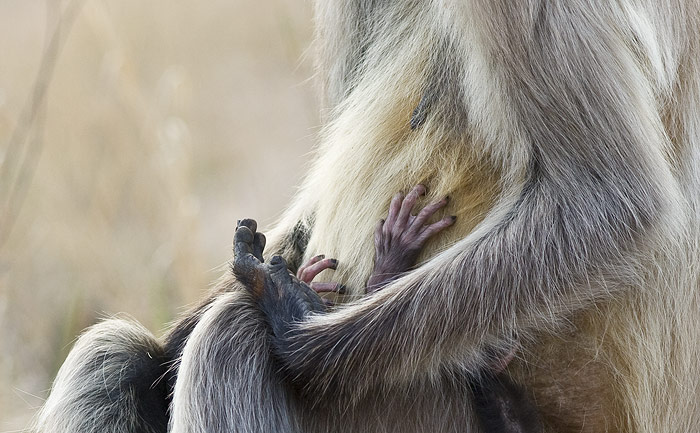
1. Langur (Semnopithecus entellus) and offspring. At the leopard cliffs along the road through the buffer zone.
2, 3. Indian treepie, Dendrocitta vagabunda. Often called the rufous treepie (see Manakadan R, Pittie A. 2004. Standardized English and scientific names of the birds of the Indian subcontinent (222 Kb pdf)).
4. Chital (Axis axis) stags.
5. Sambar (sambhar, sambhur), Rusa unicolor (often referred to as Cervus unicolor (but see Pitra C, Fickel J, Meijaard E, Groves PC 2004. Evolution and phylogeny of old world deer. Molecular Phylogenetics and Evolution 33: 880–895. Online as a 613 Kb pdf file.)). If you look carefully, those are langurs in the background.
6. Roots along the entrance road.
7. Langurs at the entrance to the park's core zone, below the fort.
8. Evening feed, below the fort.
9. Moon over the leopard cliffs.
10. Tiger at Naini Tal, Uttaranchal. CAPTIVE animal. This single male tiger was confined within a surprisingly large enclosure which—perhaps even more surprisingly—included areas where he could hide from view. He seemed in magnificent condition. Most significantly, he was interested in his surroundings—including me, perhaps as potential prey (hence the gaze).
11. Juvenile langur below the fort.
Photos and words © 2007 Pete McGregor


