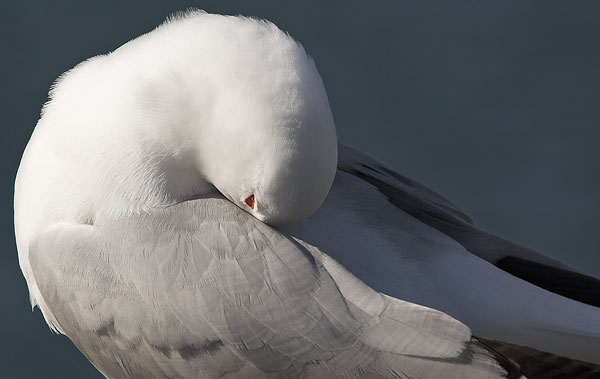
30 October 2006

The Last Post? *

Tell me what is a thought, and of what substance is it made?
Tell me what is a joy, and in what gardens do joys grow?

—William Blake [1]

The man in the bookshop at Shannon leans back in his chair, eyes closed, feet propped on the desk, hands clasped, an open book face down on his lap. Limp kiwifruit skins litter a plate on the desk. The smell of old books.Little shag gular fluttering
He wakes as I slide the door open.
“I was just having a little doze,” he says, smiling.
I ask whether he has a copy of Thus Spake Zarathustra and his face lights up.
“Oh yes,” he says, “I usually have a couple of copies.”
He walks to the back of the front room, crouches and begins to look through a row of aged books. He frowns, seemingly perplexed that he can’t find a copy, but then extracts a volume from the row.
“Ah, this is the only copy I have at the moment.”
We talk a bit about Nietzsche, and it quickly becomes apparent that he shares my low regard for the great philosopher. I suspect we could natter all afternoon but I’m keen to keep moving. I buy the book, half wondering whether it’s a waste of money but I'm nagged by a feeling of obligation to read something of Nietzsche’s original work rather than slandering him solely on the basis of secondary literature.

...

At Williams Park the little shags now have chicks—strange, reptilian little animals. The light there is too harsh, too contrasty, so I carry on to Burdan’s Gate. But there, also, the hard, flat light and incessant wind stymie my intention to photograph. I retreat to the car and sit for a while, thinking of things I've seen earlier in the afternoon as I drove South. Somewhere near Tokomaru I saw cattle in a roadside field. One beast reclined on the ground, feet tucked under—but it was the curve of its neck I noticed. It had its head turned back so it lay against its shoulder, facing back. Something about the curve of the neck, the long swell of muscle under the skin. The poise of the head.

Soon after, I'd passed an old, gnarled Lorina Harding & Nigel Gavin at the Celticmacrocarpa, hardly even tree-like in its form, distorted by accidents and weather and perhaps a history of ill considered pruning. One of the big main branches curved in the exact form of the steer's neck; the swell of muscle appeared in the form of the wood beneath the bark. Even the same colour—the weathered silvery-grey of a charolais cross echoed by the bark of a Monterey cypress.

But no one calls them that here. They’re always macrocarpas. I wonder who first called them that consistently, and why, and when. Cupressus macrocarpa. When I was a child, discovering the world at McCormack’s Bay, macrocarpas were old trees where herons roosted and possums called at night and the darkness under low branches fostered too much imagination.


...

Why is Nietzsche held in such regard? Some call him a genius; he’s widely quoted, usually with awe; the literati relish dropping his name into a conversation, and he’s often referred to as one of the great philosophers of more recent times. Yet, his philosophy—if it can be called that—seems more assertion than reason; more diatribe than argument. I suspect much of the idolising arises from his skill with rhetoric—his ability to form such powerful aphorisms that to deny them is to appear weak and simple-minded. Take, for example, his statement that:

Most thinkers write badly because they communicate not only their thoughts but also the thinking of them.”

It's clever and powerful. However, like so many of Nietzsche’s claims, it's largely bullshit. And, since he deemed it unnecessary—in fact, undesirable—to justify his aphorisms, I won’t attempt to justify my claim that this example is bullshit; instead,Lorina Harding at the Celtic I’ll simply point out that in my experience, poor communication of thoughts more often results from the failure to communicate the thinking of them.
Admittedly, and certainly, some of what he had to say has merit. I think here of one of his more famous aphorisms:

A very popular error: having the courage of one's convictions; rather it is a matter of having the courage for an attack on one's convictions!!![2]

True. His idea of eternal recurrence—live your life as if you're destined to relive that exact life over and over, for ever—can hardly be surpassed as a guiding principle. I'm also very much in agreement with his exhortations to embrace life intensely, to welcome the slings and arrows of outrageous fortune because they offer the opportunity for growth. While I don’t share the intensity of his disgust at the attitude that would shrink from adversity and take refuge in servility, I do prefer courage as a response. But there's a world of difference between turning adversity to your advantage and actively seeking it at the expense of joy. Moreover, courage takes many forms: many more than Nietzsche’s narrow view, which seems heavily weighted towards violence, oppression, deceit, and exploitation. For example, true compassion can require great courage—it's one of the ways it differs from pity or sympathy—yet Nietzsche considered compassion a weakness. The idea that one human being might desire that another will find joy seems not only incomprehensible to him, but repugnant.

...

My friends visit for lunch, bringing their month old baby and pumpkin pie, and the kind of conversation and understanding that delights me. After the pie we sit on the verandah and talk. Emma, soon to turn three, comes over and leans against me, using me as a buffer between the others and herself, her shyness struggling with her curiosity.

My friends leave. Next door, Olive and Trev’s visitors drive off and the grandkids' parents prepare to leave. Carly and Emma run over and sit, one on each side of me on the verandah steps, talking simultaneously, making the most of their last opportunity for the weekend. I can't get a word in edgeways.

Being trusted by children. There’s as much delight and joy in that as in anything I know.

...

It’s tempting to characterise Nietzsche as being at the far end of an attitudinal spectrum with the Dalai Lama at the other; however, although I suspect Nietzsche would have appreciated this and probably considered it a spectrum of greatness, the Dalai Lama would probably dismiss the idea as a dualistic illusion. Moreover, I’m sure he would feel genuine compassion for Nietzsche. This, of course, would have driven Nietzsche insane if he hadn’t already been so for the last 11 years of his life.

I'm left struggling to understand why a person who considered women should be “playthings of the warrior”, most of the human race as “bungled and botched” and their wellbeing meaningless, and who compared them (us?) to apes [3], should be revered as an intellectual genius. Moreover, the pervasive dualism in his attitudes—exemplified by his contrast of Apollonian with Dionysian attitudes towards life—seems, to me, shallow; the opportunities for exploring how to combine those approaches to live a better life are wasted. My best guess is that he’s admired for two main reasons: his rhetorical brilliance, and his sheer audacity—his willingness to declaim against conventional, and mostly reasonable, beliefs. In my opinion, only the first deserves respect, and neither makes him a great philosopher.

...

Grey, drizzly rain; the mountains behind Levin receding in successively lighter silhouettes. Finally, nothing. Perhaps these were the mountains Zarathustra cameMuscovy duck portrait down from; mountains that give birth to legends. Mountains of myth, mountains in the mind. I wonder what our society today would be like if we all followed Nietzsche’s principles? In effect, I suppose I’m loosely applying Kant’s categorical imperative [4] as a test of Nietzsche’s philosophy—but Nietzsche considered Kant’s views absurd and dismissed him as unimportant. Typical, and it does nothing to show Kant was misguided. To the contrary, the little I know of the categorical imperative suggests it’s a useful tool for assessing the value and consistency of a philosophy, and, unfortunately for Nietzsche, it suggests the outcome of applying his teachings would be highly depressing. For example, if we all acted as if compassion were a weakness and the suffering of most of the world’s population as justifiable if it produces even a single great man, then what kind of world would we live in? Not one in which I’d like to live.
...

Wellington's about to be blown out to sea. Spray from the harbour gusts like squalls of rain across the waterfront; several times I'm almost lifted off my feet. But in the shelter of the canyons of the main business area the wind can't maintain its ferocity and resorts to being merely annoying. I make my way back to the car in the late afternoon, luckily avoiding the heaviest of the real rain which began an hour or so ago. A woman in her late 60s, perhaps her early 70s crosses the street with me, and after a particularly vicious wind gust, we strike up a conversation—the familiarity of shared adversity. She wonders whether she’s met me before; my face looks familiar, she says. I explain I'm not local; mention the Pohangina Valley; shake my head when she asks if I’ve been to Teachers’ College. She smiles and says I look like a tramper. You got that right, I say. She doesn’t elaborate, so I don’t know what gives her that impression but suspect it's the gradually moulting down jacket, the day pack, and the weatherbeaten disarray.

There's a fierce joy in foul weather. I think that kind of feeling may have been part of what gnawed at Nietzsche.

...

Back in the valley; a warm afternoon; the last clouds disappearing. A strange evening. I drove into town not long before dusk, and everything had an odd, hazy look—like an imminent fog. Down South, a bank of cloud hung over the Tararua Range, the world vanishing into the blank haze. Almost apocalyptic but without the trumpets and horsemen. For all my criticism of him, I think Nietzsche would have understood this feeling. Whether he'd have longed for the trumpets and horsemen is another matter—contentment seemed not to figure in his thinking. Perhaps he considered that a vice, too? Perhaps he thought dissatisfaction's necessary for growth, or, rather, that satisfaction hinders it? Maybe I'm misrepresenting him, but if I'm not, I'm pretty sure he's wrong. And if he's right, well, it's hard to see the point of a life. That, I think is the root of much of my dissatisfaction with his perspective; it's the feeling that it leads nowhere I'd like to be; a life lived as he advised would be an unpleasant and dissatisfied life.
I prefer the life I'm living.


Notes:
1. from Blake's Visions of the Daughters of Albion. Many thanks to Debbie Lee for this gift.
2. from Nietzsche's
Works, 1920-1929, Volume XVI, page 318

3. I'll point out that I don't necessarily consider “apes” to be a pejorative term, although some of their habits are particularly unpleasant. But in this sense at least, Nietzsche was a man of his time. “What is the ape to man? ” he wrote, “A laughing-stock, a thing of shame. And just the same shall man be to the Superman: a laughing-stock, a thing of shame. ” from Nietzsche's Thus spake Zarathustra.
4. Loosely stated, the categorical imperative states you should act as if what you're doing should be a universal way of acting in similar circumstances. Although it resembles the Golden Rule, it is not the same. The Wikipedia article's a good starting point.

Photos (click the smaller photos to enlarge them):
1.
Little shag (kawaupaka, Phalacrocorax melanoleucos) gular fluttering (it gets hot sitting on those nests. his is how they keep cool). Williams Park, Days Bay, near Eastbourne.
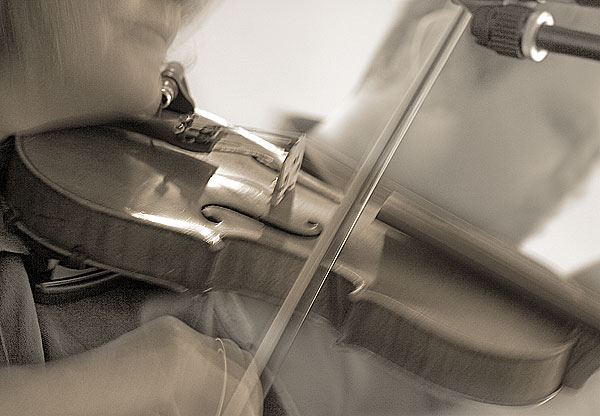
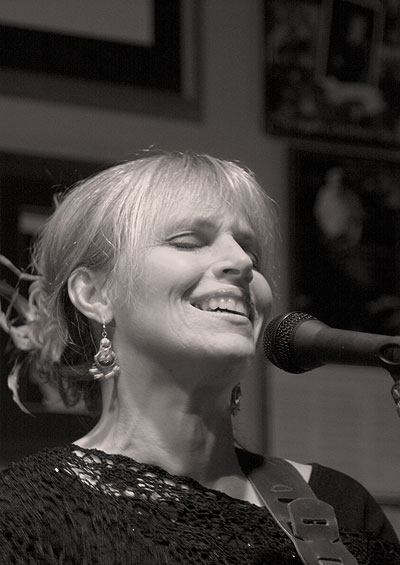
2 & 3. Nigel Gavin and Lorina Harding at the Celtic last Tuesday. Magnificent music. I didn't know they were playing until I arrived as they were setting up; after hearing just a few snippets and phrases of songs I abandoned my intentions of going to a movie. I had the camera with me; the lighting was appalling for photography (dim and red) and I pushed everything to the limits.
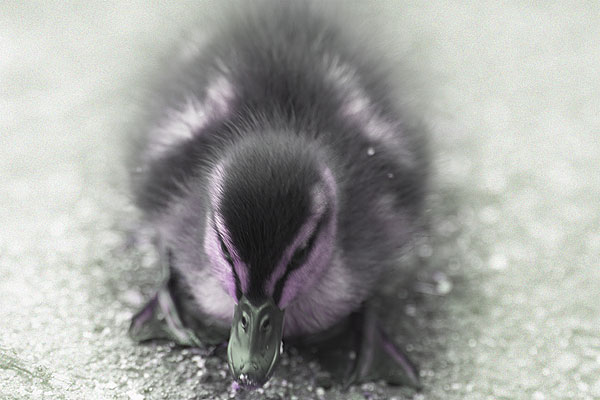
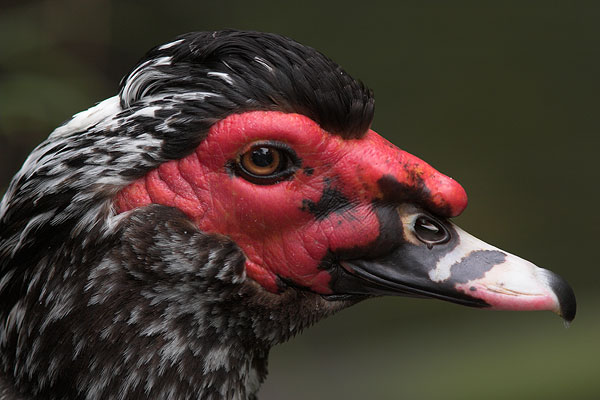
4. It's been good weather for ducks lately. A muscovy at Williams Park. I trust I won't look like this by the time the journey's over.
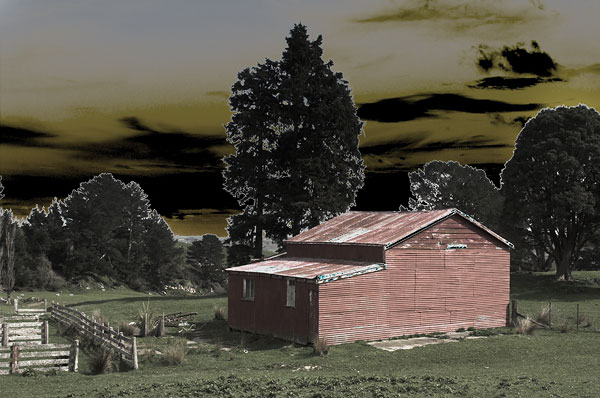
5. Woolshed, No. 2 Line, Pohangina Valley. Playing with the postprocessing.
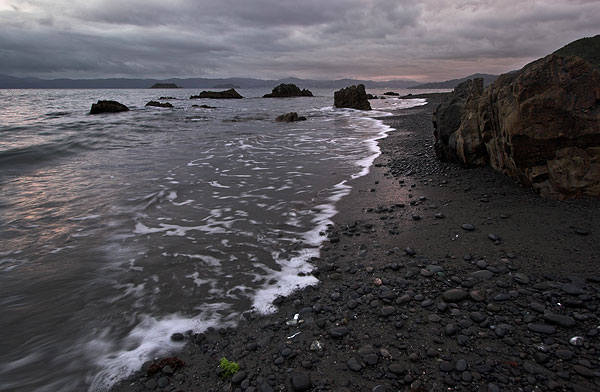
6. Another in the series of the Wellington coast at dusk, Burdan's Gate, near Eastbourne.

* That's likely to be it for a while, as I fly out early tomorrow morning. I had intended to write more before I left; in particular, I wanted to do something about how I photograph, including the post-processing, but that will have to wait. However, this is only a last post in the sense that all time is contingent; I trust it won't be the last in any absolute sense. Take care, and look after each other.

Photos and words © 2006 Pete McGregor

05 October 2006

Departure

Place is security, space is freedom: we are attached to the one and long for the other.”
—Yi-Fu Tuan [1]


When John and I wandered the central Ruahine Range for eight days last November, I saw how he gazed out over the cloud enveloped headwaters of the Pourangaki; sat in the sun above Pinnacle Creek and looked out over the head of the Kawhatau and on into the blue distance; lay back in the snowgrass at the top of the Mania Track, listening to the wind, trying to absorb the nature of the land and breathe in the sky, trying to notice everything. How he seemed to be storing it all up, building memories, a store of solace for the dismal London winter to which he would soon return.

I think I understood how he felt. Now, I not only understand it—I feel it. In less than a month, I leave Aotearoa; I fly out from New Zealand for India and, eventually, Africa. A departure, and an arrival.

Barring the unforeseen, I close the door in the early morning of the 1st of November, make my Burdan's Gate shoreway to the airport and fly to Auckland. Later that day the big jet will speed me away from the place where I was born, to a place I've never been. Leaving home? No—I prefer to think my home comes with me.

However, the problem with saying my home travels with me is that it suggests I'm closed, I'm insulated in my small world. In fact, nothing could be further from the truth—I try to remain open, at least as far as reasonable common sense allows. Perhaps it's better to say my home opens out? Where are the walls of a home? When you step outside and close your door behind you, have you departed from your home? You walk to the edge of the terrace and look out over the evening valley—are you at home? You fall asleep under a bivvy rock in the Darrans, on a different island—are you at home? [2].

At the top of No. 2 Line, I circle slowly on the bike, recovering from a fast, hard climb. The view from the end of the road goes on, seemingly forever. Over deep valleys, endless hills receding; cloud looming; a glimpse of late snow on the shadowed mountains. In the valley below, vivid greens and russets—spring grass and the flush of new leaves on willows and poplars. Already, Azolla, the water fern, has begun to spread its pinkish-red mat over the burnished waters behind farm dams. Patry wasn't wrong when she said I live in one of the most beautiful places on earth. And this is my home; I feel at home here. I understand this, but I also realise “home” can be a matter of degree; to insist, “This is home and that is not,” is to fall into a dualistic trap. Even to say, “Here I feel at home and there I do not,” has elements of that dualism. Perhaps the important question is, “To what degree do I feel at home here?”

Yesterday MB left a comment remarking on the resemblance of some of my photos to the landscapes in which she lives. She's landlocked, far from the sea, yet something about the photo along the coast seemed familiar. I've noticed this when I travel: that tendency to compare landscapes, to recognise what's familiar. I wonder whether we do this to feel more at home?

When we do this, what prejudices do we bring? How does it prevent us from coming to know the true nature of a place?

There's much truth in Yi-Fu Tuan's aphorism, but the more I mull over it, the more I begin to think perhaps “security” isn't quite the right word—for me, at least. “Ease” or “comfort” seems to fit better—or am I confusing place with home? Or maybe it's Yi-Fu Tuan who equates place and home? For me, place is an element of home; sometimes strong, sometimes subtle—possibly necessary but never sufficient.

I circle once more, and begin the descent, gravel crackling under the tyres, the rush of a wheel twitch around a corner reminding me of the fragility of a life. I wonder if, for me, “Home is comfort, space is freedom: I am attached to the one and long for the other”. But even that seems unsatisfactory. Attachment and longing—these are feelings that are slowly becoming strangers to me; paradoxically, these seem increasingly unnecessary while the delight and joy of being with my friends and where I am grows. Perhaps that's good—but one feeling will never be unfamiliar.

I'll always wonder.


The details, and housekeeping:

I arrive in Delhi on 2 November; soon after, I'll make my way to the Garwhal and Kumaon regions, the foothills of the Himalaya. I don't know how far in I'll get—winter will be on the way and I'm not built for the cold. When I can't bear it any longer I'll move South, probably into Rajasthan and on to Gujarat. After that, who knows. Where my feet take me, I suppose. When I find somewhere that feels right, I'll settle for a while—a month or so, then move on.

Five months later, at the end of March, I fly to Ghana. Three weeks there, then a week and a half in northern South Africa, then up to Malawi for a month, all of May. At the beginning of June I head for the UK to catch up with friends and relatives for a week, then on to Paris for a week with friends. Then I'm back—I almost said “home”—to Aotearoa/New Zealand, in late June 2007.

That's the plan, almost as much of it as is confirmed. Whether it happens remains to be seen, but I trust it'll go something like that. There will be great times and there will be ... memorable times.

As for the blog... Sorry, but don't expect much while I'm away. Yes, there will be internet cafes, but there's more to life than hunting for the next internet connection—far more. I'll publish a few more posts before I depart, but from November until July next year, "pohanginapete" will be fairly quiet. If you want to be notified when I do publish a new post, send me an email and I'll put you on the list [3]. I'm unlikely to be able to process photos so they'll be few and far between. However, I will be photographing, and I will be writing—by hand, with a pen, on paper. When I return to Aotearoa—and, with luck, the Pohangina Valley (although that's uncertain)—I expect to have a substantial amount to work on. I don't want to say there will be a book, because every time I say that, it seems to get harder. But...

The travels also mean I won't be commenting on other blogs, or only rarely. Again, I'm sorry; I know how good it is to hear other people's responses, and know I've been remiss in staying silent when even a stone (o) or a :^) would convey what's important. I know it sounds facile, but please trust me—I won't forget you. I'll miss you, too.

He aha te mea nui o te Ao?
Maku e ki atu
He tangata, he tangata, he tangata.


Notes:
1. P. 3 in Tuan, Yi-Fu 1977: Space and place: the perspective of experience. London, Edward Arnold. 235 pp. ISBN 0-7131-5971-5.
2. Yes.
3.
For reasons beyond my understanding, RSS feeds don't seem to work for this blog—when I try to verify the feed I get a truckload of error messages. Sorry.

Photos (click the smaller photos to enlarge them):
1, 2 & 4. Coast at dusk, Burdan's Gate, near Eastbourne, Wellington harbour.
3. Tui (Prosthemadera novaezealandiae) and kowhai (Sophora sp.), Williams Park, Days Bay, Eastbourne.
5. Little shag (kawaupaka, Phalacrocorax melanoleucos), Williams Park.


Photos and words © 2006 Pete McGregor

01 October 2006

Rain

2006:

The first of October. The afternoon darkens; grey cloud thickens, saying rain soon. But it’s still warm out here on the verandah, still calm. The firstMallard of October, and this morning I heard the first pipiwharauroa. In the East, cloud begins to melt into a misty veil of rain over distant hills. A blackbird sings a gentle song from the sycamore and another answers from lower down, perhaps in the apple, perhaps the manuka. A tui too: warbles and clucks punctuating melodic phrases.

The rain veil spreads. Two putangitangi fly, silent and synchronised, across that sky, South to North, upvalley. In the same moment a swallow darts and flickers over the paddock, flying directly away from me, more a quick movement than substance. Receding, flickering its way into the oblivion of the encroaching rain. As the putangitangi fly North and the swallow East, a small flight of finches scatters South and alights in the top of the sycamore. The moment lasts no more than a handful of seconds but seems to contain the meaning of a lifetime. I look up into the sky, above the rain, where the cloud seems uncertain whether to close and thicken or break to let the light shine through. It resembles something William Blake might have painted—dark, immanent, potent, full of symbolism. The first of October.

The first rain begins to tap on the verandah roof.


1997:

Rainwalking, Pohangina River

I used to hate the rain
the miserable drip and
Duckling dreaming
gradual seep the drum
on the hut
s iron roof
with the river rising
all the time uncountable
crossings still to go

Now on my own making
whatever time I like
it
s just another part
of being out here
the silence expands
in this taptaptap this
leafsplatter the dull gleam
of riverbed boulders

Anyone else would wreck it
I hope the other world
s
long gone tucked behind
warm walls with the radio on
leaving me with the cold the
mist thunder in the gorge rain falling -
anyone else would wreck it

but I remember the colour
of the sea and find myself
smiling.


Photos (click them if you want a larger image):
1. Mallard. Williams Park, Days Bay, near Eastbourne, Wellington harbour.
2. Image based on a mallard duckling (loc. cit.), with significant post-processing.
3. Shoreline at Burdan's Gate, Point Arthur, Wellington harbour.


Photos and words © 2006 Pete McGregor

22 September 2006

Dreaming

A stone sits in the middle of the driveway in front of the house. One stone, darker than the rest. A stone that would fit into a cupped hand. The shape is irregular Possum skulland lumpy; the texture rough and pitted. The stone is encircled by a small, blue band of webbing, like a miniature climber’s sling. I recognise its significance.

It is the mark of incipient terrorism.

...

The Neurological Foundation of New Zealand (NFNZ) suggests the current scientific consensus is that dreams have no meaning. The Foundation’s usually excellent newsletter quotes Harvard Medical School’s Allan Hobson [1] as pointing out that “hallucinatory mental content is lowest during active waking and highest during REM sleep,” while “the incidence of thinking is highest during quiet waking and lowest during REM sleep.” From this, the Foundation’s article concludes a sleeping brain cannot simultaneously generate perceptions and think about them; in other words, you cannot make sense of your dreams.

I’m still struggling to make sense of that logic.

...

I walk down the driveway and through the gate, into an area of scrub-covered hillside and crumbling rock, leading down to flat land. I spent my childhood here; now, however, it is Viv playing fiddlemore arid, full of drought and fear. I walk with my hands held out and up to show I am helpless, that I am no threat. I am afraid, but keep walking. A group of small men walk past me and I try to explain that I just wish to talk. They seem to be in a hurry, but they assure me they will arrange a meeting. I am doing this to avert the attack on my family.

...

The NFNZ’s article was published this year. I check the article on which it was based and find it was published in 1998 [2]. Given the article did not present original research but instead was a selective, popular summary, the conclusions are likely to be close to a decade old. That’s a long time in science, and I wonder what the consensus is now.

...

I wake in a room already full of light, and reach out to turn on the radio. A New Zealand woman has been seriously wounded by a gunman in Jordan; another person in her group was killed in the attack.

I am awake in my room in the Pohangina Valley, listening to what happened in the world while I was dreaming.

...

Even a cursory investigation raises doubt about the NFNZ’s dogmatic conclusion. Hobson's models ofTony singing dreaming have not been universally accepted; indeed, they have been opposed vehemently by Mark Solms, whose research results disagree with Hobson's in three major areas.

Hobson claims dreams originate in the same region of the brain (the pons) that stimulates REM sleep; the signals arising here are relatively chaotic [3] and it is the forebrain’s attempts to “make sense” of these chaotic impulses that we experience as dreams. He now concedes that the forebrain might in fact influence REM activity, but still maintains that because the “thinking” part of the forebrain (the prefrontal cortex) is not active during dreaming, while the “emotional brain” (the limbic and paralimbic regions) is active, dreams have little or no meaning.

Solms, however, claims to have shown that dreaming is not synonymous with REM sleep—in other words, that significant dreaming activity occurs independently from REM sleep [4]; and that dreams originate in a different area of the brain (the ventral tegmental area of the midbrain).

Hobson and Solms also disagree about the biochemistry of dreaming. Hobson focuses on the levels of serotonin, norepinephrine, and acetylcholine and how the interactions of these chemicals cause the observed characteristics of dreams, while Solms argues that the dopaminergic system—which also regulates appetites and desires—forms the basis of dreaming.

Thus, the controversy arises from three major differences: the area of the brain in which dreaming Paul playing harmonicaoriginates (and therefore the implications of this in light of what is known about the function of these different regions); whether dreams are substantially a byproduct of REM activity; and the neurochemical basis of dreams (and again, therefore, the implications of this).

The upshot of these differences is that Hobson’s theory points strongly to dreams as being largely random and therefore meaningless, but Solms’ theory links dreaming with areas and processes considered important in generating our appetites and desires. This also means Freud’s theories of dreams can have no place in Hobson’s model, but seem to be not just allowed, but supported by Solms’ model.

Despite this polarisation, Hobson and Solms both consider dreaming as akin to psychosis; they regard dreams as fundamentally bizarre and emotional. However, empirical sleep research—in loose terms, experimental observation—suggests otherwise; moreover, this research suggests both theories are wrong because the predicted associations between neurophysiological activity and the characteristics of dreams (e.g., “bizarreness”, or intense emotion) have not been observed [5].

...

I lie awake, thinking about the dream, thinking about dreaming. When I was a small child, I often dreamed of being chased by wolves and escaping into the sky. As I grewPhymatosaurus in the Ruahine older and learned more about the true nature of wolves, the dream became less frequent. Now, I no longer have recurring dreams—at least, not that I remember. But other people do, and I wonder: if brain activity during dreaming really is so chaotic, how can this explain recurring dreams?

...

Further investigation leads me into a mire of arguments, hypotheses, digressions, and technical jargon well beyond my comprehension, but what does seem clear is that the NFNZ's dogmatic conclusion is unjustified: other theories have been proposed, but all are flawed in some way. Even the popular assertion that sleep serves to consolidate memory is hotly argued [6].

Currently, no satisfactory model explains dreaming. A sound model, it seems, remains a dream.

...

Do dreams have meaning? For all my scepticism about the quality of the NFNZ’s article and regardless of whether Allan Hobson’s theories (or any others) are correct, I’m inclined to agree with at least part of what he says: the greatest value of dreams is that the attempt to interpret them tells us something about ourselves. The difficulty, of course, arises if you believe they mean nothing; if you believe you cannot meaningfully interrogate your dreams. If you believe that, then dreams can tell you nothing about yourself.


Pseudowintera

Notes:
I’m not suggesting any kind of prescience in the dreams I mention here, nor do I attach any importance to the supposed coincidences. Dreams about terrorism are, I suspect, not uncommon. Tragically, nor is terrorism solely a nightmare.

1. Hobson is one of the developers of the activation-synthesis hypothesis, which in its original form regards dreams as essentially meaningless (Hobson, J.A.; McCarley, R. 1977: The brain as a dream state generator: An activation-synthesis hypothesis of the dream process. American Journal of Psychiatry 134: 1335–1348. [Read the abstract]).
2. The original article is no help, because in it Allan Hobson doesn’t argue the case for denying that dreams have meaning—he insists they have no meaning: ‘"Dreams do not contain messages from the unconscious mind, or provide an outlet for repressed feelings," insists J. Allan Hobson, professor of psychiatry at Harvard Medical School.’ (op. cit.)
3. This has been disputed; brain stem signals may be ordered and predictable, or at least not as chaotic as claimed by Hobson (Jones, B. E. 2000. The interpretation of physiology. Behavioral and Brain Sciences 23: 955–956).
4. The association between dreaming and REM sleep has been recognised since 1953 (Aserinsky, E.; Kleitman, N. 1953: Regularly occurring periods of eye motility, and concomitant phenomena, during sleep. Science 118:273–274); however, this aspect of the Hobson/Solms controversy focuses on whether REM sleep is the sole origin of significant dreaming.
5. Domhoff, G. W. 2005: Refocusing the neurocognitive approach to dreams: A critique of the Hobson versus Solms debate. Dreaming 15: 3–20.
6. For example, compare Robert Vertes' conclusion that “there is no compelling evidence to support a relationship between sleep and memory consolidation” with the view of Jan Born and Björn Rasch that “ compelling evidence has accumulated that links sleep to learning and memory.” Vertes, R. 2004: Memory Consolidation in Sleep: Dream or Reality. Neuron 44: 135-148; Born, J.; Rasch, B. 2006. Sleep to remember. The Neuroscientist 12 (5): 410–424.


Photos (click them if you want a larger image):
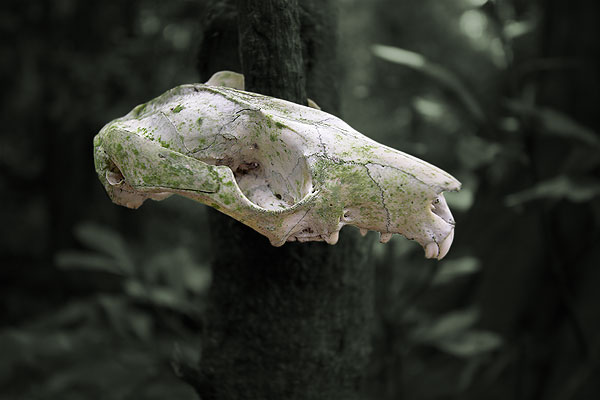
1. Possum (Trichosurus vulpecula) skull, No. 1 Line track, Ruahine Range. Someone had hung this by its eye socket from a small, dead shrub in front of the massive rimu, a tree hundreds of years old.
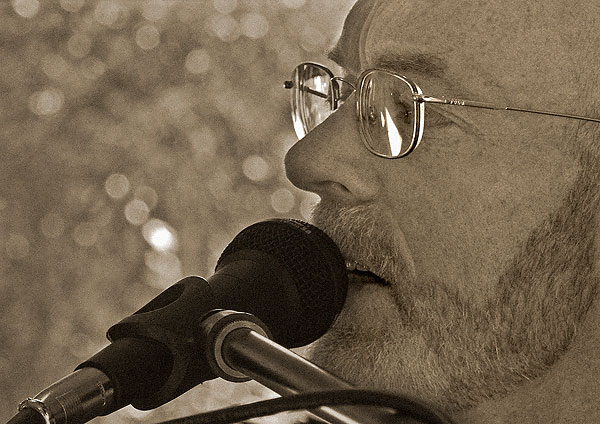
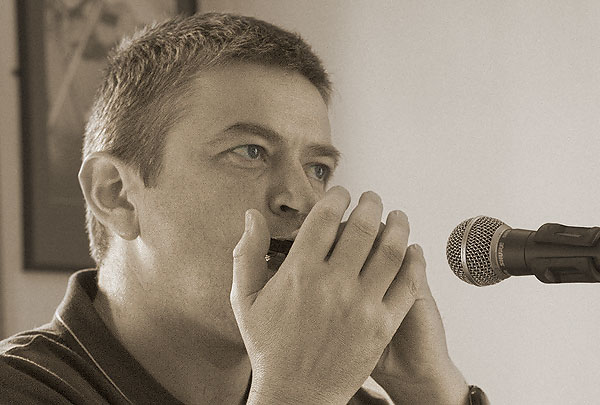
2, 3, 4. Viv, Tony, and Paul playing at the Waterford a few weekends ago.
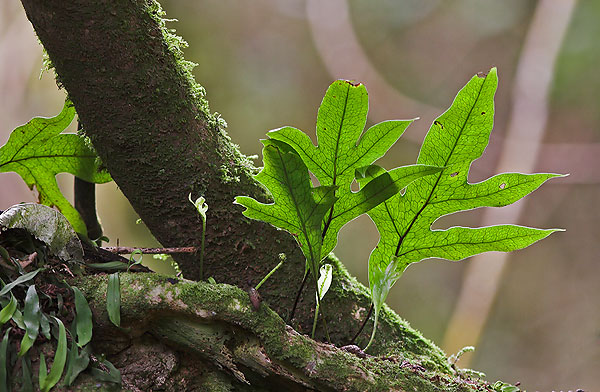
5. Kowaowao (hound's tongue fern, Microsorum pustulatum), No. 1 Line track.
6. Image based on a photo of horopito (mountain pepperwood, Pseudowintera colorata), No. 1 Line track.


Photos and words © 2006 Pete McGregor


15 September 2006

Corrugated iron

Corrugated iron. It’s so much a part of the New Zealand landscape—sheds, roofs, fences, shelters, old sheets lying in paddocks. Newly erected iron gleaming; iron painted every colour; unpainted, faded iron; rusted iron. Patchworks of reused iron salvaged from demolitions and nailed onto the side of a shed to replace the iron rotted by age and too much rain and damp seeping from cold ground. It’s everywhere, from every angle you choose to view the landscape; it’s rural and urban; you find it on old huts in remote areas among mountains and along coasts—particularly along coasts where people shelter after a day’s whitebaiting [1] or surfcasting and drink beer and whisky and lie about what they had on the line. The rain arrives—hard, West Coast rain so loud you can hardly hear the lies so you sit back and eat fritters and enjoy the sound and hope it’ll be a good day in the morning.

Not everyone appreciates corrugated iron. Some people associate it with other things. Years ago I knew someone who emigrated from South Africa to New Zealand to practise as a GP for the foreseeable future. As her plane flew low over Palmerston North she looked down on the rooftops. She looked down on all those corrugated iron rooftops and burst into tears. She thought she'd come to live in a shanty town.

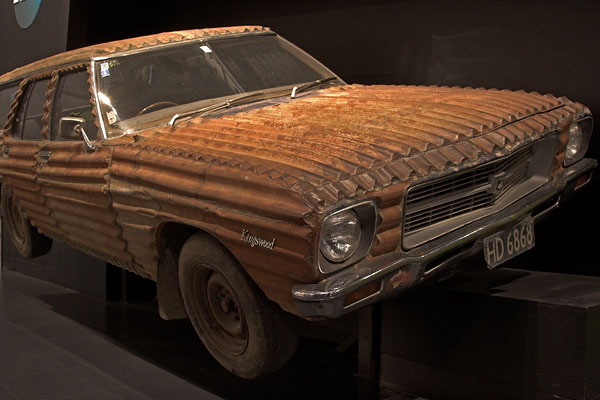
At Te Papa, the Museum of New Zealand, there’s a Holden Kingswood station wagon on display [2]. The panel work is made from corrugated iron the colour of rust. To me, cars are tools, but I can appreciate a car like that.

I think it’s the texture I love as much as anything else. A corrugated iron wall can never be a blank wall. Not like the freshly painted wall I see out this window, across the street from the Wellington City Library, next to the construction site. A blank, concrete wall, painted khaki. Bland and featureless, it functions aesthetically only as a screen on which the late morning sun projects patterns of shadow and Pukekolight from the glass and concrete surroundings, and as a backdrop for the found sculpture of reinforcing rods projecting skywards from the foundations like stripped sinews. Corrugated iron, however, always has texture; it’s never blank. Lead-head nails slide their shadows across the corrugations; the sun glances off the side of a shed at a low angle and every long hollow’s a line of shadow, every ridge a bright line of light. The pattern's so regular that every dent stands out, each containing a story. A world without imperfections is a world with nothing to say.

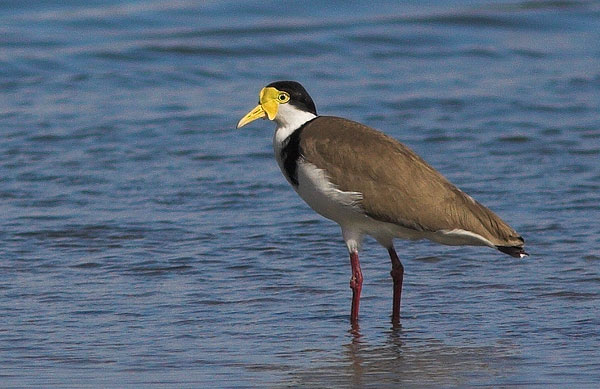
I drive the narrow road to Kuku beach, past dairy farms and ragged hedges, by old wire fences with battens leaning at random angles. The wire's still the old, pliable No. 8, not the thin and difficult high tensile modern stuff. Beyond the railway line there’s a poultry farm, every shed made of corrugated iron. Pukeko [3] forage in roadside paddocks, high stepping, tails flicking. One stretches its neck to inspect the car as I idle past; another slips away, head down, through long, hummocky grass. More reptile, or dinosaur, than bird. Each house has one or more sheds or garages of corrugated iron; the houses themselves are roofed with it. Haybarns, milking sheds, calf shelters, abandoned fowlhouses—all corrugated iron in shades of oxidised galvanising and faded red. That battered shed over there might once have been pale lavender, perhaps from a cheap lot of bargain bin paint; now it’s almost indistinguishable from the grey of aged iron. A shelter by a farm driveway is the simplest of structures: three sides and a roof, just enough in which to keep dry until the school bus arrives; a basic frame of weathered four by twos and a few sheets of corrugated iron banged on with left-over lead-heads. But the bus has gone, the kids have disappeared, and the shelter contains nothing but sunlight and shadows, the warmth of Spring and a few infinitely patient spiders Spur winged ploverat the mouths of their retreats. Nail a sheet of corrugated iron to a wooden frame and you create 27 homes [4].

The car bounces over the last 50 metres of sandy track to the carpark. I assume this is it; it’s just a flattish area in the dunes, near a line of low, salt-stunted macrocarpas. Empty of cars, empty of people. The place has that out-of-time feel, as if it’s been abandoned by the twenty-first century, left to the birds and the wind. I walk slowly, aware how each footprint adds to the line, and sit on a driftwood log in the sun and the cold breeze. A spur winged plover [5] calls at me until it sees I’m sitting still, then it resumes its inspection of the shallow water along the edge of the stream. On the far side, pied stilts [6] step and yelp and probe the water.

The whitebaiters padlock the door and drive off, and a blowfly, trapped inside, walks up and down the windowsill; a cloud passes overhead and the iron roof cools and contracts, banging and cracking. Inside, the clock's tick stops; the fly pauses, then falls to the floor, and the room fills with the sound of surf at the river's mouth and wind around the walls.


Corrugated iron car

Notes:
1. New Zealand whitebait are juvenile forms of our native galaxiid fishes. They're mostly diadromous and definitely delicious, with inanga (Galaxias maculatus; considered catadromous because the adults migrate to estuaries to spawn) reputedly being the best of the several main species of whitebait. In Wellington last week, 100 gram punnets of whitebait were selling for NZ$15; bad luck if you're short of money—or if you're a whitebait.
2. The work is by Jeff Thomson
(do check out the link; it's an excellent essay with great examples of his work). He's well known for his corrugated iron sculptures, particularly the animals.
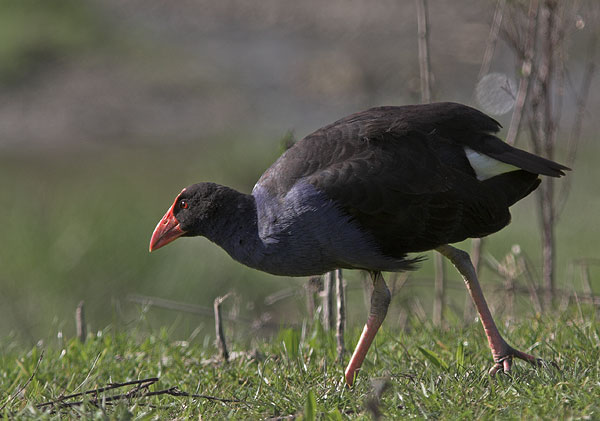
3. Porphyrio porphyrio. The English vernacular is “swamphen”, but no one I know calls them that in New Zealand. They're always pukeko. Or “pookackas”, sometimes abbreviated to “pooks”. A few farmers—those whose crops have been damaged or water troughs fouled—have other names for them.
4. Three rows of nine tunnels. Now, corrugated iron is rolled in all sorts of lengths and contours, but my calculation's roughly true for the old style sheets. Its propensity for harbouring little creatures is something else people hate about it. Understandable when you're sitting on the long drop at night, surrounded by the gleam of spiders' eyes, the long legs of Cambridgea reaching out from between the iron and wood.
5. Vanellus miles novaehollandiae
. Rare only a few decades ago, these weird and rowdy birds have spread throughout New Zealand and are now among the most common farmland birds. Because they prefer large areas of open pasture, they're found at most airports; consequently, they're the most common cause of bird strikes in New Zealand.
6. Poaka; Himantopus himantopus.

Photos (click on those above if you want a larger image):
1. Shed and creeper; Shannon.
2. Pukeko at Lindale; Horowhenua.
3. Spur winged plover at Kuku beach; Horowhenua.
4. Jeff Thomson's Holden; Te Papa, Wellington.


Photos and words © 2006 Pete McGregor

09 September 2006

Dusk

You step out into the dusk. Grey and white clouds mount over the ranges; a full moon rises, huge, the colour of bone. Colour still lingers in the sky—violet, purple, mauve, a tinge of pink. Hues fade, moment by moment; the remains of the day are overwhelmed by twilight, the looming dark. Edges soften and disappear, leaving only forms and shapes; clarity becomes a remembered concept; the world is seen best from an angle, not confronted directly by the eye. This is the time of birds roosting, late shapes flitting quick across a road, the chink-chink of blackbirds, things half seen moving under branches. This is when the rustling starts in old sheds; when you hear the pattering run of small feet along the malthoid lining of the fowlhouse roof. Chooks murmur and shuffle on their perch. Perhaps a possum[1] might start up in the macrocarpas[2]—the sound of an old man trying to cough and gasp and chuckle all at the same time. Hearing it, a man reaches for his spotlight and .22.
You step out into the dusk, which is no longer a winter dusk. Cold, but without the edge, lacking the bitterness. You step out into the dusk and fall backwards out of the present, into a half dreamed world of wire netting and paling fences preserved with old sump oil and warped by the years. A cat springs onto a post, looks briefly back, and is gone. Vegetable gardens in back yards; careful rows hoed; a few cabbages; a pruned vine trained along the paling fence, tied with baler twine. Your grandfather sits in the doorway of the shed with his pipe and his memories. Perhaps he’s thinking of a time before your mother was born, or perhaps he’s thinking about what to plant in the plot he’s just finished turning over.
You step out into the dusk and people you never met walk out of the shadows. They build fires and camp on river banks, cook eels and kereru, and move on past you, upriver, into the shadow of the mountain. They nod to you as they walk by and you do the same. No words. A ruru[3] calls and another answers; in the moonlight, something runs across a clearing. You don’t know what it is, but you know it will never be seen anywhere but here, in this time, in this twilight, in the back of your mind.


Notes:
I've been working on a post about dreams, and seem to have stalled. Late the other night I abandoned it (perhaps temporarily) and started writing something completely different; something not intended as a post; something I thought would have no structure, would go nowhere. Writing for the sake of writing and nothing more. Later, I stopped, sat back and wondered where on earth—or elsewhere—it came from. This is it.

1. The introduced Australian brushtail possum, Trichosurus vulpecula.
2. Cupressus macrocarpa. Known as Monterey cypress elsewhere but here simply as macrocarpas, these are near-ubiquitous features of the rural New Zealand landscape.
3. The morepork, Ninox novaeseelandiae. Aotearoa's only extant native owl.

Photos (click on them if you want a larger image):
1
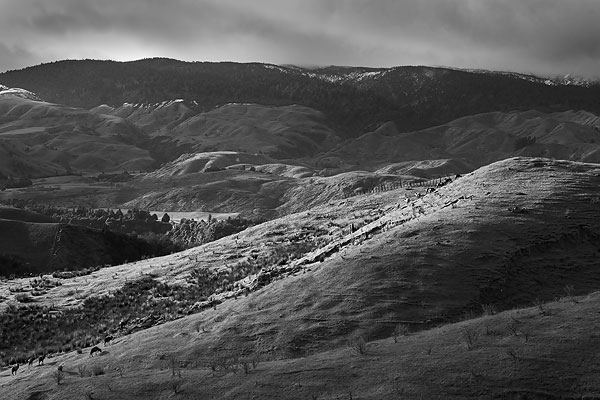
. A view East across the upper Pohangina Valley to the southern Ruahine Range, winter 2006.
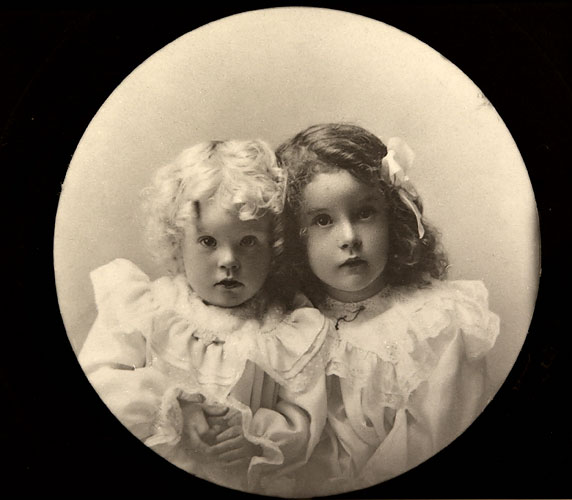
2. My maternal grandmother, Veronica Blake (R; dark hair), and her sister, Aileen. Date unknown, probably the first few years of the 20th Century. The original photographer was H.H. Clifford, of Christchurch, N.Z. Veronica ('Nana' to us when we were kids) grew up and married James McGrath.
Photos and words © 2006 Pete McGregor

31 August 2006

Vagrancy

A shower of rain, heavy on the roof at night. A friend sends a txt: the sound of rain, her bed a tent, her vehicle a bike, her house a backpack. I reply saying rain here too, but there's too much stuff here, and tell her about the herons nesting in the poplars by the bridge [1].

The Gang of Three visited this morning. We sat on the verandah and I read another book to them, but Emma, being only four, got distracted and kept checking the paddock for more pieces of wood for their fireplace. “That one's no good!” she said, “It's got dirt on it!” My reading meant nothing to Aaron, of course—he's less than a year old and only just discovering words. Carly, however, sat next to me listening, attentive, politely not interrupting. Holding onto Cookie. She tells me he likes going for walks because he gets bored lying in her room all day doing nothing until she's home from school. Eventually Olive and Aaron went to feed the deer and lambs, and the girls and I followed shortly after, to find Aaron sitting on the ground by the gate, in the mud, with two lambs checking him out while Olive threw stale buns or something to the deer in the next paddock. We rescued him as Olive returned, half muttering and half laughing about kids and mud and saying that’s what washing machines are for. Back on the verandah we sat on the steps, chatting while the kids ran up and down the verandah yelling and having fun. Aaron waddled over and managed to topple and slide head first onto the top step. Not serious, but I expected howls and tears. But Emma picked him up and put her arms around him—she’s hardly bigger than he is—and hugged him, tucked his head into her shoulder and held him tight. The tears never came—instead, he went straight back to stealing the pieces of wood she'd collected, and offering them to me. I remembered how Emma had become upset a few weeks ago and Carly had comforted her in the same way; arms around her. The wisdom of small children. I think of the puerile behaviour of our politicians and realise they don't deserve the compliment of being called “childish”.

I walked down the road, stopping to photograph tui [2] and korimako [3] and the herons standing tall and thin in the poplars by the bridge; walked on up No. 3 Line a little way, then returned, photographing the herons again and a kereru [4] in the cutting. Cold air but the brilliance of a clear day at the deep end of winter; some warmth. Birds; lambs growing day by day—already the wobbly fragility of the newborns has begun to disappear and they’re beginning to develop that slight robustness. I walked along the road and looked out over Te Awaoteatua Stream from the No. 3 Line road, looked up to the Ruahine, dense with leatherwood [5] and bright under dark cloud, and saw everything new, saw it all as if for the first time. The following evening I drove South to Point Howard. The light still had that old look to it—deep shadows, strong relief, the warm look where the sun caught the land seemingly at odds with the cold contained in gullies, under hedges, beneath trees, behind barns. Shower cloud darkened the sky and let the sunlight through in rays and beams. Prehistoric light. Along the coast between Paekakariki and Pukerua Bay the sun had almost set, the clouds orange and mauve and grey; the South Island silhouetted on the horizon. That feeling of the utter remorselessness of time. You look ahead to something, then it’s here, then it’s gone. It becomes the past; becomes history. Your history. Is that all we do—moment by moment, create our own histories? In a sense, maybe it is, whether we create it—in the sense of determining or influencing it—or not. But, seen like that, perhaps it’s the ultimate lesson in making the most of every moment: because we’ll never get another chance. What we do with these moments determines what they’ll be, forever.

My friend sends another text; words I recognise: “…geese in flight and dogs that bite…”[6]. I check the definition of “vagrant”[7], and read, “A wanderer who has no established residence or visible means of support.”

The wind picks up, and a shiver runs through the house.


Notes:
The names of some people may have been changed.
1. White faced herons; Ardea novaehollandiae novaehollandiae.
2.
Prosthemadera novaeseelandiae.
3.
Anthornis melanura.
4. New Zealand pigeon; Hemiphaga novaeseelandiae.
5. Olearia colensoi; tupare.
6. From James Taylor's, Carolina on my mind.
7. The definition is from WordWeb, the free edition. It may not be as comprehensive or authoritative as some other dictionaries, but for sheer functionality, it's peerless. Highly recommended.

Photos (click on the smaller photos if you want a larger image):
1. The kereru in the cutting.
2. Red billed gull (
Larus novaehollandiae scopulinus; tarapunga) preening; Petone wharf, Wellington harbour.
3. The same gull, doing what gulls are wont to do.
4. Rock, mussels, waves. Eastern shore of Wellington harbour, near Burdan's Gate (ref. my 6 August post). I desaturated all the colours except the greens, and tweaked the contrast a little.