02 July 2014

Walking the No. 1 Line track

The way to pay tribute to a place is not always to go there and wear it down, and capture it, and make pictures of it, and describe it.
— Nicolas Rothwell

Maybe the best journeys are the ones that are worth repeating, and are repeated.
— Rebecca Solnit

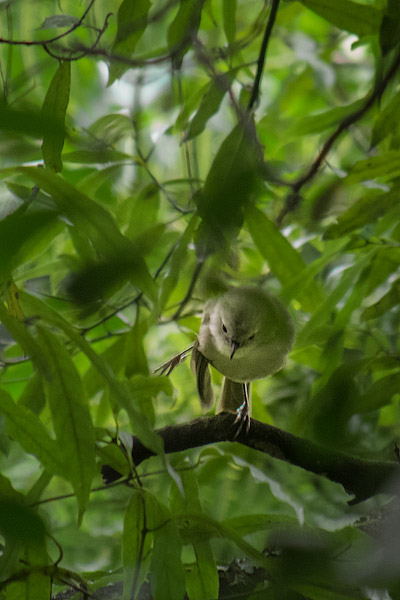
Late in the afternoon I sat again at the top of the No. 1 Line track and waited for the water to boil. A heavy overcast sky hung low, dimming the light on the mountainsides, turning them dull and flat; a long way out over the Manawatu plains, grim grey cloud obscured the horizon. No view of Kapiti; certainly no view of the distant South Island which just a day earlier had floated, hazy and silhouetted but distinct, above the dull shine of the midwinter ocean. I hadn’t stayed long then, partly because the cold wind had made sitting uncomfortable, but mostly because I’d forgotten the tea. I’d scribbled a few notes, tried to photograph the little male miromiro who’d appeared almost the instant I’d sat down, mentally kicked myself for also forgetting the binoculars—was I really so distracted by imminent travel that I could forget such essential items as tea and binoculars?—and soon started back down the track into the dusk.

Now I sat sipping Lapsang Souchong tea, cupping the blue tin bowl in my hands and every so often jotting down another thought. A blackbird sang quietly a long way below in the steep gully; a pair of hedge sparrows called to one another nearby; otherwise only the sound of occasional gusts of half-hearted wind sighing through the pepperwood and a few distant shotgun blasts broke the silence. I realised I missed the insects of summer. Nothing buzzed past; no crane flies bumbled around in the bush rice grass below the seat; nothing crawled or scuttled along the seat or over the damp cold ground or up the old stump reaching into the sky. The worst of the winter cold hadn’t yet arrived—that might not be far off, with the forecast saying snow below a thousand metres in the next few days—but already the small lives that animate this place in summer had shut down, or died, or changed into some other, possibly even more alien, form.
Life existed in abundance all around me, but the impossibly slow lives of plants can’t replace the intensity of insects. Trees may outlive us but we burn brighter; we, if we’re lucky, outlive all insects but they burn like arrows on fire. This raises the question: which is the better life—slow but long, or intense but short?
I’ve heard it said that what counts isn’t the length of a life but its quality, but that has never seemed satisfactory to me. A short, intense life might be wonderful but, barring bad luck, a long, wonderful life must surely be possible and just as surely more desirable; after all, the longer you live, the more opportunities you have. What you do with those opportunities—more accurately, how you respond to them—is up to you, but even if you stumble and waste some, or struggle to make the most of circumstances that seem on the face of it to be those you’d rather have done without, a life of 97 years, say, offers many more opportunities than one of, say, 23. For example, not the least of the advantages of a long life is the ability to develop what we usually call wisdom—the application of a life’s experiences to help interpret, tolerate, and appreciate life’s events; and to use those experiences and a lifetime of accumulated knowledge to grow, to help others, and to make the world better for the fact we’ve lived in it.

I walked back down No. 1 Line, sometimes inadvertently glissading on the mud that constituted much of the upper part of the track and wondering whether this might become a new winter sport particularly suited to the Tararua Range, that often-disparaged but popular range of mountains immediately south of the Ruahine and notorious for its weather and mud. Where the track made its way through the bush, so little light remained that I packed the camera away and enjoyed the freedom of having both hands free. I negotiated the bog at the top of the Copper Glade, passed quietly through the Possum Bones Clearing, took the usual detour past the Stinkhorn Step, and paused at the lower lookout. A tui warbled and coughed from the miro; the volcanoes of the Central Plateau hid behind a pall of dark, hazy cloud; the familiar farmland below looked bruised and worn out in the cold dusk.

How many times had I stood here and studied the same but not-quite-the-same view? I wondered about people who return to the same place, over and over—the same mountain, the same hut, the same wild little beach, the same swimming hole in the same river—the people who return year after year and sometimes become so associated with that place that it becomes part of their identity. Does this represent a lack of imagination, a lack of curiosity about other places? Or, does it indicate a love for the place, the gradual building of a relationship with it so, finally, it becomes home?
Both, I suspect, and to varying degrees depending on personality, but I like to think my own inclination to return to places like No. 1 Line and the headwaters of the Pohangina reflects a deepening love for those places; that the more I come to know them the more they come to know me and welcome me back. What I try hard to avoid, though, is any sense of ownership of those places—the kind of attitude I’ve encountered (fortunately, rarely) where a person who’s made a habit of of returning to a place projects an air of superiority, of knowing more about it than anyone else—a kind of verbal marking out of territory. This can be a subtle trap because the more you know about a place, the greater the temptation to share that knowledge, and that can be analogous to name-dropping—a particularly tempting and objectionable tendency that probably arises from insecurity. This knowledge-dropping—most noticeable among blokes, who seem unable to resist the challenge of competitive storytelling—might be well-intentioned, but that makes it no less distasteful for the listener. I’m guilty; I’ve done this far too often. Now I understand the trap I hope to avoid it, but habits die hard; in fact, habits are almost impossible to kill—the way to defeat them, I think, is to replace them.
Below the lookout I picked my way down the steepest part of the track, into the gathering dark. I tried as always to walk as quietly as possible, an effort made easier by the damp ground and harder by the silence. The breeze higher up had died away and nothing disturbed that silence other than the occasional fall of something small—a twig or berry, a leaf, or a flake of bark—and the shuffle of a large bird roosting, probably a kereru; intermittent rifle shots from somewhere down the No. 1 Line road; and my own quiet tread. When sight begins to fail the first sense to take over is hearing, and the snap of a small twig made me pause and listen harder. Nothing more, though. Possibly the first possum; perhaps even a deer; probably just the land adjusting to the approach of night.

I walked on, enjoying the thought that, in my camo bush shirt and dull green longs, I might be almost invisible. To come to know something well—some person, some place, some event—you have to interact with it, but to interact with something is to change it, and sometimes the change affects the characteristics you most love. Sometimes those changes might be for the better; too often they’re not; most often we don’t know whether they’re good or bad, and the very concept of good and bad might be irrelevant or meaningless. If my presence here, moving through the dark under the trees along a rough track, changes this place, I want those changes to be for the better, but I have no way of knowing. The best I can do, then, is to have as little effect on the place as I can, and that means moving quietly, disturbing nothing, leaving no trace, and resisting the urge to take anything. Sometimes, even photographs seem too intrusive.

But when the land seems to offer something, I’m not strong enough to resist, nor, I think, should I resist. When a miromiro flies to a perch a few metres away and eats its caterpillar there, brazenly, right in front of you when your camera’s sitting next to you with the right lens on, what should you do?

Here’s my answer.


Notes:
1. The introductory quotation by Nicolas Rothwell is from page 172 of The Red Highway, Collingwood, Australia: Blank Inc., (2010). ISBN 9781863954938. The one by Rebecca Solnit is from her essay ‘The art of arrival: On movement, stillness, and the arc of a life’, in Orion 33(3): 58—63.

Photos:
1. Kapiti Island from the top of the No. 1 Line track. June 2014.
2. Jacob’s Ladder (‘God beam’) over the Pohangina Valley. April 2014.
3. Popokatea (Whitehead) on the No. 1 Line track. May 2014
4. Miromiro at the top lookout on the No. 1 Line track. June 2014.

Photos and original text © 2014 Pete McGregor

16 June 2014

The urge to collect

'...he was also in the grip of an urge that gained a stronger hold on him with every day: it was the collector's disease, that unsleeping impulse to acquire, to classify, to create a microcosm where order and pattern can be shored up against the world.'
 — Nicolas Rothwell

In Tove Jansson’s Finn Family Moomintroll, one of the hemulens first appears in a melancholy, almost distraught state. When Moomintroll questions him, the hemulen reveals the cause of his despair: an obsessive stamp collector, he has finally completed his collection. He now has every stamp, every error; nothing remains for him to collect. Moomintroll begins to understand.

‘You aren’t a collector any more,’ he says, ‘you’re only an owner, and that isn’t nearly so much fun.’

As a very small boy, I too collected stamps. Briefly and badly, I admit, but I shared the hemulen’s urge to collect. I soon lost interest in stamps but not in collecting; that impulse took decades to dissipate. For much of my life I was possessed—and I use the word deliberately—by that urge, which manifested most obviously in the accumulation of a collection of pinned, pickled and labelled insects that to the best of my knowledge remained for some years the most extensive and interesting insect collection submitted for the fourth year entomology paper at Canterbury University. Still, compared to professional research collections like those of the university's zoology department or the New Zealand Arthropod Collection, my dead, preserved insects barely registered [2].

Somehow I eventually lost the need to own boxes of dead insects. Perhaps getting a job that came already supplied with a large—by my standard—insect collection meant most of the insects I encountered alive were already represented by dead cousins in the collection, so adding another to the killing jar and eventually to a wooden box seemed pointless (mostly, it is, although the study of variation within a species remains important for distinguishing species). Eventually the loss of the urge to collect developed into a mild aversion. My taste for collecting not just insects but most other things has become exhausted, or, perhaps more accurately, I have become exhausted by the accumulation of things and stuff. I now have more than enough things and stuff and get more satisfaction from getting rid of things and stuff than from accumulating more.

I wonder about photographs, though. I wonder in particular about photographs of insects. Having recently discovered the NatureWatch web site and at roughly the same time settled on an excellent system for macro photography, I’m getting a great deal of satisfaction from posting observations of insects and plants, thereby slowly building a record of interesting things around the house, up No. 1 Line, and in the Ruahine. Could this be a way of satisfying that urge to collect? I thought that was long gone, but maybe it was just dormant.

...

Collecting photographs, though, seems harmless. Who could object? What harm is being done? Certainly none to the subjects—the spiders and flies and beetles and little flowers and other things so easily harmed by other, even temporary, forms of capture [3].

There, though—that word: ‘capture’. At the risk of disclosing my crankiness, I’ll admit that the word ’capture’, along with an increasing number of other too-often thoughtlessly used words, bugs me. Look at the photoforums and you’ll see the comments infested with statements like ‘Great capture!’ or its twin, ‘Great catch!’ The subject hasn’t been photographed; it’s been captured, ensnared, possessed. My aversion to this has become so unreasonable I don't even like to say I 'took a photograph', preferring instead to say 'I photographed'.

'Nit-picking,' you say. 'Semantics—"capture", "catch": they're just words.'

No, they aren’t. It’s a way of thinking. It’s a collector’s attitude. I’ll stress that I accept no harm is being done to the subject, unless of course the photographer is one of those morally suspect or possibly well-meaning but ethically unaware individuals who breaks branches off instead of tying them out of the way, or who persists in trying to get closer to a bird that’s clearly anxious. In general, though, most subjects will have no awareness that they're being photographed. Many won’t even have what we could reasonably consider ‘awareness’ of any sort; for example, a little gentian flowering on the side of the No. 1 Line track responds to its environment in only the most basic of ways. When did you last hear a plant exclaim ‘Eek! A photographer!’ and close its petals over its pistils?

If any harm is being done, therefore, the most obvious recipient of that harm is the photographer, the collector of photographs.  Mostly, no harm will be done even to him (or her). Another possibility is that those who view the photographs might in some way be harmed. The obvious way this might come about is through inurement: after repeated viewing of photographs that at first kindled wonder and awe, the viewer might lose not just that ability to be moved, but the empathy that accompanies it. This, however, seems to draw a long bow; if it's true at all, I doubt it's common enough and important enough to agonise over. Feel free to disagree.

...

Moomintroll was right when he said owning isn’t nearly as much fun as collecting. What he didn’t say was why it’s not as much fun. That’s a much bigger question, though; it has many answers and Moomintroll might never have carried on with his adventures if he’d stopped to philosophise about the consequences of owning compared to collecting [4]. However, as far as I can work out, the main reasons owning isn’t as much fun as collecting are twofold. First, the owner has the responsibility of looking after the collection, and that can lead to the gnawing fear that something dreadful might happen to the collection — theft, fire, pestilence, the depredations of small children, and so on. Second, an owner is no longer creating anything, at least in any significant sense. That second reason rings most true for me because the act of creating something is the primary way a life attains meaning [5].

Perhaps this, then, explains why I continue to add to these collections of words and photographs: because I'm driven not by the desire to amass, but by the desire to create.


Notes:
1. The introductory quotation is from page 11 of The Red Highway, Collingwood, Australia: Blank Inc., (2010). ISBN 9781863954938.

2. If the hemulen had chosen insects rather than stamps, he could have spent his entire life collecting with no risk whatsoever of completing his collection. Even specialising in beetles, the most numerous organisms on earth in terms of species, would have left his collection incomplete and him permanently happy.

3. Unless you believe, like Dr Brett Mills, that animals are aware enough to understand the concept of privacy.

4. That’s a job for the Muskrat who, if his whiskers have anything to do with it, might be a cousin of Nietzsche (although this has been disputed and a reasonable claim advanced that the Muskrat was modelled on arch-pessimist Schopenhauer). The Muskrat, however, would undoubtedly have considered collecting to be useless—possibly even as useless as owning anything.

5. Richard Taylor makes a persuasive case in support of this claim.

Photos
1. Copper butterfly on the No. 1 Line track, southern Ruahine Range, January 2014

2. Crane fly at the top of the No. 1 Line track, southern Ruahine Range, January 2014

3. Fungus gnat on Agrocybe parastica fungus, Pohangina Valley, late February 2014

4. Native gentian near the summit of Tunupo, southern Ruahine Range, mid February 2014

Photos and original text © 2014 Pete McGregor

23 March 2014

The functionally invisible world

This is a female booklouse. Booklice aren't lice (although the parasitic lice probably evolved from one of the groups of booklice) and they don't eat books (although some species are associated with them and may nibble the paste in book bindings). They belong to an order of insects called Psocodea [1], which includes 'booklice' (in the narrow sense), 'barklice', and the parasitic lice. The female in the photograph is one of New Zealand's native barklice but that term is far from entirely accurate too, because they're found in far more habitats than on bark. I found her on a lichen-festooned fence batten, where she seemed to be doing her best to avoid the attentions of a male who was displaying vigorously at her.

Many years ago, this unmistakable species was included in the genus Myopsocus. Later, it was transferred to the horribly-named genus Phlotodes (which sounds to me like something you might find honked into a handkerchief); it stayed in that genus for a few years before being shifted back to Myopsocus. Now, apparently, someone has moved it to the genus Nimbopsocus, a name roughly ten times longer than its owner even without the part that identifies the species: australis.

What often strikes me about these kinds of tiny creatures is the way they're unknown to most people. I'd be amazed if the number of New Zealanders who'd ever noticed Nimbopsocus australis [2] got beyond double figures. This species is fairly easy to find: just look closely at anything with a good growth of lichen and eventually you're likely to see either the adults or the herds of nymphs (which cluster in mobs like tiny wildebeest, grazing on algae, fungi and lichen). But who bothers to look? A few oddballs like me; weirdos who get more delight out of peering at lichen-encrusted fence battens and stockyard railings than polishing their Holdens; eccentrics who'd rather know about barklice than Bathhurst. They (these barklice, not me) are beautiful to look at, and the antics of the males when displaying to the females are hilarious (but the same is often true of us, although I've yet to see some bloke doubled over with his head on the ground, waving his arms in the air behind his back, and rocking from side to side).

They're not just beautiful, though: they're fascinating too. Think about everything needed to allow an insect's tiny body to be called 'alive' — the complexity of that astonishing number of structures and processes packed into something so small we overlook it unless it stings us or drowns in our soup. Despite our remarkable advances in engineering, an insect remains utterly beyond our ability to construct; compared to the little barklouse in this photograph, a V8 Supercar is about as complex as a brick.

In short, they're worth watching and thinking about (although I'm unlikely to have convinced the petrolheads [3] I've just antagonised). Yet hardly anyone does watch them — not just barklice, but most of the thousands of species of tiny animals that surround us every day. We don't even see them. They're out there in plain view, but functionally they're invisible.

Notes: 
1. Psocodea is sometimes considered a superorder comprising the order Psocoptera ('booklice' and 'barklice') and the order Phthiraptera ( parasitic lice).
2. More photographs in this NZ NatureWatch entry.
3. I'm using 'petrolhead' in the sense of definition no. 2 in the wiktionary entry.

Photos and original text © 2014 Pete McGregor

09 March 2014

Nietzsche on the No. 1 Line track

When I came around the corner just above the Stinkhorn Step, Nietzsche was sitting beside the track with his head in his hands.
   "Cheer up," I said, "it's not far to the top now."
He looked up.
   "Is it hard?" he said.
   "No. Pretty straightforward. There's a steep, slippery bit, but it won't kill you."
He groaned and put his head back in his hands.
   "Buggerit," he said.
   "It's not that bad. You'll get up it easily."
   "No!" he shouted. "What's the use if it's easy? I want adversity! My soul cries out for hardship!
   "Oh, ... I see," I said. 
He looked so downcast at the prospect of not encountering something that might kill him that I thought I should try cheering him up.
   "It's nice at the top. Bitterly cold; showers of sleet. You could get frostbite or hypothermia."
   "Really?"
   "Yep. Only the strong survive up there."
He looked a little less despondent. 
   "How long did you stay?" he asked.
   "Didn't even stop," I lied. "Just turned around and got out of there."
   "Hmph." He looked away: the kind of not-looking that people do to dog turds on footpaths.
   "You'll like it up there," I said, not put off by his dog turd not-look. "You get to look out over the world. Everything's beneath you. It's like an eagle's nest."
He grunted something noncommittal, but I could tell he'd started to warm to the idea that freezing to death might be possible. I decided to leave him to make up his mind so he wouldn't think he'd been persuaded by one of the bungled and botched.
   "See you later," I said, and left him muttering into his moustache.

A little further on, I recognised the corner above the Stinkhorn Step. When I rounded it, Nietzsche was sitting there with his head in his hands. He looked up.
   "Are you a demon?" he asked.


Note: Mostly just a bit of fun, based on my rudimentary knowledge of Nietzsche's philosophy. If it perplexes you, this might help, at least with the last bit. 
Photograph: The No. 1 Line track near its beginning. Nietzsche wasn't there when I photographed this—perhaps he was nearer the top in the lousy weather, not being killed.

Photos and original text © 2014 Pete McGregor

16 January 2014

Changes to Pohanginapete


Because of the ongoing problems with Pohanginapete (the blog, not me), I've finally taken a deep breath and upgraded the template. In the short term the appearance is likely to mutate until my dissatisfaction reaches a level I can live with for a while. If the change proves disastrous, I have the old template — and the blog itself — saved, so in theory I could restore everything.

Links to blogs and other interesting sites will go up eventually. Unfortunately, the transfer isn't quite as simple as changing the other aspects.

Here's hoping the changes reduce the number of problems. Feel free to comment on the new format. What doesn't work so well? How might it be improved? What do you not want me to change?

(The photograph's just to make this post look pretty. Well, I think this tachinid fly looks pretty.)

Update (17 Jan 2014): The upgraded template hasn't fixed the problem that the blog doesn't update in other people's blog lists. I've discovered a few other problems, too (e.g. the template I chose only allowed one 'page' in the bar beneath the blog description, so I've had to change the template). Still, I'll persevere. Keep the suggestions coming. :^)


Photos and original text © 2014 Pete McGregor

15 January 2014

Being still


After dinner I check the spiders. They crouch in their webs, legs folded tight against their bodies so they look like ragged bundles of debris, like the mangled bodies of the prey they've consumed, the bodies they've attached to the web like a string of macabre beads. Which is the killer and which are the killed? Hard to say. Hunched up like this, exquisitely still, one of these spiders is just another bead, indiscernible from its surroundings.

The wind shakes the webs. They tremble and flex and almost touch. What would happen if two webs entangled? Spiders are not known for their interpersonal skills, with the outcome of an encounter generally being death or sex—often both—and even these colonial spiders might not suffer someone else in their webs. Action can be so swift it makes the preceding and following stillness seem even more uncanny.


At night I dream I'm walking a path through long grass in an abandoned garden. No one else accompanies me and I hear no voices from beyond the old trees and the high, paling fence, the boards of which have warped after years of weather. No birds, just the sound of wind. No dogs barking, just the sound of a branch creaking in the moth-riddled apple tree. Two spiders with gleaming, maroon bodies and long, attenuated legs watch me as I walk past. They're almost my size. I climb an old wooden box, shoulder height, because I have no other way to escape. I know this is futile but fear turns hopeless ideas into options. I look down and see the spiders walking towards me. One begins to climb the box.


Nothing is more patient than a spider waiting in a web. Nothing is more focused. These spiders, crouching at the centre of their webs, will wait endlessly until some insect becomes entangled, then they'll rush out and murder it. Another meal—perhaps the first in weeks. Another crushed corpse to add to the string. Then they go back to waiting.

If I could attain the stillness of one of these spiders, might I, too, vanish into my surroundings? Would the spider climbing the box walk right over me and down again and wonder where I'd gone?


Jimmy puts his paws on my leg as I sit trying to write; he hooks at my elbow and his claws penetrate the thin fleece of my jacket and prick my arm. I shake him off several times before he desists. He ignores the food I've put out for him and puts his head in the rubbish instead, investigating, sniffing for scraps of meat. Futile, of course: I don't put meat scraps in the rubbish. I growl at him. Surprisingly, he lifts his head out of the bag and walks away. Cats are predictable only in their unpredictability, and perhaps also their perversity, but I still love them. Maybe I still love them because of their unpredictability and perversity.

Today, though, I have the dogs to look after. Olive and Trev have gone north for the weekend so I'm looking after the farm. I took the dogs for a walk yesterday evening and they seemed remarkably restrained, noticeably quieter than their usual exuberant, almost frenzied pounding around. Hardly sluggish, but more interested in wandering—not far, but as if more interested in investigating, in sniffing out interesting things and eating or rolling in them, than in demented charging around. The spaniel with no brain followed me around more than usual—which is to say he sometimes followed me around—and once even lay down and looked at me as if wishing to be well-behaved. This is new behaviour for him. I looked at him, and remembered the other times I've seen him lying down. These comprise just two situations: when he's chewing something or when he's flaked out in his kennel. But even sleeping dogs can never attain the stillness that comes naturally to a cat, with the possible exception of a heading dog controlling sheep with the power of its gaze.

This reinforces the view that stillness is a quality more than the absence of motion. Even when a cat turns its head to look towards a sound—a door opening, footfalls on a verandah, a food bowl being placed—the cat remains still, as if its head were attending to a matter independently from the rest of its body, which remains focused on the need for stillness. True stillness is more akin to intense concentration than to the state of being motionless.


The coast of Ghana in 2007, somewhere between Agona Junction and Takoradi. A man stands on a traffic island between lanes of speeding vehicles.  He wears a rag on his head, an open, grimy shirt, loose trousers cinched tight around a hard, narrow waist.  He carries his arms slightly raised, poised as if for action—but this man is the antithesis of action.  Utterly motionless, he stands so still he might have been turned to basalt when struck by the sun's first rays.  Even in the few seconds I see him from our passing car, I'm transfixed by the sheer intensity of his stillness.  His is not mere paralysis, it is pure quality—the quality of absolute stillness, as if the components of his cells had suddenly seized, hardened in an instant.

In Europe or New Zealand or elsewhere, this man would be called a street performer or an artist and applauded for his accomplishment.  Here, I suspect, he is called bewitched.

What was the purpose of his absolute motionless, that stillness as if the part of the universe forming his body had frozen while the rest of the cosmos carried on? As if he had stepped outside space-time? Perhaps this was his way of becoming invisible; perhaps he thought if he abandoned every form of motion, including his passage through Time, the cosmos— including all those passing him by on the hectic sweltering street; including the van from which I gazed out and wondered how anyone could be so still, and why— could no longer see him? But among all the frantic activity—the people walking or running or calling out, the vehicles speeding by, the dust rising and swirling, the fierce mid-morning tropical sun melting the dark bodies crowding the street—he was the most visible. Maybe we were the ones who did not exist.

Stillness, then, can be used to become invisible or to become the only thing visible. A third and better purpose is to become part of everything: to be accepted into the world.


I sit on the verandah, very still, my old straw hat tilted slightly forward to shade my eyes. A family of swallows swoops and jinks over the long grass in the hay paddock. Two youngsters, not long from the nest but already almost as accomplished at flying as their parents, speed past. One flashes by, just metres away, then turns suddenly, flies back and hovers in front of me as if checking to see what's under the brim of the hat. The tiny bird is so close I could almost reach out and touch it. But then the spell would break.

I am bewitched.

Notes:
1. Both photographs are of Cyclosa trilobata, a spider that lives in groups. Currently, I have several colonies of these spiders living in the harakeke (New Zealand flax) bushes along the driveway.
Photos and original text © 2014 Pete McGregor

05 December 2013

The trouble with photographs


The trouble with bad art, Tom Stoppard claimed, is that the artist knows exactly what he’s doing. The trouble with that claim is that not knowing what you’re doing doesn’t guarantee you’ll make good art. If it did, I’d be making good art every time I photographed something.

On the far side of the valley, misty rain hangs gloomy in the gullies around Zigzag Road, wraps itself around old macrocarpas and broken pines and scrubby kanuka, softens the morning, softens the ground that’s been drying and hardening as spring rushes towards summer. Some urge compels me to step outside to try to capture the mood of the morning in a photograph. I’ve tried this before—to make a photograph that accurately evokes this particular rainy-morning mood—but every attempt has left me dissatisfied. This time I think I’ve come close, but the thing with photographs is that they need time before their worth—or worthlessness—can be assessed reliably.
Sometimes a photograph excites me immediately. Later, after having looked at it frequently, or after not having looked at it all, maybe for weeks, I’ll open it and study it and be unimpressed. Sometimes I’ll even cringe: is my judgement that bad? Did I know what I was doing?

It’s tempting to say the reason for this inability to immediately assess a photograph remains a mystery, but if it is, the mystery isn’t complete. One obvious reason is that initial impressions are always coloured by the memory of what was photographed—one sees not just the photograph but the image in memory, which we now know is horribly unreliable. But recent memories are likely to be more accurate than older memories; more to the point, they’re more comprehensive than older memories, so when we look at a photograph soon after its creation, the things that excited us enough to make the photograph will be remembered more clearly and comprehensively than if we look at the photograph a few weeks later. Consequently, the photograph evokes a more comprehensive set of uplifting memories. A problem with this reasoning, however, is that sometimes an initially uninspiring photograph will look better after a period of forgetting. Maybe one forgets the feelings that initially detracted from the photograph? Plausible (perhaps), but I’m unconvinced.

Another reason is that how one responds to a photograph will almost certainly be coloured by one’s mood. The Online Photographer’s Mike Johnston noticed this about his perceptions of music and wondered whether the same could be said about photographs; I, like some of those who commented, imagine this to be indubitable. No one’s mood remains constant—or, if it does, they fall into one of three types: saints, arseholes, and the pathologically boring—so one’s response to a photograph might also be expected to fluctuate. While this reason at least has the advantage that it explains equally well why a photograph can eventually look better or worse than it did at first, it fails to explain why the impression of a photograph seems eventually to settle down, or at least not change as wildly as sometimes happens after that initial period.

So, I’m taking a risk with this photograph, which hasn’t yet matured enough to persuade me it does what my early impressions tell me it does. I know some people will see gloom, depression, and miserable weather—which does NOT mean those people are necessarily gloomy, depressed, and miserable—and perhaps a year from now I’ll see that in this photograph too. Now, however, I see hints of wildness and solitude, hints of the kind of weather that keeps the red dust of the world from settling, and that suggests the possibility of being able to disappear, to walk out of the hectic world. This, I suppose, is the difference between a literal and a metaphorical viewing of a photograph. Others would call it romanticism, or worse, but that’s their prerogative. I’ll take comfort in the thought that I wasn’t entirely sure what I was doing.


Notes:
1. Tom Stoppard’s claim — cited by Clive James (2008) on p. 787 of Cultural Amnesia, New York: Norton.  
2. ‘“Red dust'” is a Buddhist cliché for sensation’ — Red Pine (Bill Porter) (2000), on p. 110 of his translation of The Collected Songs of Cold Mountain. Port Townsend, WA: Copper Canyon Press.
Photos:
1 & 2. Two attempts about five minutes apart. A slight difference in feel.
Photos and original text © 2013 Pete McGregor