
Clare, way up in Arctic Bay, has
tagged several bloggers with the invitation to respond to a set of five questions. One of the bloggers he tagged is me, and here I respond to just one of his questions: "What person in history would you most like to have a conversation with?".
That got me thinking. In fact, it got me thinking in the wee hours of the morning a week ago; after waking and finding it difficult to get back to sleep, I tried to distract myself from my worries and restlessness by thinking about that question. I'd expected it to be one of the easier topics; however, I found it harder than I'd imagined. Partly, the difficulty arose because my knowledge of history isn't great and the possibilities seem innumerable — I suspect whomever I chose, I'd quickly think of someone more appropriate
[1]. Partly, the difficulty also arises in my natural inclination to choose someone I admire, and I can think of no historical figure I admire unreservedly. Add to those reasons the likelihood that many of those with whom I chose to have a conversation would either think at a level far beyond my capabilities (
David Hume, for example) or respond so gnomically (
Lao Tzu and many more) that I'd understand nothing, and the difficulty of choosing seems insurmountable
[2].
Moreover, many of the candidates are people about whom I know too little. Herodotus, for example, has been identified as the kind of person who'd make an ideal travelling companion
[3]; fine — he sounds fascinating, entertaining and accessible — but some of his claims seem bizarre and outrageous. Without reading his work and without knowing more about the basis of his claims — to what extent they might be credible — I wouldn't know how far I could trust his stories. Moreover (and here again my very limited knowledge leaves me on shaky ground), I know little about the extent to which he discussed ideas rather than described events, places and customs, and in any discussion with an historical figure I'd prefer to listen to and question ideas rather than being simply entertained by stories that might or might not be largely true and might or might not be designed to convey some larger idea.
Conversely, others seem too fixed on ideas, or at least on evangelising particular ideas rather than exploring them. Gandhi, for example: while I have great respect for his advocacy of non-violent protest,

his compassion and his commitment to live in the manner he evangelised, I remain unconvinced about his interest in exploring ideas other than those he fought for. Again, I might be unfair: my perceptions might be inaccurate because of my limited knowledge and because most of what's written about him focuses on the ideas for which he's most famous. But I have serious misgivings about some aspects of his treatment of women. Perhaps, however, these are actually compelling reasons for conversing with him: to attempt to understand his beliefs sufficiently to understand how he could hold some that seem to me to be harmful to others.
Why so few women?
Now I've touched on the subject of women, I'll admit something that disturbs me: in this consideration of historical figures, I can identify only one woman who might rank highly on the list of candidates:
Rachel Carson. Arguably she founded the modern "environmental" movement, but equally important for me is her great knowledge and feeling for the coastal and marine environment, coupled with an outstanding ability to convey that knowledge and feeling through her writing. Just what she was like to hold a conversation with, I don't know, but I'm unable to think of any other woman to include in the shortlist. Of course, I can think of a great many women with whom I'd like to hold a conversation— enough to see me talking and listening for the rest of my life — but the list of people with whom I'd most like a discussion is a different matter altogether.
So why are women so scarce in the shortlist? Surely I must have overlooked someone, or perhaps many? Some who spring to mind immediately count themselves out just as immediately. Ayn Rand, for example, whose
Atlas Shrugged so often figures prominently in lists of supposedly great books: not only do her views differ so radically from mine that we'd have no common ground on which to discuss, well, anything at all, but she was so convinced of her own genius
[4] that discussion would be out of the question — I'd be reduced to the role of mere listener, if she even deigned to converse with anyone so little like a genius as me. I, on the other hand, would rather have a conversation with the much more open-minded Genghis Khan.Seriously: for all his cruelty and propensity for genocide, he did foster not only a remarkable degree of tolerance for some aspects of other cultures (for religions, it bordered on true pluralism), but in his society women reputedly enjoyed an historically uncommon degree of influence and importance
[5].
But back to the absence of women from my list. Most count themselves out because their interests or influence have been largely political (for example, Elizabeth I and Joan of Arc (whose belief that the voices she alone heard were her god speaking directly to her would have counted against a worthwhile conversation), or too focused on the pragmatic (Marie Curie, for example), while those motivated by religious beliefs (Mother Teresa's the outstanding example) leave me uninterested.

Personally, I find nothing enlightening in appeals to arbitrary supernatural entities — any system of belief that can explain anything ("It's a miracle/mystery/the will of [insert name of preferred deity]") explains nothing — and deeds motivated by belief in unimaginable rewards after the death of the body or by love of some deity seem less worthy to me than those motivated by sheer compassion for others. This does not mean I'm anti-religion; it means only that I, personally, lack the faith necessary to find value in religious beliefs. However, others do have that faith, and to the extent their beliefs help those people live better, more fulfilled lives without harming others (which includes respecting the rights of others to hold different beliefs), that's fine with me. In fact, the only substantial interest I have in religious beliefs is in trying to understand how others can hold them
[6].
I suspect my male-dominated short list arises from two reasons: first, my poor and selective knowledge of history; second, until recently, history has been documented almost exclusively by men, and this, along with the way women have been largely subordinate to, and too often subjugated by, men, has led to a predominantly androcentric view of historical events. For the first reason, I can ask for enlightenment (which women would make your shortlist?); for the second, I can do nothing other than encourage and support research by women and in particular, by women about women in history.
Another approach
But maybe I'm approaching this from the wrong angle. Maybe, instead of casting about trying to think of people I'd like to talk with, I should be asking what I'd be seeking from these hypothetical conversations. What kind of person could offer wonderful conversation; what characteristics would this person have?
Several things spring immediately to mind. Insight and its close relative, wisdom, seem paramount: without those, any conversation can be no more than enjoyable or entertaining. Conversely, humour has an important and generally overlooked role because it so greatly helps build a sense of connection between people — well, between those who have a sense of it, as I trust I do. Perhaps that's another reason for disqualifying Ayn Rand, along with Nietzsche — but Rand and Nietzsche also disqualify themselves on the basis of their apparent complete lack of another crucial characteristic: empathy. I think specifically of Rand's and Nietzsche's absence of empathy for other human beings, at least all but the tiny proportion of humanity they admired: the
ubermensch for Nietzsche; Nietzsche for Rand. More generally, but just as crucially, I consider empathy for the non-human world
[7] to be a highly desirable characteristic of anyone with whom I'd like to hold a conversation that goes beyond the merely academic.
Three characteristics remain: curiosity (a person without curiosity must be either exceedingly dull or insufferably cocksure); awareness, meaning the ability and inclination to notice things; and, finally but certainly not least, the ability to articulate ideas and emotions. That ability to say what's needed can be interpreted broadly; absolute clarity isn't always a virtue and often, it seems to me, fails miserably where true poetry succeeds magnificently.

While the more opaque and difficult poems generally fail to move me, I do find it hard to accept that "Yes, but what does it mean?" can be any sort of meaningful or important response to a poem. The attempt to explain a poem, or, for that matter, any work of art, too often drains the life from it. It's like asking about the meaning of a great haiku: the haiku itself says what needs to be said — would
Bashô be as great, or even remembered, if he'd set down explanations of what he felt when he heard a frog plop into that old pond
[8]? So, when I say "the ability to articulate", I mean also the ability to choose the appropriate form of language, which may sometimes be none at all — the silence that invites one to reflect on what's just been said.
So where do these six characteristics — insight, humour, empathy, curiosity, awareness and the ability to articulate — leave me in my choice of historical figure with whom to have a conversation? I can only go on what little I know, which I suspect will often be wildly off the mark, and I'm willing to accept the absence of some of those qualifying characteristics in return for an abundance of others — for example, given the acuity of his insights into human nature, I'd love to know why Nietzsche thought compassion a vice and apparently lacked it completely
[9]. Moreover, I suspect humour doesn't attract much attention from historians, who seem much more taken with power and influence, so my list of contenders contains few I'd even guess had a sense of humour.
The shortlist
The shortlist, therefore, is short indeed, but before I disclose a final choice I'll make two points. First, we probably learn more by trying to understand those whose values are anathema to us than we do from those whose values we already share; however, because I'd strongly prefer to enjoy the conversation, I've included only one person whose attitudes include many I can't stand: Nietzsche, for the reason I mentioned in the previous paragraph. Second, I'm excluding Zhuangzi because
Dave has already bailed him up and is getting drunk with him. Man, I'd love to be in on that conversation.
The remainder: Herodotus, despite my reservations about his predilection for exaggeration and (possibly) invention;
Hanshan, for his empathy and his superb ability to articulate the essence of the kind of life I love; Bashô, for his compassion and remarkable ability to notice not just the natural but the human world; Lao Tzu, although I fear his gnomic pronouncements would make for a difficult conversation comprising far more reflective (and possibly mystified) silence than animated discussion; and, finally, the person I'd most like to have a conversation with because of his intense interest in the natural world and his delight and participation in the human, his curiosity about almost everything, his ability to think and to articulate those thoughts, his friends, including Steinbeck and Joseph Campbell, and as far as I know, pretty much all the desirable characteristics I've mentioned:
Ed Ricketts, the man who "...would listen to any kind of nonsense and turn it into a kind of wisdom. His mind had no horizon and his sympathy had no warp"
[10].
...
This is my response to just one of Clare's five questions. By ignoring the other four (possibly temporarily) I suppose I'm flouting the rules of 'memes', but I've never been keen on rules. Moreover, I'm supposed to tag five other bloggers to follow up Clare's questions but instead I'll just leave it as an open invitation. The questions are all well worth contemplating and I'd love to read your responses to any of them. If you do accept the invitation, please let me know.
Notes:
1.I vaguely recall Salman Rushdie saying something similar — "As soon as I say something, I want to disagree with myself" — or words to that effect, but I can't track down the quotation. Perhaps my memory has attributed the quotation incorrectly. The closest I've found so far is Jane Campion's assertion, "...as soon as I say something I think I can stick with, I realize the opposite is true" (Verhoeven, D. (2008). Jane Campion. Routledge. 288 pp. ISBN 0415262755.) Moreover, even as I edited the draft of this post, I found myself discovering other historical figures I'd prefer over my initial choices.
2. For the purposes of this hypothetical conversation I'll assume language is no barrier.
3. Justin Marozzi, (January 2010). Travels with the Father of History.
4. Corey Robin (May 2010). Garbage and Gravitas.
5. Genghis Khan's religious pluralism is well documented (see, e.g., John Man's excellent biography, Genghis Khan: Life, Death and Resurrection); however, despite being widespread, the claim about the role of women is hard to verify — most examples I've found provide no citations and may simply be repeating each other. The most plausible I've found so far is Prof. Morris Rossabi's lecture on Women of the Mongol Court, transcribed by Heidi Roupp (retrieved 25 June 2010).
6. I suspect some of those people are similarly interested in why people like me can't believe what seems unquestionable to them.
7. One can argue whether it's possible or not to empathise with the non-living world, but that's a matter for another discussion.
8. Basho's frog pond haiku is probably the most famous of them all; unfortunately, most of the English translations seem awkward, wordy, or in other ways simply unable to convey the immediacy and depth of that moment.
9. I have my suspicions, but that also is another matter.
10. John Steinbeck, quoted in a 2003 NPR article. Also well worth reading is an article by Ricketts' most recent biographer, Eric Eno Tamm.
Photos:
1. Bishnoi man, near Jodhpur, Rajasthan.
2. Textile worker, near Bhuj, Gujarat.
3. Anne-Marie at Flounder Bay, Aotearoa.
4. Tide pools between Driftwood Cove and the Cove of Giants, near Flounder Bay.
5. Jono outside Phil's Biv, Darran Mts, Aotearoa.
Photos and original text © 2009 Pete McGregor


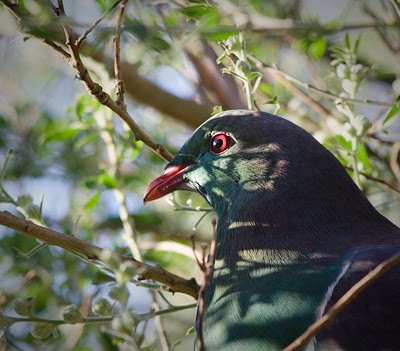 long, engaged observation to help us imagine the answers, recognising as we do that we can never truly know, that we can never hear like any bird even if our ears could capture precisely the same range of frequencies. Much of the time we guess wrong when we try to understand what one of our own species hears — a song, for example, or a sound in the night. I hear boring, toneless, puerile, repetitive chanting; you hear complex, clever, rhythmic insight into the modern condition. You hear unexplained footsteps; I hear the house releasing the heat of the day. Sometimes, admittedly, we claim to hear the same thing or, by some comment or gesture, suggest it, but always the inescapable truth remains: we are trapped inside ourselves.
 the pale bird, long legs stretching downwards, head looking down, body suspended from upraised wings. Another emblem or omen, like an angel — not the pretty, insipid angel of catechisms but the powerful, dangerous angel of mythology.
 Perhaps guilt suppresses thought—you are privileged, these observations say, and privilege is generally an accusation; the traveller, unable to deny her observations, turns away from their implications. Better not to think.


