17 May 2010

The climber


On the edge of the town the high stone buildings, grey with age, with small, high, grimy windows, begin to change, to transform into the cliffs that ring the plain. A small figure climbs on those cliffs — a man, climbing with no rope, alone in the dull afternoon light. He slides a hand into a long crack that runs almost the full the height of the cliff; he twists slightly and lowers his free hand, shaking his arm for a few moments. He pauses, looks upwards, then resumes climbing, jamming one hand above the other alternately into the crack, placing his feet deliberately, precisely, until he arrives at a great slab projecting horizontally above his head like a roof.

He locks his left hand hard into the crack and leans back and outwards, reaches wide with his right arm and feels for a hold over the lip. Another pause. He drops his head and waits several seconds, stretched out with arms wide. Then he looks up and releases his left hand from the crack.

His feet leave the rock; his body swings out over forty metres of empty space. Forty metres of nothing; forty metres of the long fall into oblivion. He swings from a single wiry arm, out towards the point at which his hand must surely slip from its hold. He draws his legs up to slow the swing and begins to pull himself up on one arm; he reaches up with his free hand and grasps another hold.

The sight makes you feel nauseous. You see him from a great distance, a tiny form hanging over the void, a speck of muscle, bone and blood on that great hard face, hanging there on the edge of life. You see him as if you were a bird hovering a metre from his left shoulder; you hear his hard breathing, you see the thin tough muscles in his arms move as he swings. The ground seems immensely far below; it seems like a memory, the recollection of safety too long ago.

You feel nauseous, sick with the fear that arises from imagination. You feel exhilarated, knowing his freedom, his utter independence and self-reliance, his complete focus like a meditation, the feel of movement like a dance. You hold these polarised emotions in your heart as you begin to walk across the plain towards the cliffs. You walk through desiccated grass, over flat stones like the remains of an ancient plaza; you walk in an arid wind that sends small eddies of dust scampering over the plain. As you walk, the edge of the plain grows outwards so you never draw closer to the cliffs — they recede continuously, like the horizon, as you walk. The climber still hangs there on that edge, always about to make his next move.

You realise you are walking towards yourself.


Photos:
1. John Palmer completes the difficult (V7) boulder problem Chris & Cosy at the Baring Head Rock Hop in 2008.
2. Ivan Vostinar marks up problems at the 2008 Rock Hop.

Photos and original text © 2010 Pete McGregor

12 April 2010

A conversation with Time

Angel, broken, at Jamnagar.

You sit at the table in the dim light at the border of dawn with your past looking back at you.You reach out but your past withdraws.
"You cannot touch me," it says, "I am always out of reach."
You take back your hand and sit facing your past. You ask why it is here.
"I am always with you," your past says. It gets up and walks around behind you; you turn your head but your past moves to the corner of your eye — a shadow glimpsed, always elusive. You sense its presence behind you, growing older moment by moment. When you look back across the table your future sits there with its back to you.

You cannot see its face.


Photos and original text © 2010 Pete McGregor

01 April 2010

Time at Flounder Bay [Part III]

The third and final part of the Time at Flounder Bay series. [Part I; Part II].

Dawn, and the line of light on the horizon gleams a salmon colour, a thin strip between the great plane of the silver sea and the grey clouds. Higher in the sky, a little of that colour echoes the line on the horizon. The rest of the camp sleeps on, silent, unaware. Twenty minutes later the colour's faded to pale yellow with a trace of bleached brown and the clouds have lost that beautiful, subtle shading, becoming a dirty grey bordering on black, with no apparent pattern. But the sea still gleams, and the camp sleeps on.

...

The waves here break twice. Out at sea the swell rises, mounts into a luminous green wall then curls over and crashes down in a welter of white. The remains of the wave rush towards shore then begin to rise again,swelling for a second time into a wall that crashes down before racing up the beach. Perhaps the sea bed has some particular shape — maybe a kind of sand and shingle stationary wave — that causes this. Perhaps the waves here echo what lies beneath them, the way the present can echo the past or presage the future.

As the sun climbs higher the day seems set for a scorcher. The horizon hides somewhere in a hazy, almost indiscernible mist, a kind of heat haze or the last, fast-vanishing trace of morning mist, but by the time we reach Driftwood Cove the mist has gone completely and the heat has arrived, riding the silence of the surf: that endless, repetitive, constantly changing sound; the kind of sound with the qualities of silence — in particular, that of providing the aural space in which one can think freely. I find it exceptionally relaxing, too, but it drives others mad. This morning an elderly woman from Auckland remarked to Anne-Marie how the sound of the sea had driven her to distraction: she found it difficult to sleep, she said. Perhaps one's response to the sea depends on experience; perhaps one isn't born with the response but instead learns what to think of this sound, which to others is like a homecoming.

I look up from these thoughts to see a sudden spout of water shoot skywards, and I grab for the binoculars. But the excitement's short-lived — it's no whale surfacing, just a gannet diving. I'd missed by a moment the sight of the bird plunging into the sea with half-folded wings and had seen only the plume shooting into the sky. Out on the horizon a cruise ship waits; a helicopter roars across the cove, going north. Reminders of humans; technology.

Someone has built a small shelter at the top of the beach. A surprising effort has gone into it, so it looks like something built by a castaway with plenty of time and desperation. On the shingle, the dried leg of a crab and the remnant of a shell that looks like the flukes of a whale sounding. Earlier, I'd peered into the first rock pool I'd found after we'd left the track and crunched across the small beach, over stones and shattered shells and wrack; I watched a little blue-black cushion star gliding slowly across the bottom of the clear pool and, as I watched, I noticed a snakeskin chiton also moving, almost imperceptibly. Rock pools contain enough life and interest and questions to fascinate a person for a lifetime.

Then there are the other inhabitants of the intertidal zone — inspiration for some of the most inspirational books I know, like the early works of Rachel Carson and Steinbeck and Ricketts’ magnificent Log From the Sea of Cortez. It's easy to understand this fascination — just spend a few hours pottering along a rocky coast; ideally, take a kid with you. Not long after peering into the rock pool I'd startled a couple of Leptograpsus and my first thought was the urge to show them to someone. I can't imagine anyone, let alone a child, who wouldn't get a thrill from seeing these large colourful crabs with their impressive claws, particularly when the sighting takes place where these animals are truly at home. Anyone not moved by such a sight must surely suffer from some kind of malady: some kind of illness brought on by too much isolation from the real world, too much exposure to our own artificial environments and inventions, too little connection to the world in which we evolved.

The sun beats down relentlessly. I drape a bandana over my head to cover my ears and neck and to shade my eyes, and hold it in place with a baseball cap. The relief from the glare and heat allows me to relax again and gaze about from my perch on a low, flat rock. Anne-Marie says I look like John the Baptist.

...

A bright green scallop shell mould lies on the beach, left behind, presumably, by a family with at least one small child. I make two scallop shells from damp sand, leaving them to dry and crumble in the sun and wind, and I place the mould above the high-water mark. With luck, other visitors to the beach will do the same, leaving small, impermanent records of their visits and leaving the mould behind. I wonder how many generations of this cycle will happen before someone's acquisitiveness brings it to an end.

In the terrific heat and humidity of the afternoon we visit the Redwood grove. Anne-Marie writes by the stream; I potter with the macro lens and tripod, photographing fungi; brightly coloured leaves on old, brown litter; bark; other details. As we leave the cool, quiet shade something alights on my hand. I look, and see a female robber fly grasping a small damselfly which isn't yet dead. Its abdomen, long and thin, curls and uncurls, back and forth.

After supper Anne-Marie goes for a walk around the village and I set off alone for the Cove of Giants. Perhaps because I'm alone, or perhaps for some other reason I don't understand, the small cove feels eerie — wilder than Driftwood Cove and less welcoming but also fascinating, with a greater sense of possibility: the feeling that one might find something extraordinary cast up among the rocks or half buried along the strand line. A great pine log, bleached pale grey, lies propped up and resembling an enormous cannon pointing out to sea. I walk partway up it, enjoying the balancing act, and stop where I can look down into a narrow gap between the log and the rocks. The sea rushes in beneath me, backlighting the gap, and there in the narrow space the silhouettes of several large Leptograpsus shuffle and creep, move a few scrabbling steps and stop, then move again. They look like something in a scene from Alien.

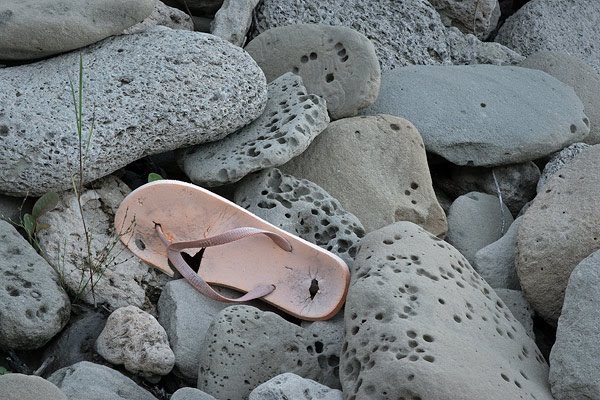
Teasel, that peculiar, distinctive plant, flowers above the high-water mark; a red jandal faded to pink lies warped among pale stones. The giant tree still lies on the shore, more bleached than when we last saw it but still resisting the sea, the storms, the scouring sand. Its branches reach out as if appealing to the evening sky. White bones of a seabird lie on a rock and, nearby, more, with the matted remains of feathers. The evening breeze slides over my skin, cicadas and black field crickets sing in the grass between the beach and the looming cliffs and, out at sea, a gannet cruises south. In the whole darkening world, there's no other human to be seen.

...

With the Mission Vineyards concert on in Napier in the evening, the camp's almost full. All the cabins are occupied and numerous tents interrupt the once-unimpeded view. Kids scream and yell, get lost, hurt themselves and bawl. Yesterday afternoon a large, dark green, excessively-polished Holden throbbed its way up the drive, circled and parked by one of the expensive cabins, and this morning we find a bulky Landcruiser Prado parked in front of our little one-room cabin: "3400 V6 Quad Cam" the beast says. It might as well have simply said "Notice my status". One can almost sense the tension between it and the Holden: the air beginning to reek with the smell of vehicular testosterone.

But when I step outside this morning into the warm dawn on the last day, no one else has woken, no one else has risen to see the spectacular light and colours over the sea and on the Nor'west clouds glowing above the valley. All the tents are zipped, the cabin curtains closed, the dusty driveway occupied only by a few sparrows — the birds are always the first up — and a dead rat, belly up, presumably a victim of the poison under every cabin.

The solitude doesn't last. Soon the kids begin to prowl, whispering at first, then talking, and so the quiet time ends. Not that they're all noisy, though: a girl, almost a teenager and wearing a T-shirt that says, "I kissed a vampire and I liked it", sits on a large rock in the sun and reads a book. Probably a book about vampires — the Twilight kind of vampires, that is — although I'm just guessing. But I doubt it was about Heidegger's concept of the uncanny; sadly, I also doubt it was anything about the real, non-vampire life living along the shores of Aotearoa.

However, at least it was a real book. In Napier I'd picked up Joe Bageant's Deer Hunting With Jesus; late in the book he comments on research showing how TV subdues the left side of the brain and stimulates the right (an oversimplified but useful shorthand for saying it discourages critical, analytical thinking and encourages emotional responses). Reading that, I wondered: perhaps one of the major advantages of the written word over TV, radio and other auditory/visual methods of communication is that when reading it's easy to stop and think but when watching TV it's much harder to do that. The same might be said of podcasts and videos, although it's possible in theory to pause those. But really: how often do you pause a video partway through, to think about what's been presented? In practice, pausing a video differs so greatly from the simple act of looking up from a page of writing to mull something over that listening/watching and reading amount to two utterly different forms of communication. Thus, even if my guess about the nature of vampire-girl's book was right, and the intent of the book was entirely to appeal to the emotions, at least she had the opportunity to think about what she was reading.
...

Our time at Flounder Bay has almost come to an end. Or has it? When does a journey end? And when does a journey begin? Suppose your journey involves travel overseas — to India and Nepal for five months, say, then two months in Africa, then brief stop-overs in the UK and France to visit friends on the way home (that nebulous concept that can be pinned down only by the trenchantly dogmatic). Does the journey begin when you close the door and turn the key for the last time for seven and a half months? Or does it begin when you step onto the plane, or when (looking the other way) you book your flights? What about when you first start planning when and where you'll go, or even when you get that first restless urge to move away from mundane life with its relatively regular and predictable (although not necessarily boring) pattern — that sense that there's more to this life than more of the same, and less of this life in which the opportunity to travel still remains?

Think like this and the start of your journey can extend back almost indefinitely, or at least as far back as the time you became aware of a world more extensive than that in which you spent your days playing and visiting other small friends and grandparents and, one hopes, learning. Perhaps you opened a book and saw photos of weird animals you never knew existed (rhinoceros, giraffe, condor, tapir, cassowary) in places you never knew existed (Africa, South America, New Guinea); now, more likely, perhaps you learned about these animals and places when you first saw them on TV. Perhaps this is when your journey began: when you first discovered these things and thought these were things you wanted to see for yourself. Perhaps, also, your journey never ends, at least not while it lives on in your memory, or in your desire to resume it.

We close the lock on the door and say goodbye to the little cabin, drive slowly past the crowds and out the first gate, past the kennels and the sheds and the old tractors, over the small wooden bridge and through the last gate onto the main road. It'll be a long, hot drive back to the valley and when we arrive, something will be missing. It'll be the sound of the sea. 


Notes:
1. Cushion star:
Patiriella sp., one of the most common starfish along the coast of Aotearoa.
2. Snakeskin chiton: Sypharochiton pelliserpentis. Abundant along our rocky coasts.
3.. "They look like something in a scene from Alien": later, the comparison strikes me as ironic — the real world compared to the fictitious, and that particular fiction drawing inspiration from the real world where parasitoids lay eggs in living creatures from which they later emerge. Life imitating art imitating life, I suppose.  

Photos (click to enlarge them):
1. Shell fragment at Driftwood Cove.
2. The edge of the sea at the Cove of Giants.
3. Writer in the redwood grove.
4. Redwood leaf on redwood leaves.
5. The Pink Jandal.
6. Beached pine at the Cove of Giants.
 
7. Recycling in the redwood grove.

Photos and original text © 2010 Pete McGregor

19 March 2010

Time at Flounder Bay [Part II]

You rise from uneasy dreams and wonder where you are, in which bed you lie, in what direction you face. You rise into awareness from dreams in which a comment meant to tease, to prompt banter, instead alienates friends; in which you draw back the curtains of your office to find the windows obscured by ivy that lets in only an old, weak light. You close the curtains again and turn to your desk with its stereomicroscope and the petri dish of insects in alcohol and the note someone's left saying "Please identify these."
It sounds more like a demand than a request.
 
...

The roar of a plane sounds suddenly overhead. I look up, beyond the top of the cliffs to clouds, patches of sky, and a few seconds later the plane slides out of white cloud into blue. The brilliant white craft seems to radiate light, the way one might imagine an angel. It slips across the blue, enters the cloud again and vanishes. All that remains is the sound, and the memory, both fading. But the memory lingers longer.

Further on, movement among the rocks at the south end of the beach catches my eye — a quick shape under a big bleached driftwood tree trunk lodged between two boulders. It doesn't look like a bird. Although I've glimpsed it only fleetingly, it seems more like a rabbit or rat. We move forward, carefully, ready to freeze. A kotare flies up and alights on a nearby boulder but this was not what made the peculiarly mammalian movement that caught my eye.

I step forward, keeping my gaze focused on the gap between the boulders where I expect to see a crouched rabbit, nervous, ready to bolt.

Closer now. I begin to move around the boulders to look behind them. And there it is — a stoat, moving fast. Back and forth under the log, disappearing into a dark recess under the far boulder then reappearing a moment later. So fast, so agile; it seems to flow rather than run. I place my pack on the sand and unzip it, reaching for the camera, taking out the big lens and trying to keep the stoat in sight but it's hopeless. I've only just got hold of the lens when I see the stoat run up onto a rock, pause, then weave onto the bank and disappear through the dry grass into a patch of blackberry. The chances of seeing it again vanish with the black tip of its tail, but the memory of something so vibrantly alive stays with me for days. From now on, this will always be the place where we saw the stoat.

...

We eat teriyaki chicken sushi on the beach in the evening, after Anne-Marie's ventured into the surf and I, a different kind of chicken, had watched through binoculars. She'd looked petrified but had returned grinning, claiming the water was wonderful but admitting the undertow was terrifying. We feed a few morsels of sticky rice and fragments of apple to the gulls, trying to favour Nipper (the gull with the droopy wing — he seems like a he although we have no idea, just as I have no idea why I've decided to call him Nipper) and Stubby, the gull whose legs are missing just below the knees. Yet another gull limps along the sand. What happened to these birds? How were their injuries sustained? How long can they survive? Are they now out of the gene pool, so to speak? 

The mild breeze feels pleasant on bare arms and legs as I look out along the beach and listen to the surf — the sound rising in pitch before the sudden crash that fades gradually into the hiss of foam across the low sandbar. Strangely, I can smell nothing. Perhaps I've simply become habituated to the particular slightly sharp, softly salt smell of the sea, or perhaps it's like the taste of pure, clean water — so fresh it needs no further flavour. Not like further back along the stream, though, near the place where we saw the stoat. There, as we picked a path among the boulders, the stink of something decaying rose from somewhere in the jumble of wrack; a particularly marine reek, distinctly different from but just as nauseating as a rotting terrestrial animal. The stench of death, recent research reveals, arises mainly from the oleic and butyric acids that are characteristic products of decomposition, but here perhaps those main ingredients have been seasoned with the odours of drying kelp, salt, desiccated barnacles and the like, or perhaps the proportions of oleic and butyric differ substantially enough so one knows, instantly, this is the edge of the sea.

...


On the evening beach a figure sits among the rocks, unmoving, looking out to sea. My heart sinks. This is not right: all humans should be banned from this place (except us, of course). As we draw closer the figure, a man, seems either unaware of us or unwilling to acknowledge our presence, and, perhaps surprisingly, I warm to him a little. Here, perhaps, is someone similar to us: someone for whom other people in a place like this on an evening like this are an intrusion, a spoiling of sublime solitude.
 
When we get within a few metres of him (we must pass close by at this constricted part of the beach) he looks up and smiles and nods; we say hello and he smiles again, looks slightly embarrassed and begins paying close attention to the daypack lying next to him. We walk on as he retrieves a stubby and lifts it to his lips; he continues to sit quietly, gazing out at the beach and the sea. Leaving him to whatever kind of meditation he's practising, we climb Watchman's Rock, the massive boulder further along the beach.

When I look back along the beach a few minutes later, I notice he's eating and I warm to him even more. To come in the evening to sit alone and watch colours change in the sea and sky, to listen to the rush and hiss of surf rushing up the sand, to smell the salt spray and the strong odour of drying wrack, and to eat a solitary dinner and enjoy a quiet drink — these are things I understand, and I appreciate those who appreciate these things.

When we return he's wearing spectacles; he's leaning forward, elbows on knees, inspecting the cover of a large, hardback book. It doesn't look like a novel. My imagination suggests something about the New Zealand shore, or ships, or lighthouses, but these are sheer speculation and it doesn't matter — my estimation of him has grown hugely. We don't try to engage him in conversation, merely exchange smiles and leave him to his reverie.

...

Saturday brings an influx of visitors to the camp, but by late Sunday morning only one or two other tents remain. We, in our little cabin, begin to sense the return of the Flounder Bay we know best; the Flounder Bay that, in some way, might know us. On the beach this morning we sat watching a surfer sitting on his board, apparently too freaked out to try catching the beautiful waves rolling in, and Nipper had watched us from a few metres away, perhaps hoping I'd throw him another black field cricket (I'd fed him the one I'd found crawling on my daypack); we sat, watching and being watched, and after a while Anne-Marie mentioned Barry Lopez's observation about the importance of being storied in a place if one tries to know that place. I suppose she, having visited Flounder Bay since she was a child, has become storied here. Not to the same extent as Bill, who's spent his whole life here and whose family goes back generations at Flounder Bay, but still with a personal, deep and distinctly storied relationship. Now I'm part of some of her stories here; she's in all mine here and my relationship with Flounder Bay continues to grow and deepen.
She looked towards the cliffs at the south end of the beach.
"There's a kind of...," — she hesitated — "...a kind of sadness about this place."
She traced an arc in the sand with her finger. I looked at the cliffs, the band of grey and white rock halfway up, the way the profile of the headland meets the sky.
"As if there's a history here that no one remembers, but the place still remembers it," I suggested.
I looked out to sea as the lone surfer toppled backwards from his board. We'd just missed what seemed to have been his only attempt to catch a wave. Nipper yawned, pulled his head back onto his shoulders and half closed his eyes. Perhaps he'd begun to dream of a plague of black field crickets.

...

Someone walks a foxie cross on the beach and a man on a four-wheeler putters along, picking up an occasional piece of driftwood and some of the more conspicuous items of rubbish. A broken fragment of a motorcycle's yellow mudguard has lain on the beach for several days, and he picks it up, turns it over and places it on the quad. He crosses the mouth of the stream between wave surges and pulls up near a dark, sinewy log. First we chat about the weather.
"Supposed to clear," he says. "Rain overnight, clearing up this afternoon."
Napier's still hidden by dark, hazy cloud, probably rain, and out at sea the Jacob's Ladders still stretch down, but at the north end of the beach sunlight catches the surf. Radiant against the dark horizon, it looks if god has stroked a finger along the crest of the swell, breaking it into a wild, luminous light.
The man tells us how just over a week ago the stream almost reached the level of the road. Hard to imagine, given it's so low and clear now. He's here now looking for wood to turn.
"Not much native stuff coming down these days," he says, giving the log at his feet a push. He gestures at a block of milled pine lying nearby. "Mostly this tanalised stuff."

Years ago, I too turned wood, mostly into bowls and boxes and, like all woodturners, became both scavenger and hoarder of wood — any log, branch or weathered plank (other than tanalised pine) would be inspected, assessed and, if it made the grade, stored. I could get a box out of that, I'd think, or even an inlay for the lid of a box. So the hoard of scraps and lengths grew, covered with shavings and sanding dust, most of it never to be used. But I did turn some lovely items and took pride in producing pieces with an elegance and simplicity all too rare at that time among the mostly lumpish bowls cluttering the overcrowded souvenir and craft shops.

That was years ago, though, and the effort of regaining and improving those long dormant skills seems too much like a distraction. We leave the man sawing the end off the water-soaked log and cross the stream, heading north. The sea, foaming around our ankles and sucking the sand from beneath our soles, feels almost as warm as a spa.

...

We walk north along the Goat Track to Earthquake Bay. Through the Swarovskis, from a point shortly before the long beach begins, I see two people on foot, possibly the odd, almost pathologically uncommunicative couple camped below us, and someone on a four-wheeler. A fire, once large but now almost burned out, smoulders on the sand near the lagoon, sending faint blue smoke inland. We amble along the beach, skipping stones across the foamy water between breakers. The undertow's fearsome: even ankle-deep, one feels it pulling hard; when the water's shin deep, staying upright requires concentration; when the wave pulls back it exposes a good fifteen metres of black, glistening shingle. It's impossible not to think of tsunamis — how the sea draws back before the giant wave surges in to smash and swallow the land. These waves aren't tsunamis but they're big enough to impress me and the break travels along the wave much better than it does at Flounder Bay: surfers would love them but, as Anne-Marie points out, getting through them to the point where one could catch a ride could be a mighty battle.
 
The mouth of the lagoon now meets the sea much further south than it has on our previous visits, and, unlike then, it's uncrossable. No question about it — the surge swirls and foams and heaves skyward when a wave hits, then sucks out to sea viciously. Spectacular, yes; feasible to cross, no.

So we sit on the edge of the lagoon, slather on more sunscreen and eat a late, makeshift lunch: cold sausage, a handful of scroggin, an apple. Then we skip stones again and my best effort sends one in a great series of leaps almost three-quarters of the way to the other side. Find a flat stone on any beach and the urge to skip it is irresistible. Maybe, at some stage of our evolution, the ability to skip stones conferred some advantage — the development or demonstration of excellent coordination, perhaps — and became part of our genetic heritage? On the other hand, maybe it's just great fun.

The people I saw earlier have gone. The beach belongs to us, or maybe we belong to the beach, but mostly this place belongs to the birds — a big gang of black-backed gulls, a few red-bills and white-fronted terns, a black shag, a solitary white-faced heron, a pair of kahu — and the sea. As the tide rises, the waves grow bigger, more intense; they rush over the shingle bar and surge along the lagoon — once, we have to scramble to shift our packs to higher ground. When we begin walking back, the beach below the great mass of driftwood and wrack and flotsam has almost disappeared. This place reminds me of imagined coasts in wild places a thousand miles from any humans; places inhabited by birds and seals, littered with white bones, lashed by storms and lit by the hand of god. Of course, here the nearest human might only be half a kilometre away in the old, mouldering shacks between the lagoon and the weathered macrocarpas, and the bones on this beach are more likely to be those of sheep or cattle than seals or whales (or castaways). But the sea and the shingle fight here the way they do on all such coasts.
 
And, despite the possible proximity of humans, the place has an emptiness about it that makes any human presence seem temporary, marginal. One could live a life here and afterwards the place would continue as if that life had left it untouched. Some places accept us and change, but others resist; even if we alter those places physically by farming or dredging or building, something about them remains unchanged. In the past this would have been called the spirit of the place, but now that phrase has been diminished, made superficial; an enlightened view would see this as nothing more than the mere projection of our own desires. That seems to go too far. Lopez's claim that a place can know you, and, by implication accept or reject you, seems far more true, but I don't know how to prove the enlightened ones wrong; conversely, I can't see how they can prove I'm wrong.


On the return to Flounder Bay I glimpse something moving fast among the rocks at the high tide line. Another glimpse — a stoat! Could it be the same one we saw last Friday? It's a long way from the south end of Flounder Bay, but stoats have large home ranges: in four days, surely it could have made it here? But it's impossible to tell.

...
 
The low sand bank at the mouth of the stream cracks and collapses into the swiftly rushing current, only slightly disturbing the standing waves. More cracks appear elsewhere; before our eyes they widen and another section slumps into the stream. Even as we stand watching, the stream moves south, one collapse at a time. Twenty minutes from now we'd be standing in the water. Meanwhile the evening waves crash in over dark rocks and a thin sheet of white foam slides down the face of one rock like a strange creature — some kind of alien slime mould perhaps — or a time-lapse film of the spread of a fungus. Over the sea, soft clouds; all the shades of grey and white, a few almost black, and a faint hint of evening colour in pastel shades of mauve and salmon. I have no idea how I could photograph this.

Later, the memory starts me thinking. Give someone a hammer and everything looks like a nail; give someone a camera and everything looks like a photo. I suppose that's true, but even without tools the trap remains: for those who write, everything looks like words. More to the point, those of us for whom writing is essential find ourselves constantly struggling to find the right words — no, more than that: the best words in the best order. But would it sometimes be better to leave the moment unwritten? Words can drain the life from a moment just as effectively as a photograph. Still, Lopez abandoned his cameras when he realised how they removed him from the moment, how they interfered with being present, but he abandoned them in order to write from more intense, immediate experience. And even Bashô, one of the four pillars of modern haiku — the master who exhorted us, if we want to learn from the pine, go to the pine — couldn't bring himself to enter the moment so completely that he'd have to abandon his writing. Perhaps, then, I can be excused for continuing to strive to find the best words in the best order, hoping that even as I fail I might be getting better.
 
...
 
On the road from Flounder Bay to the main highway, in one of the dips along the crest of the hills before the road begins its descent, we see a weasel running across in front of the car, carrying something (a mouse, I think) in its mouth. It runs right under the car but somehow misses the wheels; when I glance at the rear-vision mirror I see it slipping into the grass at the side of the road. When I mention it to Bill he tells me weasels are more common here than stoats. Three sightings of mustelids within a fortnight — the greatest frequency I can remember. Part of me despairs for the consequences of such an abundance — the birds and invertebrates being lost continuously to these small, efficient predators — but another part of me can't help rejoice in their sheer grace and vitality, and the knowledge, best appreciated by small boys, that here are things that could do you harm.
 
...
 
Today the property has been in Bill's family for exactly one hundred years.
"Tenth of February 1910," he says, and we talk about what life was like a hundred years ago.
"A trip to town took two days," Bill says, and tells us a little about the history of Flounder Bay, about the tsunami hundreds of years ago; how it took so many of the people most skilled and how, therefore, the local Maori had to learn many of those skills again; how the loss of those skills led to conflict and eventually to the massacre in Kowhero Stream.
"Hardly anyone knows about it now," he says.
I remember Anne-Marie's comment about how this place seems imbued with a sadness, and I feel a sudden shiver of the uncanny.


Notes:
1. “…he retrieves a stubby and lifts it to his lips…” — a stubby in this context is a small bottle of beer, usually about 330 ml.
2. Black field cricket: Teleogryllus commodus, a common, non-native pasture pest in warmer parts of Aotearoa.
3. “…Barry Lopez's observation about the importance of being storied in a place…” —
Barry Lopez (1997). A literature of place. Retrieved 28 February 2010, from
http://arts.envirolink.org/literary_arts/BarryLopez_LitofPlace.html. In the article he writes:
“Over time I have come to think of these three qualities--paying intimate attention; a storied relationship to a place rather than a solely sensory awareness of it; and living in some sort of ethical unity with a place--as a fundamental human defense against loneliness. If you're intimate with a place, a place with whose history you're familiar, and you establish an ethical conversation with it, the implication that follows is this: the place knows you're there. It feels you. You will not be forgotten, cut off, abandoned.”
4. “…lunch: cold sausage, a handful of scroggin, an apple…” — scroggin is an indeterminate mixture of things like nuts, raisins, chocolate and other goodies. Known elsewhere in the world as trail mix or gorp.
5. "…the best words in the best order…"— the reference is to Samuel Taylor Coleridge: "prose = words in their best order; poetry = the best words in their best order."


Photos (click to enlarge the smaller photos):
1. Flounder Bay at dusk, a glimpse of the sky in the stream.
2. Elf prints and wrack. 
3. Nipper on patrol.
4. Big surf at the shingle bar, Earthquake Bay.
5. Wrack on the beach at Flounder Bay.
6. After the wave.

Photos and original text © 2010 Pete McGregor

22 February 2010

Time at Flounder Bay [Part I]

Extracts from two weeks’ worth of writing at Flounder Bay at the beginning of February. Part II will follow sometime soon.
Kowhero Stream, where it leaves the redwoods
Rain all night long. I wake several times during the night to the sound of it, to the sound of the sea and the wind. By morning the rain's stopped but the sea and the wind still roar, incessant, insistent. Sun struggles to break through the misty cloud and manages to cast only weak, diffuse shadows, to make the puddles gleam. But out at sea the horizon shines at the boundary of an ocean like a sheet of silver. Nothing out there gives any clue about Earth's history — the scene could have been a million years before the first human looked on it and wondered what made that blinding light in the sky, reflected on the water; it could be a million years after the last human closes her eyes for the last time and wishes her species had acted otherwise.

Nothing but ocean, cloud and the cold brilliance of the hazy sun.

At the mouth of the lagoon where the creek and the sea clash, the wrack of last night's chaos litters the shore. Bleached, sodden planks, branches, tree trunks; everything wrapped in tangled weed, everything spattered and mixed with gouts of creamy white and yellow foam. The bulkier masses of spume along the strand line shiver in the wind and release small scraps that dance off along the beach with the sudden gusts. A white-faced heron steps nervously at the edge of the lagoon where the water's calmer; it steps nervously, crouches, waits, then takes flight: a slow leap into the air and the lazy lifting and falling; the bird banks and alights on the sandbar on the far side of the lagoon, beyond the log jam. Nearby, a red-billed gull stands alone at the water's edge, one wing drooping; it fluffs its feathers and settles its wings, sleeking them down. But the drooping wing — the left — won't stay put. The gull flicks it several times, but each time it falls back, its tip just touching the wet sand. After a storm, the small corpses of birds can often be found on beaches like this — petrels, prions, shearwaters, terns, gulls, occasionally something larger. What kills them? Exhaustion, perhaps — the additional effort of flying in violent, turbulent winds; perhaps an unexpected dousing? I don't know; I'm guessing; I make a note to ask my friends who might have a sounder basis for speculation.

But this gull... with a wing like this, flying will be difficult, perhaps impossible and, if so, the outcome is inevitable. Nature has no sentiment.

...

Rain. The showers come and go, drifting in misty veils from the sea, inland across the face of Te Whaurangi, the headland; past the small side valley with its regenerating bush; on up the main valley. Bill drives up in his ute, climbs out, pulls out a builder's tape and measures the door of the lounge. He comes over to where we sit at the tables next to the kitchen. The conversation begins with the weather, of course.
" We had 319 mm of rain this January," he says.
I ask him how much they'd expect in a typical January.
"About a hundred would be a wet January."
Everyone we meet talks about the weather. It's usually the first topic and the attitude's usually the same: incredulity, commiserations, outright grizzling. But last night we saw a different attitude in action. The rain had eased off but the wind still blew hard and gusty, and the British guy camped near us with his German partner and their two delightful little kids took his opportunity. Down on the flats by the stream, he flew his kite, rushing it through the semi-darkness, making it swoop and soar, making the most of the wind.
"He couldn't resist it," his partner said, and we thought what a marvellous way to turn a constraint into an opportunity to have fun with the kids. Anne-Marie tells me later how she'd walked the dogs along one of Whanganui's beaches one day when a vicious wind scouring the beach had driven away almost everyone but the hardiest of dog-walkers and other fools. She'd heard someone call her name; looked around and recognised someone from her workplace.
"I love this wind!" he'd said.
He was a keen wind surfer. Perhaps, for the kite-flyer and the wind surfer, lousy weather amounts to a fine, calm, lounge-on-the-beach day. One of the best-known sayings of Gautama Buddha begins, "We are what we think. All that we are arises with our thoughts." So rain is rain, wind is wind, but good weather and lousy weather are what we think they are.

I think this weather's great for reading and writing, but I wouldn't mind a bit of warm sunshine.

...

The gull with the injured wing still stands at the water's edge, not far from the mouth of the stream, near where we saw it this morning. It flicks the wing often, apparently irritated by its inability to fold it fully. It makes a little run and pecks at something in the water. A sad sight — a life soon to end but still determined to live. 

But suddenly the gull runs upstream and launches into the air. It flies up, over the sandbar, turns and settles. The flight seems strong, although the wing doesn't move as easily as a normal wing; the tips of the wings point downwards more than in the flight of other gulls. Nevertheless, if I hadn't known about the injury — or perhaps it's a deformity — I wouldn't have noticed anything out of the ordinary about the flight. Maybe it has a future beyond a matter of days. Nature has no sentiment, but does have an enormous capacity to surprise.

...

Rain again last night. I woke some time in the small hours of the morning to hear it pouring down; didn't care and dropped back to sleep. This morning the sky seems lighter, the cloud higher and with more structure; at times one could almost believe the sun might break through.

We walk to the mouth of the stream again, where we know we'll be sheltered from the wind, and as we approach I hear a distinctive, piping call. I look up, recognising the call, and scan the beach and the valley. And there they are — two dark birds, flying fast towards us. Torea pango, the variable oystercatcher. They speed past, their orange bills bright in the overcast morning. On out to sea and along the coast, then they circle over the ocean and fly back past us, further away. It's like meeting friends after a long absence, but we don't realise this will be the only time we see them during our two weeks here. So often, we humans are driven by wanting to know what will happen; we strive to develop ever more accurate ways to predict everything from the weather to the results of lotteries and elections; yet knowing an outcome in advance can destroy the experience — knowing we wouldn't see the torea pango again this time would have muted the delight of seeing them now. Ignorance might not be bliss, but without it there could be neither expectation nor hope. Maybe the difference between wisdom and cleverness consists in knowing what not to know.

Anne-Marie does yoga on a clear patch of sand; I photograph a gull preening on a rock, then sit on my own watching the sea, watching the surf rolling in, curling over and breaking, rushing up the beach to foam at the small sandbank. A section of the bank collapses, followed a few seconds later by another. The sculptor at work again. Driftwood bobs and tosses, and a sodden branch bumps and judders in a gap between two wave-washed boulders. There's always something going on here; always the possibility of seeing something strange and wonderful, even if it seldom happens, even if it's mostly just driftwood and the usual flotsam — plastic bottles, short lengths of rope, a faded jandal, the tennis ball someone's dog failed to retrieve from the surf six months and a hundred kilometres ago. But one never knows. One day it might be a length of colossal tentacle, or a bottle with a message from the past, or a glimpse of something large and alive surfacing momentarily where the swell begins to rise into breakers. Come here and you know what to expect, and you never know what to expect.

Later in the morning , when the weather's clearing and warming — or so it seems — we cross the stream on Bill's pontoon, walk past the new houses that appear to us like mansions but are, according to Bill, just weekend homes ("No one lives there," he says, adding, "It'll be like Coronation Street over there, all crammed in next to each other") and follow the track to the north end of the beach. On the edge of the raupo, something disturbs the water. A frog? A rat? A fish? Despite the improbability, I find myself hoping it's something rare and fascinating — a marsh or spotless crake or banded rail, perhaps. But whatever it is remains unseen, and so the possibility it might be something more fascinating and exciting than a mere frog or rat also remains. I'm almost glad I don't know.

...

On the beach: many bluebottles; a puffer fish, now substantially unpuffed. Tide lines marked by wrack — seaweeds and twigs, coated with drying salt water and iridescent bubbles. The foam here's whiter than at the southern end of the beach where the stream discharges its load of farm run-off into the surf; but here too the foam shivers in the wind; it liberates small clumps that roll up the beach leaving faint trails and growing smaller with each revolution. We walk on, down the beach towards the stream. I stop and gaze at a pile of wrack and realise, suddenly, that what I'm looking at is the small body of a bird, a shearwater. Its remains lie twisted, partly buried in the sand, mingled with the weed.

And further on, another bird — takapu, the gannet; twisted and folded as if its entire life, all those years of cruising the sky and searching the sea were now trying to fit within its own remains. Even in death, buckled and half buried like this, the eye clouded over, the head partly hidden, it's beautiful; it demands respect.  Is this what it all comes down to? It's impossible not to feel a twinge of sadness. I wonder about checking its legs for bands, but I think I can see enough to confirm it's unbanded. Besides, I don't feel like disturbing it — to do so would seem like interfering with the dead.

...

Low tide — as low as I recall ever having seen it here at Flounder Bay — exposes a herd of boulders along the northern end of the beach; boulders densely draped with weed that would most of the time swirl and writhe in the surge but now hangs glistening from the sides of the rocks, only the tips dancing in the water. Further out, the boulders and weed appear momentarily then vanish as the swell surges over; when they reappear, water pours off them in long, shining streams like a different kind of weed: unbranched, ephemeral, constantly changing. At the edge of the sea where only the spray wets the rocks and weed, a purple shore crab creeps sideways, prowling for scraps, investigating crevices, crawling over the face of a huge boulder and easing over its edge into shadow; it clings to the overhanging surface and moves over it apparently as easily as if it were level ground. It's good to see these big crabs again — the more one looks, the more of them one sees — and to confirm the huge one we saw last winter crawling, wary and spray-lashed on the edge of a wild sea, wasn't just a rare visitor or a survivor from a once-but-no-longer healthy population. Looking out at the coast it's possible to imagine hundreds of these crabs foraging among the intertidal rocks, going about their lives largely unnoticed by the humans who surf or fish or play or simply fossick along the sandy beach; unnoticed, too, by those who stride along the goat track above the boulders and what, at low tide, passes for a narrow, rocky beach.

This is one of the things I love about coming to know about a place — that sense, after repeated visits or a prolonged stay, of gradually discovering what lies beneath the superficial, of seeing how things work, and being able to fit the pieces into a more complex understanding. Much of it's not conscious awareness; it's more the developing of a feel for a place, an awareness of some kind of history — one's own history while present; what one learns consciously of the history, both human and other, of the place; and what one imagines might have happened here or might one day happen. Ten thousand years ago, this beach was probably marked often by the tracks of moa, but what will leave tracks here ten thousand years from now? I find it difficult to believe those tracks might be human, but if they are, and if by some weird warping of space-time I came face-to-face with the maker of those tracks, how much of myself would I recognise in her?

... 

After a period of steady morning rain the sun comes out, light drifting along the beach, shining on the ocean. At the mouth of the stream, sunlight on breaking surf shines so bright and white it's hard to look at, but out at sea, dark cloud drops an ominous veil of rain on the horizon. Darkness and light, weather and time. The beach and the sea seem strangely devoid of birds — a curious kind of emptiness as if the planet has not only switched to geological time but has become entirely geological, with no time for the biological. Could this ever happen — that all life, not just human life, might eventually be extinguished on this infinitesimally small particle circling through space? Perhaps it might, but, if it were to come about, the view would not be of this dark sky, steel and blue-green sea and dazzling surf, but something far more alien, unrecognisable as once being our Earth. Black rock and acid seas, unimaginable heat; or perhaps the hard light of our now-ancient sun through a sky no longer blue but eternally black, shining on waterless sand and treeless rock, and the ruins of our time here irretrievably lost, remembered by nothing. And what might have brought this about? One of only two things, I think: aeons, or our own actions. I have no idea which is more likely.

The beach at Earthquake Bay

Notes:
1. Birds mentioned: White-faced heron (Egretta novaehollandiae); red-billed gull (tarapunga); torea pango (variable oystercatcher); marsh crake (Koitareke; Porzana pusilla affinis); spotless crake (Puweto; Porzana tabuensis plumbea); banded rail (mohopereru; Rallus philippensis assimilis); takapu (Australasian gannet; Morus serrator); moa (Aotearoa’s group of extinct, flightless birds now thought to have been most closely related to the South American tinamous).
2. Raupo: Typha orientalis; bulrush.
3. Bluebottle: in this context, the Portugese man o’ war, Physalia utriculus.
4. Puffer fish: closely related to porcupine fish, and also poisonous. I’ve used it as a generic term — I don’t know whether the fish we saw washed up were puffers or porcupines.
5. Purple shore crab: Leptograpsus variegatus.


Photos (clicking on the smaller photos will open slightly larger versions. Use the back button to return to the post, or open them in a new tab):
1. Kowhero stream near its exit from the redwood grove.
2. Anne-Marie on Watchman’s Rock.
3. Tractor country. Bill’s a keen collector of old tractors.
4. The gull with the droopy wing. Will feature in Part II.
5. Takapu.
6. I never tired of seeing light and patterns like this.
7. The beach at Earthquake Bay

Photos and original text © 2010 Pete McGregor

07 December 2009

How to post big photos in blogger (and other tweaks)

In a comment on my latest post, Avus said, “I keep meaning to ask, Pete. How do you manage to include the large images on your blog? Blogger only allows me quite small ones which need clicking on to enlarge.”


Earlier, Dr FTSE had pointed out how to get rid of the redundant clickability for large photos (clicking on them just opened up a page with nothing but the same photo at the same size) and how to change the mouse pointer from a hand to an arrow. Unfortunately, the new style of editing form for blogger posts wouldn’t accept his latter suThe code (s400/) for the size has already been removed from this exampleggestion; however, there’s a simpler way to:
1. include large photos in your blog;
2. make them non-clickable and prevent the cursor from changing to a hand pointer instead of an arrow pointer when you move it over the photo.

1. How to display a photo at its original size in a Blogger post

First — and this is crucial — you need to resize your photo to exactly the size at which you want it to appear in your blog. If you make it too large, you’ll screw up your blog’s formatting; too small is less serious, but why not get it right? The easiest way, if you use Firefox, is to install the addon MeasureIt and use it to check the width of the text on your blog. Remember to allow a few pixels on each side for the photo’s borders, too. The proper and accurate way is to inspect the html for your blog’s template, but if you can interpret that, you won’t need to read this post.

Next, after uploading your photo into the post editing form, click on the “HTML” tab (circled in red on the figure above) and look for the block of code that begins with “<img” and ends with “/>”. It’ll look something like this:
<img border="0" src="https://blogger.googleusercontent.com/img/b/R29vZ2xl/AVvXsEglPo6Onx7f6b-eceRBFgryEqjXp7ocxjcCN9YLkOcXsXMSQQCbqLKzkspgPR7EAaCJx8uxY26HB_Ud6RWNST551f_YkIFz9GfOPplrdF4Roi5s81mQ33UXlRWY06byDj_r2ffi/s400/Kea_8961.jpg"/>
Now look for the filename, and immediately before it you’ll see some code that looks like “s400/”. Depending on what size you've chosen when Blogger asks you to pick small, medium, large, or x-large, this code will appear as s200/, s320/, s400/, or s640/ (you can probably guess which code refers to which size), but it doesn’t matter. I’ve marked it in red. Now, simply delete it (i.e. the code in red):
<img border="0" src="https://blogger.googleusercontent.com/img/b/R29vZ2xl/AVvXsEglPo6Onx7f6b-eceRBFgryEqjXp7ocxjcCN9YLkOcXsXMSQQCbqLKzkspgPR7EAaCJx8uxY26HB_Ud6RWNST551f_YkIFz9GfOPplrdF4Roi5s81mQ33UXlRWY06byDj_r2ffi/s400/Kea_8961.jpg"/>
Your photo will now appear at its original size.

2. How to remove the link (URL) from a photo

When you’ve tweaked the html so your photo appears at its actual size, it’s pointless to keep it clickable. Here’s how to get rid of the link and keep the cursor as an arrow, not a hand.
 
After uploading your photo, click on the “HTML” tab and look for the block of code that looks similar to this:
<a href="https://blogger.googleusercontent.com/img/b/R29vZ2xl/AVvXsEglPo6Onx7f6b-eceRBFgryEqjXp7ocxjcCN9YLkOcXsXMSQQCbqLKzkspgPR7EAaCJx8uxY26HB_Ud6RWNST551f_YkIFz9GfOPplrdF4Roi5s81mQ33UXlRWY06byDj_r2ffi/s1600-h/Kea_8961.jpg" imageanchor="1" style="margin-left: 1em; margin-right: 1em;"><img border="0" src="https://blogger.googleusercontent.com/img/b/R29vZ2xl/AVvXsEglPo6Onx7f6b-eceRBFgryEqjXp7ocxjcCN9YLkOcXsXMSQQCbqLKzkspgPR7EAaCJx8uxY26HB_Ud6RWNST551f_YkIFz9GfOPplrdF4Roi5s81mQ33UXlRWY06byDj_r2ffi/"/></a>
Delete the sections in red (i.e. the bit beginning with “<a href” and ending immediately before “<img”, and the “</a>” at the end):
<a href="https://blogger.googleusercontent.com/img/b/R29vZ2xl/AVvXsEglPo6Onx7f6b-eceRBFgryEqjXp7ocxjcCN9YLkOcXsXMSQQCbqLKzkspgPR7EAaCJx8uxY26HB_Ud6RWNST551f_YkIFz9GfOPplrdF4Roi5s81mQ33UXlRWY06byDj_r2ffi/s1600-h/Kea_8961.jpg" imageanchor="1" style="margin-left: 1em; margin-right: 1em;"><img border="0" src="https://blogger.googleusercontent.com/img/b/R29vZ2xl/AVvXsEglPo6Onx7f6b-eceRBFgryEqjXp7ocxjcCN9YLkOcXsXMSQQCbqLKzkspgPR7EAaCJx8uxY26HB_Ud6RWNST551f_YkIFz9GfOPplrdF4Roi5s81mQ33UXlRWY06byDj_r2ffi/"/></a>
That's it. When you hover the mouse over the photo, the pointer will appear as an arrow rather than changing to a hand, and clicking will do nothing.

You can see the result of each of these changes on the post Kea, Darran mountains, on my photoblog, The Ruins of the Moment.


Note: Ignore the links in the sections of code I've listed — Blogger won't let me convert them to plain text. A bit beyond my technical ability, I'm afraid. 


Photos and original text © 2009 Pete McGregor

19 November 2009

Different people

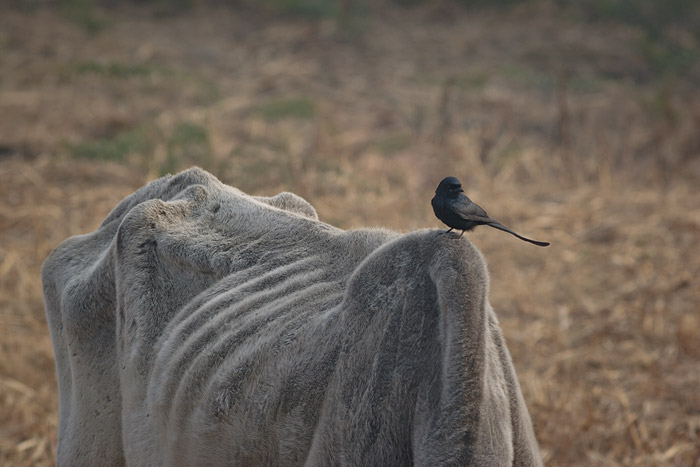
Cow and drongo at Keoladeo Ghana NP
In the library recently, I encountered (from a distance) a man who seemed entranced with the phrase "political correctness gone mad". Having seen some young people eating in the library, he accosted a library assistant, first asking her to stop this outrage, then, because she responded by referring him to the person in charge if he wished to make a complaint, somehow reasoned this was "political correctness gone mad".
   "In my day," he began... and finished by strolling among the shelves, loudly proclaiming "political correctness gone mad" — presumably forgetting that in his day silence in libraries was even more of an imperative than not eating.

What is it about libraries that attracts what might, for want of a more politically correct expression, be called the different people? Visit the local public library at any time and you're likely to encounter them — the busy, elderly woman with a backpack and several carry-bags, noisily rustling the pages of magazines and never sitting down; the loud talker with his slightly unfocused gaze, addressing similarly not-quite-present friends or a patient, non-committal librarian or just everything within earshot (generally a substantial radius); the loud talker's friend who responds with less volume but a curiously definite way of speaking that has never admitted the use of contractions; or the gaunt, haunted young man with cheeks like the hips of an Indian cow and pale eyes apparently accustomed to searching for enlightenment in the subterranean dark.

Then there's the quiet, slightly sad-looking, middle-aged man with long, lank, greying hair; his trousers loose, well-worn and shiny, his old nylon windbreaker faded to an indefinite colour, his spectacles relics from the 1980s (when he wore spectacles from the 1960s) — the same man who creeps around the shelves avoiding eye contact and occasionally sitting to peer at an opened book or magazine in a manner suggesting what's being read refuses to sink in.

A diverse range, but what they all have in common is a worn-out air, like things left out in the weather too long — a jacket left behind on a fencepost at the start of winter and rediscovered in spring, Between the shelvesor a pair of overalls salvaged from a grubby pile in the corner of a workshop then given an inadequate wash and pressed into service, resurrected for cleaning out the shed, painting the house or crawling under the car to change the oil.

It's not that all hope has gone. Not like the man I saw dragging himself along a back street in St Petersburg — I saw him and recognised inevitable and imminent death; his pallor almost there already, his eyes, although open, seeing something other than the reality I and the other living perceived. No, these library regulars live real lives, with the possibility that circumstances might change, that they might have surprisingly rich social lives, that they might belong to subcultures every bit as intriguing and fulfilling as those of the surfies, the practising petrolheads, the poets, the green activists and the folk musicians.

But those are only possibilities and the reality might be far more quietly desperate and grim. What appears to us (the supposedly normal — that slippery and indefinable concept) as oddball behaviour might simply be how they persuade themselves they do in fact lead rich and normal lives, or at least lives less grim than they appear to us. Perhaps they come to libraries not just to read, not just to escape the mould, draughts and chilling ache of wherever they call home, not just to piss in an unblocked toilet, but to see and hear other people, perhaps even to have conversations, to feel part of a larger community. In that respect they're just as normal as anyone else — maybe they’re not so different after all. Perhaps the man obsessed with political-correctness-gone-mad was, consciously or otherwise, trying to convince himself he had a role to play in society rather than just occupying space on its fringes — and isn't that what most of us would like to believe? Yet we see the strange behaviours, the apparent self-absorption, the intense focus that admits no casual intrusion, and we avoid eye contact and detour around the other side of the shelves. Better not to risk getting involved, you think. Who knows what you'd be getting yourself into if you smiled and said g'day?

Yes, it could all turn pear-shaped — but what if it didn't? Perhaps you'd get a smile in return, or maybe you'd just get the knowledge that someone felt, even for a moment, that he was no longer invisible, no longer a fringe dweller among grimy, plastic-covered books; the knowledge that someone felt, even for a moment, that she was no longer different.
After dark


Notes:
1. All characters in this post are fictional (except the political-correctness-gone-mad man), but they could be real.

 
Photos:
1. Cow and drongo at Keoladeo Ghana National Park, Bharatpur, Rajasthan.
2. Book dreaming, Palmerston North public library
3. Carpark after dark (not the library)

Photos and original text © 2009 Pete McGregor