16 December 2005

A nice day...

I woke suddenly in the wee hours of a hot, humid night, startled by the roar of the house shuddering about me. Instinct told me to throw back the covers, roll out of bed, and hit the floor, but some other part of my brain—the sensible cortex, perhaps—refused to wake. I lay there, the usual earthquake thoughts rolling through my semi-consciousness: how long will it last, how big will it be, should I take cover, is Wellington a pile of rubble? Eventually it stopped. I looked at the clock—2:57 a.m.—and went back to sleep.

The ‘quake was centred about 50km away and 25 km deep; 5 on the Richter scale. Wellington wasn’t a pile of rubble and National Radio even appeared unaware the ‘quake had happened. Here in Aotearoa, on the Pacific rim of fire, you get used to earthquakes. From an early age you’re taught what to do—stand in a doorway, get under a table, and so on—but after years of surviving them and having nothing actually falling on you, you become complacent. You know what you should do, but when it requires getting out of bed you lie there instead, trying to decide just how bad it has to get before you move. It’s as if the land has been crying “Wolf!” all your life.

But one day we’ll get the big one.

At breakfast I listened to Jakob’s Subsets of Sets, compelled by the title of the brilliant 3rd track: “Nice day for an earthquake”. The day had an oppressive, brooding feel; a sense of tension; of something about to happen. If anything, the humidity had increased despite a hot, blustery wind from the North-East. I kept expecting a storm, another earthquake, maybe an eruption from Ruapehu or Ngauruhoe; but the sky remained quiet and strewn with patternless cloud, the ground remained firm and immobile beneath my feet, and Ruapehu, according to the GNS website, was doing nothing more than simmer at level 1. By mid afternoon I’d decided to release some of my own tension, so I wheeled the mountainbike out and set off for No. 2 Line.

I’d expected to feel exhausted, enervated by the weather, but the feel of doing something physical and energetic revitalised me. I won’t say I raced up the steep and dusty gravel road—I was less like a racing sardine than a jogging flounder (a floundering jogger?)—but a steady effort took me to the end of the road without shattering me. From the end of the road I could see out across the Pohangina Valley and over the hill country towards Wanganui; South to the Tararua; North along the line of the Ruahine to the Ngamoko Range where the tops were hidden by cloud rolling over from the East and dissolving down deep gullies, silhouetting ridgelines. In the West, at last, a thunderstorm had formed over the hills, its borders hazy with dark rain, its upper region a mountain of wild, white and black and grey cumulus. I released the brakes and began the descent. No more floundering; now I felt even quicker than that racing sardine, maybe even as fast as a Pohangina Valley blowfly. It’s one of the most accessible ways to get a buzz—powering down a gravel road on a mountainbike on the edge of control, eyes showing more white than a hard-boiled egg, imagination switched off, and the smell of fear in your nostrils after you feel the back wheel twitch on a bend. Despite the wind generated by my speed, I could still feel the nor’easter’s buffeting. I shot around a corner, lifted my head slightly to check the road and BANG!—the wind tore the sun visor from my helmet. Bummer. By the time I’d managed to stop, I was faced with an unwelcome grind back up the road to retrieve it. More exercise than I’d intended, but I’m sure it did me good. It also gave me the opportunity to realise there was a truck speeding up the single lane road.

The highlight of the ride came as I accelerated up out of a dip in the road and rounded a bend where the road levels off for a short way. Up ahead, something crossed the road. Lithe, quick, a ripple of agile energy—then another, a body’s length behind the first. Stoats! A few seconds’ glimpse, then they were gone, vanished into the long, wind-whipped grass on the roadside. I pulled up, swung off the saddle and peered into the dense grass; scanned the close-cropped paddock on the other side of the fence. A sheep stared back at me. Distant thunder growled, a long rumble reverberating around the valley. The image of the stoats seemed to fit the sound—intensely charged and ephemeral, like a strange form of lightning. Nothing moved other than the grasses. No sign of stoats.

I drove into town that evening. Beyond Ashhurst I saw railway lines, deeply rusted but, on top, polished clean and gleaming, forming perfect lines of light; sunlight through the shimmer of a starling’s wings as it arced away from the car. I returned after dark, late, with the headlight beams full of erratic moths and wisps and ghosts of mist rising from the warm tarmac. A bird rose from the side of the road, straight up and into darkness. Over everything—the valley, the Ruahine, the western hills, to every horizon—long clouds stretched in moonlight. Pure drama; the essence of legend. A nice day for an earthquake.


Photo 1: Inspired by the Urban Dragon Hunters, I fossicked through some old photos and found some I'd taken last year at little tarn on the summit of the Ngamoko Range. These are Austrolestes colensonis.
Photo 2: ...and these are Xanthocnemis zealandica.
Photo 3: Thundercloud and rain, Pohangina Valley.

Photos and words copyright 2005 Pete McGregor


12 December 2005

We save the world (tomorrow)

This is mostly true. If it were to be filmed, it would be called a dramatised documentary, or “based on true events” (and possibly many other things also—“dog’s breakfast” springs to mind). The names of the characters have been changed, but I am me. Some of the conversation actually occurred.

Pubs are where the world’s problems are solved1. At the Celtic on Tuesday evening we addressed the problem of how to save the world: an exploration of the question, “What on Earth makes us act in ways that will ruin it?”

It had begun with the assertion that because we know we’re going to die—and (relatively speaking) soon—only altruistic people give a toss about securing a reasonable future; in other words, because our actions are so far removed from their consequences, we’re mostly free to act irresponsibly.

“Perhaps,” I argued, “if we thought we weren’t going to die—if we thought we’d live indefinitely—we’d look after the planet much better.”

There was general agreement that we were all going to die.

“Not me,” I said, “I’m not.”

Art looked at me, his expression half amused, half scared. “Everyone’s going to die,” he said.

“Prove it.” I could say this confidently, knowing his veganism prevented the taking of life—mine at least, I hoped. “Just because 99 point something of the world’s humans have died doesn’t prove I’m going to. It’s inductive reasoning. Besides, look at all these people,” I said, gesturing at the other patrons and passers-by. “They’re not dead.”

“You’re in denial. You’re afraid of dying.”

To avoid the accusation of inductive reasoning, I resorted instead to wild, sweeping generalisations. “Most people are afraid of dying,” I said.

Wal disagreed. “No,” he said, “most people are afraid of living.”

He went on to explain how most of us live half afraid, insecure, not pursuing our passions. Not taking risks. Not living. But, although he had disagreed, there was no real contradiction. People can be afraid of dying and also afraid of living. I suspect they’re afraid of living because it’s risky and they’re scared it might kill them.

By now some of my friends were laughing nervously and studying their beers. Dee, however, was interested in the original proposition and wasn’t put off that easily. She’d seen a flaw in my argument. “ What about your kids?” she said, referring to children as a concept rather than as real individuals—the fleeting wish of harassed parents the world over. “People do things so their kids will have a good place to live.”

“The time frame’s too long,” I said, although I didn’t believe it, “and you have to imagine the consequences vividly enough to want to save your kids from them, but most people,”—that incomparably useful generalisation—“have no imagination.”

There was general disagreement that people in general have no imagination.

A boy racer prowled past, panels pulsing, neons glowing. He changed gears—a sound like glass being smashed—and accelerated down the street in a squeal of tyres.

“There, see?” I said, “—no imagination. He can’t imagine the consequences of driving like that.”

“Inductive reasoning,” Art said, “—generalising from one kid to everyone. Your argument’s shit. Most people have some imagination.”

I had to admit it was true—my argument was shit. “But the principle’s true. If he can’t imagine ending up like train smash even when he’s driving like that, how seriously will he think about the consequences for his kids?”

“Maybe if he had kids he’d think about it?” Dee suggested. “He might drive more responsibly, too.”

“There’s an idea,” Andrew said. “Perhaps we could save the planet by encouraging everyone to have more kids?”

There was general agreement that his proposition was flawed.

I thought about Dee’s argument. Perhaps she had a point. When you have kids, you’re more likely to consider the consequences of your actions—at least, I imagine this is what happens. But even then, so many consequences seem remote, abstract, doubtful: faced with the immediate, definite fallout of forgetting to buy batteries for the animatronic Christmas raptor, a special trip to town in the SUV means nothing.

“Immediacy always trumps consequence,” I said, out loud, ending the conversation. We walked across the road to the Downtown complex to watch Harry Potter and the Goblet of Fire, a long film rescued by its humour.

...

I stopped at the gate and got out to open it. The half moon hung bright in an almost perfect sky; a few tatters of luminous cloud glowed along the Ruahine; the night glittered with stars. Despite the steady murmur of the idling engine, a deep silence infused everything—the clang of the metal tubing gate, the hack of a coughing sheep, the slam of a door in the distance: those brief sounds accentuated rather than diminished the silence. I paused, looked up at the immense sky and across to the faint shapes of deer moving in moonlight. What would all this be like a hundred years from now? What will our children see? Where will they find wildness?

I parked the car and walked across to the back door, trying to remember where the puppy shit was so I didn’t step on it. A ruru began calling. It sounded like a message from the present, to the unknowable future.


1 I was going to add, “...and cafes”, but then realised it’s not true. Cafes are where the world’s problems are generated. They’re where we buy coffee, thus supporting the giant pesticide corporations and compounding the problems of the desperately exploited people who grow the beans; they’re where we eat cake and cultivate obesity; they’re where we incubate our affluenza.

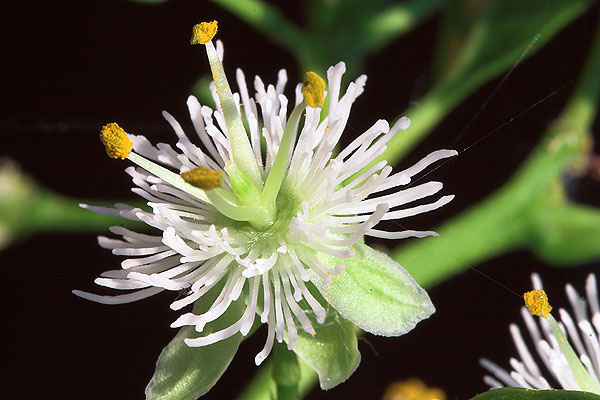
Photo 1: Yes, I have a new set of neighbours. Three, in fact. Here are two.
Photo 2: Possibly my favourite... but they're working dogs, not pets [sigh]...
Photo 3: Southern hemisphere half moon. If you're in the northern hemisphere, have a look at the moon one night and see if you can spot the difference.
Photo 4: If your monitor's brightness is set too low, this might be a bit hard to appreciate. As with all the photos, click on it to get a larger view.

Photos and words copyright 2005 Pete McGregor

08 December 2005

Bird. Life.

The sparrows are copulating on the gate again. They’ve been at it a lot lately; momentary cloacal conjunctions punctuating the daily grind of collecting dry grass, poplar fluff, shed feathers, and dog hairs for the nest. It’s a tough life being a sparrow—even the matings are so quick it’s inconceivable (if that’s the right word) that they can enjoy it. Must be more like a duty: “Dang, there she is again, better get on with it,” or, “Bugger, it’s him again, guess I should assume the position.” Two seconds later, a bit of feather ruffling and it’s back to the dog hairs.

Meanwhile, the sun’s just 20 minutes above the horizon. Corridors of light slip through gaps in the terrace-edge vegetation to slide across the evening paddock; shadows creep out from under the mahoe, the lacebark, the dense tangle of native passionflower1, the kennels. The blackbird’s still working hard out there, foraging for worms, pursued by his fully fledged brood. They should be quite capable of finding their own tucker, but instead they’re just a few hops behind him: “Feed me!! Feed me!!” The poor old guy’s looking utterly frazzled, scrawny-necked and almost bald; looks as if he’s on chemo but he’s still going hard out. It’s that irresistible imperative: reproduce!—even if it kills you.

Through binoculars I watch a kereru2 drink from the stock trough then rise with powerful wing strokes, sweep around and alight next to a slightly smaller, slimmer bird. He—I assume he’s a him, and I’m probably right—shuffles along the branch until he’s almost touching the other bird. He dips his beak to his chest, pulls his head back, and fluffs every feather on his body and shivers. It looks as if those berries he ate have exploded inside him, but I suspect what’s on his mind is something quite different from indigestion.

She edges away and drops to a lower branch, out of sight. The sun’s about to drop out of sight too; it’s left the paddock, but while there’s a little light left the blackbird family still fossicks among the wiry, seeding grasses. The breeze is cold, so I go inside, thinking about birds and families; imperatives and responsibilities. I’m glad I’m not like that harrassed blackbird. I’m not yet ready to be bald.


1 Passiflora tetrandra; kohia.

2 You should know this bird by now. Here’s the latest photo; and one from Kapiti Island. All right, for good measure, another from Kapiti.


Photo 1: This is NZ's endemic tui, Prosthemadera novaeseelandiae. The background tree is the introduced black locust, Robinia pseudoacacia.
Photo 2: Kohia flower (see footnote 1). It's just over 1 cm diameter.
Photo 3: We had another thunderstorm a couple of days ago. The rain obscured most details, creating a beautiful aerial perspective on the far side of the valley. [Disclosure for the pixel pedants and grain gurus—I've added the noise].

Photos and words copyright 2005 Pete McGregor

02 December 2005

Small is beautiful

Small things tend to go unnoticed—it’s hardly surprising, and there must be innumerable reasons for it. However, I suspect one major reason is simply that paying attention to tiny things requires more effort. Sometimes, considerable effort. Take this little beetle as an example. He’s about the size of a match head, but not as fat, and with those colours and bumps he’d be pretty difficult to spot on the bark of a tree. In fact, you’d have to inspect a lot of bark, very closely, to find one of these, and all that inspecting would require a lot of effort and would necessarily be at the expense of other things—possibly more important things, like enjoying the sun on the verandah in the evening while eating a nice bit of cheese, or whatever else you might consider more important than searching for Hoherius meinertzhageni. Actually, it’d be much easier to find his name than him—it’s about 10–15 times longer than he is, and would stand out much better against the bark1.

Yes, that’s him—and yes, he is a male: you can tell because he has a big head. The females are much more normal. Don’t ask me why the males have those huge2, flattened, whitish heads; I could speculate indefinitely but testing all those hypotheses would interfere even more with eating cheese on the verandah (for example), and as far as I know, no one knows. In fact, the sum of knowledge about H. meinertzhageni is largely included in Bev Holloway’s monograph on the New Zealand Anthribidae3. It’s not a lot, but at least it tells you you’re likely to be wasting your time looking for H. meinertzhageni on anything but plants belonging to the mallow family4, which makes it all the more surprising that I found this individual on the curtain in my laundry. I suspect it arrived from one of the lacebarks (Hoheria sp.) growing nearby.

Now, I’m sure many people would have either ignored the small speck on the curtain or reached for the flyspray, but my years of entomological training prompted me to look closer. On realising I had a live, male H. meinertzhageni loose in my house, I decided to try for a photo, so I found the nearest handy container (which had contained leftover lasagne but was now, surprisingly, washed and spotless) and after a careful stalk, captured him. I was determined not to repeat the same, shameful mistake I’d made with the weta, so I set up the camera, attempted a few photos, then left him with a sprig of freshly clipped lacebark for an hour or two before experimenting with a few more photos. Having confined him for long enough, I took him outside and watched as he cleaned his antennae, turned a couple of circles then took to the air. He disappeared from view within a few seconds, but when I last saw him he was heading for the bush on the edge of the terrace.

Many years ago I would probably have killed him, glued him to a triangle of card, and pinned the arrangement into a box with a label. The specimen (that’s what he would then have been called) might or might not have added an infinitesimal amount to our store of scientific knowledge. But it’s been years since I’ve felt like collecting insects, and seeing him fly off like that, I felt an enormous sense of delight. He may have been tiny, and the noticing and photographing may have required effort, but the reward has been immense. Good luck, little fella.

Now, where’s that nice bit of cheese...


1 Hoherius meinertzhageni was originally called Proscoporhinus albifrons—which would be even harder to spot against the bark, as it’s very slightly shorter (if the fount’s the same).

2 Relatively speaking. A millimetre wide isn’t usually considered enormous.

3 Holloway BA 1982. Anthribidae (Insecta: Coleptera). Fauna of New Zealand 3. Lincoln, NZ, Manaaki Whenua Press. 272 p. ISBN 0-477-06703-4.

4 "Hoherius meinertzhageni has been reared only from endemic Malvaceae" (Holloway 1982). However, I’ve found adults on the introduced (i.e. not native) mallow Lavatera trimestris. As far as I’m aware, this has not been recorded in the scientific literature, nor any other published literature, until now.

Photo 1: That's him.
Photo 2: Morning grass, Pohangina Valley.

Photos and words copyright 2005 Pete McGregor

29 November 2005

Fossil fools

Near Wellington, the grey afternoon light seems thick, almost tangible, coating the sky and land rather than illuminating it. Kapiti Island crouches in the West, a dull silhouette over sea the colour of zinc; on the edge of the world the South Island’s dark ranges rise beyond a narrow strip of brilliant, sunlit ocean. Sometimes light like this makes the world seem old. Older than your childhood, when anything seemed possible, before you knew the names of all the birds in the little valley where you grew up, before you realised the small caves led nowhere and contained nothing but dust and dry sheep droppings; when you never knew the limits of what you might find. Sometimes that grey, dense light with its occasional shafts of yellow sunlight seems so old it’s prehistoric. You know it’s not possible but you keep looking out to sea because those wheeling shapes might have been pterosaurs, soaring over a school of amoured fish. You can almost see them, there, on the fringe of the present, not quite breaking through.

Keep your eyes and mind on the road, Pete. This is the notorious Centennial Drive, the coastal section just a few kilometres long but averaging a fatality a year and who knows how many horrific but nonfatal accidents. The crashes are head-on; according to the ambulance officer interviewed on the radio this morning, drivers become “enamoured of the view” and cross the centre line. It pays not to imagine the consequences and it pays to pay attention.

It’s good to be safe and comfortable at John’s, settling down in the evening with a good feed and a glass of wine, yarning about possible reasons for the absence of rats in our respective ceilings this year, ranting about the environmentally irresponsible views of the NZ AA’s CEO (be assured the AA will fight vigorously to ensure we can drive as much as we need or want—oh yes, and we’re not going to run out of oil anytime soon) and later, watching the slow, strange, beautiful Solaris. Partway through the film, John turns suddenly and nods towards the window. “There’s a morepork,” he says, and I listen. Sure enough, the two notes return a minute later, distinct, slightly eerie, and fitting the surreal mood of the film. Before dawn a morepork begins to call right outside the window, so loud it wakes me; so loud only logic tells me it isn’t in the room. Light from the street lamp filters through the old curtains, filling the room with shadows and pale shapes the way the full moon illuminates a room full of dreams. I lie half awake, listening, smiling. Dreaming.

In the morning I looked out from the lounge through the big windows, through the gap in the trees to the native bush on the far side of the deep gully. Fine, misty drizzle drifted and floated in brilliant sunlight—the genius of a weather spirit apparently able to entertain two contradictory ideas simultaneously. It stayed like that all weekend, until I began to wonder whether the weather was the genius I’d imagined or whether I’d infected it with my own delight in unpredictability—or, as some of my friends must think, my own inability to make up my mind. Persistent cloud and rain or a fine sunny day? I just can’t seem to decide... But it didn’t matter; I met R1 and R2 at JK, A & R3’s house in Eastbourne in the afternoon and no kind of weather could have dampened that.

I woke several times during the night and heard rain drumming on the conservatory roof; a comfortable sound as I lay in my liner under a thick duvet on the lounge floor wondering if Ralph (R3) would check me out, perhaps stand on my chest and purr cat breath in my face, but when morning arrived the weather reverted to its indecision and Ralph still hadn’t appeared. I turned over and went back to sleep, which seemed to be his cue. Having snubbed me all night, he suddenly materialised from a vapour of purring and started walking back and forth next to the mattress, wiping his tail across my face. I reached out, still half asleep, and ran my hand along his back. He moved away but the purring got louder. I opened my eyes and found myself looking straight at his unwashed arse.

The whole way home I had to keep switching the wipers on and off and constantly adjusting the demister as I drove through seemingly random patterns of weather. There were no pterosaurs over the ocean, but behind Levin, the Tararua receded in a series of progressively fading silhouettes, each ridgeline higher, fainter, a more faded grey than the one in front. The aerial perspective conferred a sense of legend, of myth; a kind of wild hope that if you crossed beyond that last, grey, remote horizon you could walk out of time into another world where not everything’s mapped and surveyed; a world where exploration is something you do, not something you read about.

But you know that all there really is beyond that haze of misty rain is the Wairarapa: farmland, fences, roads, Masterton and Eketahuna, sheep, 4-wheelers and ragwort and real estate agents. All of it parcelled up, owned, possessed, used. You’re not a guest—you’re an occupier; you don’t belong to it—it belongs to you. Kind of sad, really. It makes you wonder whether the pterosaurs were brighter than us; after all, they were around for far longer than we’re likely to be. They might be the fossils, but I can’t help thinking we’re the fools.


Photo 1: This kereru alighted during a light drizzle on the kawakawa outside the conservatory at the JK/A/R3 household. I think it was a young bird; it seemed smaller and sleeker than the fat old birds back in the Pohangina Valley. I took the photo through the glass of the window.
Photo 2: Wellington rain at sunset, from Eastbourne.
Photo 3: The more appealing end of Ralph.

Photos and words copyright 2005 Pete McGregor

25 November 2005

Reading the water

Words are never silent
the clicker tap key click tap
too quick for the eye the instant letters
form words that flow around the issue
the way the river envelopes the rock

it's the same whether letters stretch
from point to line to whole from
a nib's scratch a murmured roller ball
or even the soft abrasion seldom used
of a misnamed lead—it's all the same

at best you see something hidden
it's the way the river heaves and slides
but the stream is not the rock; the sound
never ceases and no one ever learns
the perfect way to read the water.


Photo and words copyright 2005 Pete McGregor

14 November 2005

Wet, wild, and wonderful: Ruahine wandering

Eight days in the central Ruahine Range. Eight days in the wild; eight days when we saw no other people, knew nothing of what was happening in the outside world, saw no buildings other than the huts we stayed in, heard no vehicles other than an occasional, distant aeroplane glinting high and tiny overhead, going somewhere irrelevant. By the time we returned from the hills I’d already become unaccustomed to a predominance of human activities—driving back, I realised how strongly I was aware of houses, roads, fences, sheds, vehicles, domestic stock, exotic trees, and the other innumerable reminders of what we call the ‘civilised’ world. The act of driving, of sitting in a comfortable seat being whizzed along a back country road by an enormous mass of metal, seemed unreal, almost absurd. The following day, Friday, I drove into town to meet friends and couldn’t believe the amount of traffic on the road. Yet, it was no more than a typical Friday evening and Palmerston North’s hardly a giant metropolis. I guess that’s what eight days in the wild does to you.
...

Perhaps “home” is the art of feeling at ease where you are, regardless of whether it’s where you intended to be. If so—as I believe it to be—then Triangle Hut was the first of several homes during the trip; or maybe it was the beginning of a continuous exploration of a particular form of home. I can’t honestly say I’d felt particularly at home during the first night: we’d spent it bivvying on the tops in the dense mist and persistent rain but at least we were sheltered from the worst of the wind. Surprisingly, we both slept much of the night and—because the weather didn’t relent—most of the morning too. Luckily the drizzle eased by lunchtime, allowing us to struggle out of our bags like hatching stick insects, pack up without saturating everything, and descend to Triangle to wait out the weather instead of carrying on to Pourangaki Hut.

We spent two nights at Triangle, teased by the weather which cleared to reveal a starry sky the evening we arrived, but clouded over again during the night. I woke at dawn as gusts of wind shook the walls, raining leaves and twigs on the roof; once or twice I saw the cloud break into layers: swift, grey, fast-moving veils low down; lighter, relatively static cloud higher up. We read, dried damp gear, drank tea, enjoyed long sessions of yarning, collected large amounts of firewood, and watched the sporadic showers become persistent drizzle. Late in the afternoon—too late to pack and head for the tops—the weather cleared. That evening we heard whio1 whistling in the river; probably two birds, but it was too dark to check. We’d heard them briefly the first night, but never did get to see them. Somehow it didn’t matter; it was enough to hear that marvellous whistle and know they were out there, close by. It felt like a message from very special friends.

And, at 5:20 a.m. on the second morning at Triangle, not long after night had begun to lighten into day, I heard them again. Shortly after, a ruru2 began calling, close outside the hut. I lay in my sleeping bag, warm, comfortable, only half awake, caught up in the sounds—two of my favourite birds; the river rushing nearby... even better looking up through the skylight and realising the grey cloud signalled no urgency to try for the tops. Later, John emerged from his bag and went outside. He returned saying it was raining. Wonderful. I dozed for a while, then got up and made porridge and a brew. We read much of the morning, and when the weather finally looked as if it might clear, began packing.
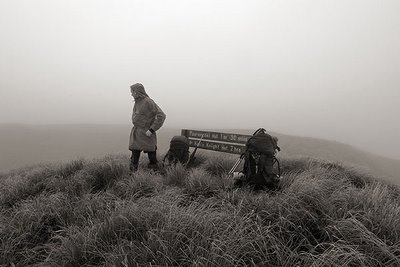
We climbed steadily, reaching the top and the inside of the cloud after about two hours. We sidled to the main Whanahuia Range, through drenched snowgrass, past the skeleton of a stag—shreds of half-mummified, half-putrefied flesh and hair still clinging to white bones. The back legs were missing; the vertebrae had begun to disarticulate. A cold, drizzling mist blew by as we walked on, past small tarns, across the East face of Mangamahue, across the saddle with its rusting rain gauge and eventually to where the ridge forked. Immediately before us, steep bluffs fell away into the mist. Somewhere hidden down there the Pourangaki surged through dark beech forest; somewhere down there, Pourangaki Hut promised relief from heavy packs and respite for weary legs. We turned left, followed the edge of the bluffs and soon after arrived at the top of the spur where the track descended to the hut. By then our world had a radius of about 100 m and included nothing other than saturated snowgrass, small, low, subalpine plants, and mist that enveloped everything like a blindness. But within 20 minutes we’d descended below the cloud into a high, wild, and beautiful world; the kind of environment that says slow down, linger, look around, enjoy this.
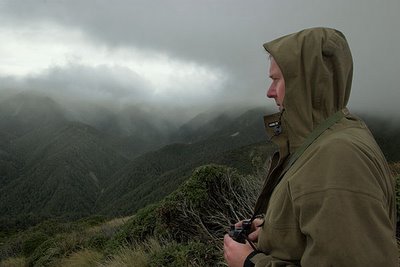
We did.

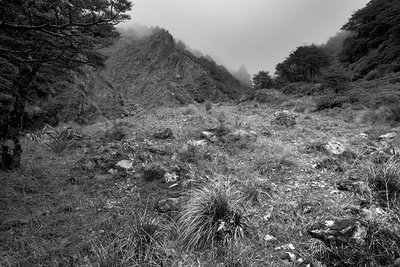
Although the weather was still misty, damp, and marginal the next day, we decided to head for Waterfall Hut in the Kawhatau Valley, as the route is well defined—a long, steep climb up a good track and a narrow spur; a short section along the main ridge; then a steep descent into Pinnacle Creek, which joins the Kawhatau not far from the Hut. At times, the view over the Pourangaki catchment was nothing short of spectacular, the hazy mist and veils of patchy rain giving the ridges a beautiful, almost ethereal, aerial perspective. Later in the trip we’d see the same views under a perfect blue sky, and, ironically, something seemed to be missing. Perhaps the fact that so much less is hidden means there’s less sense of mystery, less sense of what might be possible. It was the same at the head of Pinnacle Creek: there, jagged gendarmes3 and crenellated spurs loomed in the mist above us, conferring an epic feel to our surroundings; as if we were traversing a legend; yet when we returned on a cloudless blue day the towers and pinnacles seemed smaller, benign, almost disappointing.
More rain overnight, but by the time I had breakfast underway the weather had begun to clear. Properly this time, so that by mid morning we had a magnificent, blue-sky, gentle-breeze, deep-warmth day. John headed upriver; I ambled slowly downstream to Rangi Stream, following it almost to where it branches to Rangi Saddle. There, I stopped to do nothing in particular, just to enjoy being remote and alone on a warm day under a brilliant sky. I loitered on the bouldery riverbed in the sun, nibbling a handful of cashews, listening to the river and watching countless, small ground beetles hurrying everywhere. Back where I’d left my pack, I sat in the shade and snacked, and as I did so I glanced down at the ground next to me. I was sitting next to a rotting possum carcase.
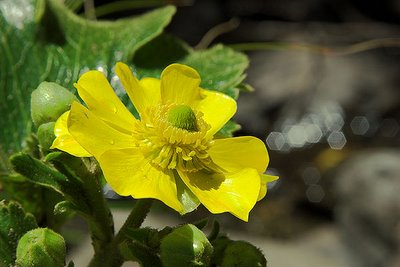
We stayed two nights at Waterfall Hut, then climbed back over to Pourangaki in the heat and wind of another perfect day. Yes, the views lacked the mystery of the first five days, but in their own way they held another kind of possibility—that of distance. On the eastern side of the ridge above Pinnacle Creek there’s a benched area, a perfect place to relax and brew up and eat lunch, or even camp if you’re inclined to do that. We stopped there for lunch, as it was sheltered from the wind and offered the best views imaginable of the central Ruahine. Rangi Saddle, Te Atuaoparapara, Tussock Creek, Broken Ridge, Ohuinga... up North, ridge after ridge, receding into the blue-hazed distance. This time it wasn’t mist, cloud and rain that hid the secrets of the land; it was the land itself and the vagueness of distance, like old, dim memories. You think you recognise a valley where you once walked, but that was years ago; the valley’s changed; what does it look like now? How has it changed? What new stories does it hold? You realise you know next to nothing about it—you walked it once, or a few times, but it’s old; older by far than the history of humans here, and all but a minute fraction of its countless stories will remain forever inaccessible to you. Its knowledge is Orphic and all you can do is be silent and listen.

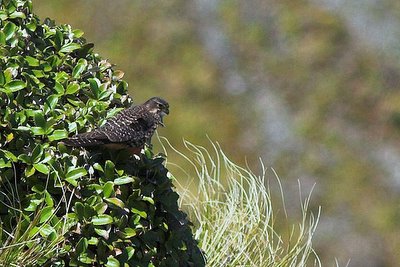
Suddenly, John points. “Falcon!” he says. Looking down, I see it wing around the curve of the steep spur and disappear. Later, we hear the hard chatter and see the bird fly back across the gully; hearing the sound behind me also, I look up and see a second bird sailing over the ridge, the unmistakeable silhouette with its long tail and angled wings dark against the bright sky. On the descent, another bird flushes from the near the track and alights nearby on the leatherwood4; it’s a falcon, karearea5, but we have no way of knowing whether it’s one of the two we’ve already seen. John sees another further down; it’s much lower, well below the bushline, flying up the valley. That makes five sightings with definite confirmation of two individual birds and a high probability of a third.
Half past six in the evening at Pourangaki Hut. From time to time I interrupted my writing to check the venison simmering on the MSR while John had gone up the track to see whether any deer had emerged onto the slip downstream. We had just one day left and tried not to think about it, but it arrived anyway. We had the whole day to walk out, and despite still-heavy packs our fitness had improved substantially, so we stopped frequently to enjoy where we were and delay the inevitable arrival at the car. The closer we got to the road end, the more we stopped and the longer we rested. We ate lunch in a sheltered hollow on the Whanahuia with the incessant hiss of the spring wind through deep snowgrass and a long bank of dazzling white snow slowly turning to slush. Again, it was a day of huge views: blue-grey, distant ridges and valleys; a pale half-moon fixed in a cerulean sky above a lion-coloured skyline. But when we looked out towards the low hills of the Rangitikei farmland, the land looked diseased: infected and scarred with innumerable slips, mostly the aftermath of the February 2004 ‘rainfall event’ but essentially the consequence of human activities that still haven’t attained a sustainable relationship with our land. Many good people are working hard to solve those problems and many good people are trying hard to manage that land in the best ways they know, but the inadequacy of those efforts confronted us clearly as we looked out from the high Ruahine. During our 8-day walk, John and I often talked about what might loosely be termed ‘environmental’ as well as social justice issues—how to live ethically, respecting and looking after the world and the people who live in it and are part of it. We speculated about what the future might bring and what motivates people to act irresponsibly or unsustainably regarding the use of resources (in the broadest sense) and towards each other. Being of similar minds, we felt at ease inveighing against various economic and political systems, although we both recognised the futility of levelling any such criticisms in any company other than the already-converted. In that aspect, our discussions were in part just letting off steam.
But they were also explorations; one thought leading to another; seldom opposing in the all-too-common, confrontational dialectic. I realised that in some ways these sorts of exploratory discussions, although superficially easier than the usual dialectic form, were actually more difficult. The challenge wasn’t to find a counterargument or opposing example but to seek potentially productive connections with other ideas; to find examples and analogies that create new ideas: in particular, to be open to and alert for insights. In these sorts of discussions there’s a kind of constructive tension between allowing your thoughts to wander widely (and wonder widely, too) and keeping them sufficiently focused. Of course, if you want to stay firmly fixed on a topic, these discussions will drive you crazy. But if your discussion is more akin to a conversation, then explorations seem to me to be not just more interesting, but more useful. After all, it’s in the nature of explorations to lead to discoveries—discoveries all the more interesting because you so often have no idea what you might find. I guess you might call it the joy of uncertainty.


1 Hymenolaimus malacorhynchus; blue duck.
2 Ninox novaeseelandiae; morepork (NZ’s native owl)
3 In this context, a gendarme is “a pinnacle, needle or tower of rock on a ridge” (Pascoe J. 1939. Unclimbed New Zealand. Woking, Great Britain; Unwin.)
4 Olearia colensoi; tupare.
5 Falco novaeseelandiae; New Zealand falcon.

Photo 1: The view from Triangle Hut looking up to the Whanahuia Range where we bivvyed the first night.
Photo 2: The top of the spur leading down to Pourangaki Hut.
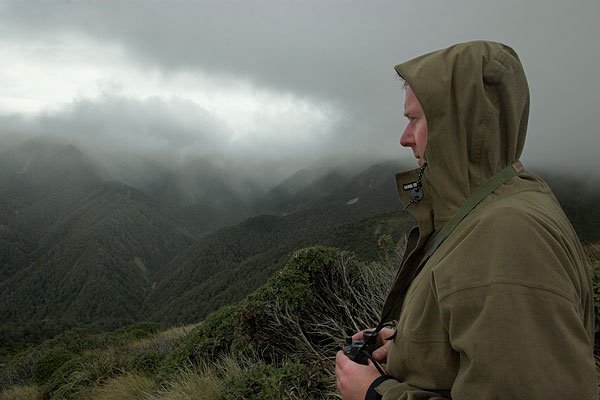
Photo 3: John looks out over the Pourangaki catchment on our way down to the hut.
Photo 4: Looking back up Pinnacle Creek.
Photo 5: Ranunculus sp. in Waterfall Creek by the hut.
Photo 6: The karearea we saw on the descent to the Pourangaki on the penultimate day.
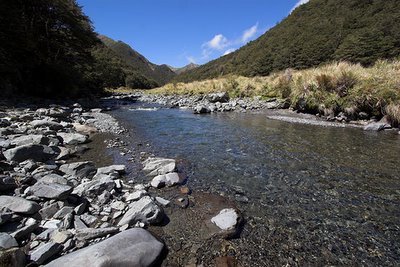
Photo 7: The Kawhatau River at its confluence with Rangi Creek.

Epilogue
I didn’t switch on the computer that evening. I wasn’t yet ready to re-enter that world. The following morning I dialled up and began finding out what had happened while we were away. Rod Donald had died. I couldn’t believe it. I thought again of those marvellous discussions John and I had enjoyed, and how, although I often felt pessimistic about how much we’re likely to lose, I was more optimistic knowing that people like Rod were working so hard to foster a brighter future. Of the few politicians I have much respect for, Rod was way out in front. I didn’t know him personally, but Wordgirl did, and, like her, I can’t think of a better way to honour him than to ensure his work continues; that his legacy will be a brighter future for all of us.


Photos and words copyright 2005 Pete McGregor