08 December 2005

Bird. Life.

The sparrows are copulating on the gate again. They’ve been at it a lot lately; momentary cloacal conjunctions punctuating the daily grind of collecting dry grass, poplar fluff, shed feathers, and dog hairs for the nest. It’s a tough life being a sparrow—even the matings are so quick it’s inconceivable (if that’s the right word) that they can enjoy it. Must be more like a duty: “Dang, there she is again, better get on with it,” or, “Bugger, it’s him again, guess I should assume the position.” Two seconds later, a bit of feather ruffling and it’s back to the dog hairs.

Meanwhile, the sun’s just 20 minutes above the horizon. Corridors of light slip through gaps in the terrace-edge vegetation to slide across the evening paddock; shadows creep out from under the mahoe, the lacebark, the dense tangle of native passionflower1, the kennels. The blackbird’s still working hard out there, foraging for worms, pursued by his fully fledged brood. They should be quite capable of finding their own tucker, but instead they’re just a few hops behind him: “Feed me!! Feed me!!” The poor old guy’s looking utterly frazzled, scrawny-necked and almost bald; looks as if he’s on chemo but he’s still going hard out. It’s that irresistible imperative: reproduce!—even if it kills you.

Through binoculars I watch a kereru2 drink from the stock trough then rise with powerful wing strokes, sweep around and alight next to a slightly smaller, slimmer bird. He—I assume he’s a him, and I’m probably right—shuffles along the branch until he’s almost touching the other bird. He dips his beak to his chest, pulls his head back, and fluffs every feather on his body and shivers. It looks as if those berries he ate have exploded inside him, but I suspect what’s on his mind is something quite different from indigestion.

She edges away and drops to a lower branch, out of sight. The sun’s about to drop out of sight too; it’s left the paddock, but while there’s a little light left the blackbird family still fossicks among the wiry, seeding grasses. The breeze is cold, so I go inside, thinking about birds and families; imperatives and responsibilities. I’m glad I’m not like that harrassed blackbird. I’m not yet ready to be bald.


1 Passiflora tetrandra; kohia.

2 You should know this bird by now. Here’s the latest photo; and one from Kapiti Island. All right, for good measure, another from Kapiti.


Photo 1: This is NZ's endemic tui, Prosthemadera novaeseelandiae. The background tree is the introduced black locust, Robinia pseudoacacia.
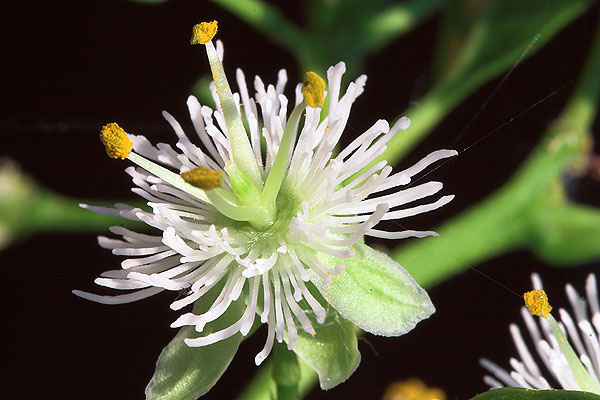
Photo 2: Kohia flower (see footnote 1). It's just over 1 cm diameter.
Photo 3: We had another thunderstorm a couple of days ago. The rain obscured most details, creating a beautiful aerial perspective on the far side of the valley. [Disclosure for the pixel pedants and grain gurus—I've added the noise].

Photos and words copyright 2005 Pete McGregor

02 December 2005

Small is beautiful

Small things tend to go unnoticed—it’s hardly surprising, and there must be innumerable reasons for it. However, I suspect one major reason is simply that paying attention to tiny things requires more effort. Sometimes, considerable effort. Take this little beetle as an example. He’s about the size of a match head, but not as fat, and with those colours and bumps he’d be pretty difficult to spot on the bark of a tree. In fact, you’d have to inspect a lot of bark, very closely, to find one of these, and all that inspecting would require a lot of effort and would necessarily be at the expense of other things—possibly more important things, like enjoying the sun on the verandah in the evening while eating a nice bit of cheese, or whatever else you might consider more important than searching for Hoherius meinertzhageni. Actually, it’d be much easier to find his name than him—it’s about 10–15 times longer than he is, and would stand out much better against the bark1.

Yes, that’s him—and yes, he is a male: you can tell because he has a big head. The females are much more normal. Don’t ask me why the males have those huge2, flattened, whitish heads; I could speculate indefinitely but testing all those hypotheses would interfere even more with eating cheese on the verandah (for example), and as far as I know, no one knows. In fact, the sum of knowledge about H. meinertzhageni is largely included in Bev Holloway’s monograph on the New Zealand Anthribidae3. It’s not a lot, but at least it tells you you’re likely to be wasting your time looking for H. meinertzhageni on anything but plants belonging to the mallow family4, which makes it all the more surprising that I found this individual on the curtain in my laundry. I suspect it arrived from one of the lacebarks (Hoheria sp.) growing nearby.

Now, I’m sure many people would have either ignored the small speck on the curtain or reached for the flyspray, but my years of entomological training prompted me to look closer. On realising I had a live, male H. meinertzhageni loose in my house, I decided to try for a photo, so I found the nearest handy container (which had contained leftover lasagne but was now, surprisingly, washed and spotless) and after a careful stalk, captured him. I was determined not to repeat the same, shameful mistake I’d made with the weta, so I set up the camera, attempted a few photos, then left him with a sprig of freshly clipped lacebark for an hour or two before experimenting with a few more photos. Having confined him for long enough, I took him outside and watched as he cleaned his antennae, turned a couple of circles then took to the air. He disappeared from view within a few seconds, but when I last saw him he was heading for the bush on the edge of the terrace.

Many years ago I would probably have killed him, glued him to a triangle of card, and pinned the arrangement into a box with a label. The specimen (that’s what he would then have been called) might or might not have added an infinitesimal amount to our store of scientific knowledge. But it’s been years since I’ve felt like collecting insects, and seeing him fly off like that, I felt an enormous sense of delight. He may have been tiny, and the noticing and photographing may have required effort, but the reward has been immense. Good luck, little fella.

Now, where’s that nice bit of cheese...


1 Hoherius meinertzhageni was originally called Proscoporhinus albifrons—which would be even harder to spot against the bark, as it’s very slightly shorter (if the fount’s the same).

2 Relatively speaking. A millimetre wide isn’t usually considered enormous.

3 Holloway BA 1982. Anthribidae (Insecta: Coleptera). Fauna of New Zealand 3. Lincoln, NZ, Manaaki Whenua Press. 272 p. ISBN 0-477-06703-4.

4 "Hoherius meinertzhageni has been reared only from endemic Malvaceae" (Holloway 1982). However, I’ve found adults on the introduced (i.e. not native) mallow Lavatera trimestris. As far as I’m aware, this has not been recorded in the scientific literature, nor any other published literature, until now.

Photo 1: That's him.
Photo 2: Morning grass, Pohangina Valley.

Photos and words copyright 2005 Pete McGregor

29 November 2005

Fossil fools

Near Wellington, the grey afternoon light seems thick, almost tangible, coating the sky and land rather than illuminating it. Kapiti Island crouches in the West, a dull silhouette over sea the colour of zinc; on the edge of the world the South Island’s dark ranges rise beyond a narrow strip of brilliant, sunlit ocean. Sometimes light like this makes the world seem old. Older than your childhood, when anything seemed possible, before you knew the names of all the birds in the little valley where you grew up, before you realised the small caves led nowhere and contained nothing but dust and dry sheep droppings; when you never knew the limits of what you might find. Sometimes that grey, dense light with its occasional shafts of yellow sunlight seems so old it’s prehistoric. You know it’s not possible but you keep looking out to sea because those wheeling shapes might have been pterosaurs, soaring over a school of amoured fish. You can almost see them, there, on the fringe of the present, not quite breaking through.

Keep your eyes and mind on the road, Pete. This is the notorious Centennial Drive, the coastal section just a few kilometres long but averaging a fatality a year and who knows how many horrific but nonfatal accidents. The crashes are head-on; according to the ambulance officer interviewed on the radio this morning, drivers become “enamoured of the view” and cross the centre line. It pays not to imagine the consequences and it pays to pay attention.

It’s good to be safe and comfortable at John’s, settling down in the evening with a good feed and a glass of wine, yarning about possible reasons for the absence of rats in our respective ceilings this year, ranting about the environmentally irresponsible views of the NZ AA’s CEO (be assured the AA will fight vigorously to ensure we can drive as much as we need or want—oh yes, and we’re not going to run out of oil anytime soon) and later, watching the slow, strange, beautiful Solaris. Partway through the film, John turns suddenly and nods towards the window. “There’s a morepork,” he says, and I listen. Sure enough, the two notes return a minute later, distinct, slightly eerie, and fitting the surreal mood of the film. Before dawn a morepork begins to call right outside the window, so loud it wakes me; so loud only logic tells me it isn’t in the room. Light from the street lamp filters through the old curtains, filling the room with shadows and pale shapes the way the full moon illuminates a room full of dreams. I lie half awake, listening, smiling. Dreaming.

In the morning I looked out from the lounge through the big windows, through the gap in the trees to the native bush on the far side of the deep gully. Fine, misty drizzle drifted and floated in brilliant sunlight—the genius of a weather spirit apparently able to entertain two contradictory ideas simultaneously. It stayed like that all weekend, until I began to wonder whether the weather was the genius I’d imagined or whether I’d infected it with my own delight in unpredictability—or, as some of my friends must think, my own inability to make up my mind. Persistent cloud and rain or a fine sunny day? I just can’t seem to decide... But it didn’t matter; I met R1 and R2 at JK, A & R3’s house in Eastbourne in the afternoon and no kind of weather could have dampened that.

I woke several times during the night and heard rain drumming on the conservatory roof; a comfortable sound as I lay in my liner under a thick duvet on the lounge floor wondering if Ralph (R3) would check me out, perhaps stand on my chest and purr cat breath in my face, but when morning arrived the weather reverted to its indecision and Ralph still hadn’t appeared. I turned over and went back to sleep, which seemed to be his cue. Having snubbed me all night, he suddenly materialised from a vapour of purring and started walking back and forth next to the mattress, wiping his tail across my face. I reached out, still half asleep, and ran my hand along his back. He moved away but the purring got louder. I opened my eyes and found myself looking straight at his unwashed arse.

The whole way home I had to keep switching the wipers on and off and constantly adjusting the demister as I drove through seemingly random patterns of weather. There were no pterosaurs over the ocean, but behind Levin, the Tararua receded in a series of progressively fading silhouettes, each ridgeline higher, fainter, a more faded grey than the one in front. The aerial perspective conferred a sense of legend, of myth; a kind of wild hope that if you crossed beyond that last, grey, remote horizon you could walk out of time into another world where not everything’s mapped and surveyed; a world where exploration is something you do, not something you read about.

But you know that all there really is beyond that haze of misty rain is the Wairarapa: farmland, fences, roads, Masterton and Eketahuna, sheep, 4-wheelers and ragwort and real estate agents. All of it parcelled up, owned, possessed, used. You’re not a guest—you’re an occupier; you don’t belong to it—it belongs to you. Kind of sad, really. It makes you wonder whether the pterosaurs were brighter than us; after all, they were around for far longer than we’re likely to be. They might be the fossils, but I can’t help thinking we’re the fools.


Photo 1: This kereru alighted during a light drizzle on the kawakawa outside the conservatory at the JK/A/R3 household. I think it was a young bird; it seemed smaller and sleeker than the fat old birds back in the Pohangina Valley. I took the photo through the glass of the window.
Photo 2: Wellington rain at sunset, from Eastbourne.
Photo 3: The more appealing end of Ralph.

Photos and words copyright 2005 Pete McGregor

25 November 2005

Reading the water

Words are never silent
the clicker tap key click tap
too quick for the eye the instant letters
form words that flow around the issue
the way the river envelopes the rock

it's the same whether letters stretch
from point to line to whole from
a nib's scratch a murmured roller ball
or even the soft abrasion seldom used
of a misnamed lead—it's all the same

at best you see something hidden
it's the way the river heaves and slides
but the stream is not the rock; the sound
never ceases and no one ever learns
the perfect way to read the water.


Photo and words copyright 2005 Pete McGregor

14 November 2005

Wet, wild, and wonderful: Ruahine wandering

Eight days in the central Ruahine Range. Eight days in the wild; eight days when we saw no other people, knew nothing of what was happening in the outside world, saw no buildings other than the huts we stayed in, heard no vehicles other than an occasional, distant aeroplane glinting high and tiny overhead, going somewhere irrelevant. By the time we returned from the hills I’d already become unaccustomed to a predominance of human activities—driving back, I realised how strongly I was aware of houses, roads, fences, sheds, vehicles, domestic stock, exotic trees, and the other innumerable reminders of what we call the ‘civilised’ world. The act of driving, of sitting in a comfortable seat being whizzed along a back country road by an enormous mass of metal, seemed unreal, almost absurd. The following day, Friday, I drove into town to meet friends and couldn’t believe the amount of traffic on the road. Yet, it was no more than a typical Friday evening and Palmerston North’s hardly a giant metropolis. I guess that’s what eight days in the wild does to you.
...

Perhaps “home” is the art of feeling at ease where you are, regardless of whether it’s where you intended to be. If so—as I believe it to be—then Triangle Hut was the first of several homes during the trip; or maybe it was the beginning of a continuous exploration of a particular form of home. I can’t honestly say I’d felt particularly at home during the first night: we’d spent it bivvying on the tops in the dense mist and persistent rain but at least we were sheltered from the worst of the wind. Surprisingly, we both slept much of the night and—because the weather didn’t relent—most of the morning too. Luckily the drizzle eased by lunchtime, allowing us to struggle out of our bags like hatching stick insects, pack up without saturating everything, and descend to Triangle to wait out the weather instead of carrying on to Pourangaki Hut.

We spent two nights at Triangle, teased by the weather which cleared to reveal a starry sky the evening we arrived, but clouded over again during the night. I woke at dawn as gusts of wind shook the walls, raining leaves and twigs on the roof; once or twice I saw the cloud break into layers: swift, grey, fast-moving veils low down; lighter, relatively static cloud higher up. We read, dried damp gear, drank tea, enjoyed long sessions of yarning, collected large amounts of firewood, and watched the sporadic showers become persistent drizzle. Late in the afternoon—too late to pack and head for the tops—the weather cleared. That evening we heard whio1 whistling in the river; probably two birds, but it was too dark to check. We’d heard them briefly the first night, but never did get to see them. Somehow it didn’t matter; it was enough to hear that marvellous whistle and know they were out there, close by. It felt like a message from very special friends.

And, at 5:20 a.m. on the second morning at Triangle, not long after night had begun to lighten into day, I heard them again. Shortly after, a ruru2 began calling, close outside the hut. I lay in my sleeping bag, warm, comfortable, only half awake, caught up in the sounds—two of my favourite birds; the river rushing nearby... even better looking up through the skylight and realising the grey cloud signalled no urgency to try for the tops. Later, John emerged from his bag and went outside. He returned saying it was raining. Wonderful. I dozed for a while, then got up and made porridge and a brew. We read much of the morning, and when the weather finally looked as if it might clear, began packing.
We climbed steadily, reaching the top and the inside of the cloud after about two hours. We sidled to the main Whanahuia Range, through drenched snowgrass, past the skeleton of a stag—shreds of half-mummified, half-putrefied flesh and hair still clinging to white bones. The back legs were missing; the vertebrae had begun to disarticulate. A cold, drizzling mist blew by as we walked on, past small tarns, across the East face of Mangamahue, across the saddle with its rusting rain gauge and eventually to where the ridge forked. Immediately before us, steep bluffs fell away into the mist. Somewhere hidden down there the Pourangaki surged through dark beech forest; somewhere down there, Pourangaki Hut promised relief from heavy packs and respite for weary legs. We turned left, followed the edge of the bluffs and soon after arrived at the top of the spur where the track descended to the hut. By then our world had a radius of about 100 m and included nothing other than saturated snowgrass, small, low, subalpine plants, and mist that enveloped everything like a blindness. But within 20 minutes we’d descended below the cloud into a high, wild, and beautiful world; the kind of environment that says slow down, linger, look around, enjoy this.
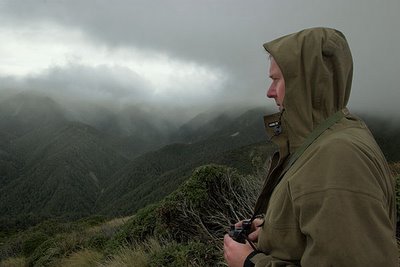
We did.

Although the weather was still misty, damp, and marginal the next day, we decided to head for Waterfall Hut in the Kawhatau Valley, as the route is well defined—a long, steep climb up a good track and a narrow spur; a short section along the main ridge; then a steep descent into Pinnacle Creek, which joins the Kawhatau not far from the Hut. At times, the view over the Pourangaki catchment was nothing short of spectacular, the hazy mist and veils of patchy rain giving the ridges a beautiful, almost ethereal, aerial perspective. Later in the trip we’d see the same views under a perfect blue sky, and, ironically, something seemed to be missing. Perhaps the fact that so much less is hidden means there’s less sense of mystery, less sense of what might be possible. It was the same at the head of Pinnacle Creek: there, jagged gendarmes3 and crenellated spurs loomed in the mist above us, conferring an epic feel to our surroundings; as if we were traversing a legend; yet when we returned on a cloudless blue day the towers and pinnacles seemed smaller, benign, almost disappointing.
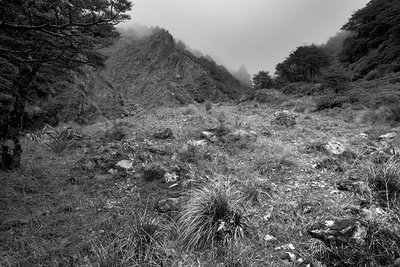
More rain overnight, but by the time I had breakfast underway the weather had begun to clear. Properly this time, so that by mid morning we had a magnificent, blue-sky, gentle-breeze, deep-warmth day. John headed upriver; I ambled slowly downstream to Rangi Stream, following it almost to where it branches to Rangi Saddle. There, I stopped to do nothing in particular, just to enjoy being remote and alone on a warm day under a brilliant sky. I loitered on the bouldery riverbed in the sun, nibbling a handful of cashews, listening to the river and watching countless, small ground beetles hurrying everywhere. Back where I’d left my pack, I sat in the shade and snacked, and as I did so I glanced down at the ground next to me. I was sitting next to a rotting possum carcase.
We stayed two nights at Waterfall Hut, then climbed back over to Pourangaki in the heat and wind of another perfect day. Yes, the views lacked the mystery of the first five days, but in their own way they held another kind of possibility—that of distance. On the eastern side of the ridge above Pinnacle Creek there’s a benched area, a perfect place to relax and brew up and eat lunch, or even camp if you’re inclined to do that. We stopped there for lunch, as it was sheltered from the wind and offered the best views imaginable of the central Ruahine. Rangi Saddle, Te Atuaoparapara, Tussock Creek, Broken Ridge, Ohuinga... up North, ridge after ridge, receding into the blue-hazed distance. This time it wasn’t mist, cloud and rain that hid the secrets of the land; it was the land itself and the vagueness of distance, like old, dim memories. You think you recognise a valley where you once walked, but that was years ago; the valley’s changed; what does it look like now? How has it changed? What new stories does it hold? You realise you know next to nothing about it—you walked it once, or a few times, but it’s old; older by far than the history of humans here, and all but a minute fraction of its countless stories will remain forever inaccessible to you. Its knowledge is Orphic and all you can do is be silent and listen.

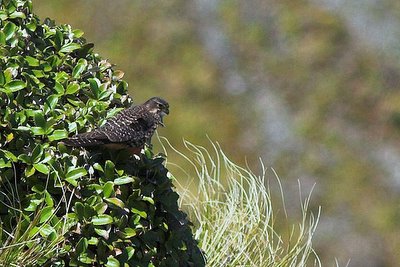
Suddenly, John points. “Falcon!” he says. Looking down, I see it wing around the curve of the steep spur and disappear. Later, we hear the hard chatter and see the bird fly back across the gully; hearing the sound behind me also, I look up and see a second bird sailing over the ridge, the unmistakeable silhouette with its long tail and angled wings dark against the bright sky. On the descent, another bird flushes from the near the track and alights nearby on the leatherwood4; it’s a falcon, karearea5, but we have no way of knowing whether it’s one of the two we’ve already seen. John sees another further down; it’s much lower, well below the bushline, flying up the valley. That makes five sightings with definite confirmation of two individual birds and a high probability of a third.
Half past six in the evening at Pourangaki Hut. From time to time I interrupted my writing to check the venison simmering on the MSR while John had gone up the track to see whether any deer had emerged onto the slip downstream. We had just one day left and tried not to think about it, but it arrived anyway. We had the whole day to walk out, and despite still-heavy packs our fitness had improved substantially, so we stopped frequently to enjoy where we were and delay the inevitable arrival at the car. The closer we got to the road end, the more we stopped and the longer we rested. We ate lunch in a sheltered hollow on the Whanahuia with the incessant hiss of the spring wind through deep snowgrass and a long bank of dazzling white snow slowly turning to slush. Again, it was a day of huge views: blue-grey, distant ridges and valleys; a pale half-moon fixed in a cerulean sky above a lion-coloured skyline. But when we looked out towards the low hills of the Rangitikei farmland, the land looked diseased: infected and scarred with innumerable slips, mostly the aftermath of the February 2004 ‘rainfall event’ but essentially the consequence of human activities that still haven’t attained a sustainable relationship with our land. Many good people are working hard to solve those problems and many good people are trying hard to manage that land in the best ways they know, but the inadequacy of those efforts confronted us clearly as we looked out from the high Ruahine. During our 8-day walk, John and I often talked about what might loosely be termed ‘environmental’ as well as social justice issues—how to live ethically, respecting and looking after the world and the people who live in it and are part of it. We speculated about what the future might bring and what motivates people to act irresponsibly or unsustainably regarding the use of resources (in the broadest sense) and towards each other. Being of similar minds, we felt at ease inveighing against various economic and political systems, although we both recognised the futility of levelling any such criticisms in any company other than the already-converted. In that aspect, our discussions were in part just letting off steam.
But they were also explorations; one thought leading to another; seldom opposing in the all-too-common, confrontational dialectic. I realised that in some ways these sorts of exploratory discussions, although superficially easier than the usual dialectic form, were actually more difficult. The challenge wasn’t to find a counterargument or opposing example but to seek potentially productive connections with other ideas; to find examples and analogies that create new ideas: in particular, to be open to and alert for insights. In these sorts of discussions there’s a kind of constructive tension between allowing your thoughts to wander widely (and wonder widely, too) and keeping them sufficiently focused. Of course, if you want to stay firmly fixed on a topic, these discussions will drive you crazy. But if your discussion is more akin to a conversation, then explorations seem to me to be not just more interesting, but more useful. After all, it’s in the nature of explorations to lead to discoveries—discoveries all the more interesting because you so often have no idea what you might find. I guess you might call it the joy of uncertainty.


1 Hymenolaimus malacorhynchus; blue duck.
2 Ninox novaeseelandiae; morepork (NZ’s native owl)
3 In this context, a gendarme is “a pinnacle, needle or tower of rock on a ridge” (Pascoe J. 1939. Unclimbed New Zealand. Woking, Great Britain; Unwin.)
4 Olearia colensoi; tupare.
5 Falco novaeseelandiae; New Zealand falcon.

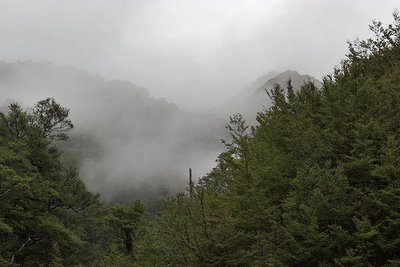
Photo 1: The view from Triangle Hut looking up to the Whanahuia Range where we bivvyed the first night.
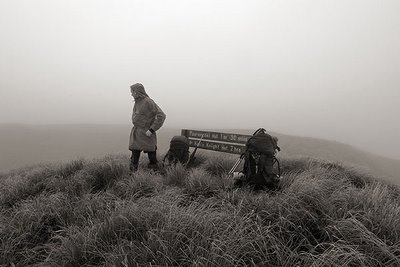
Photo 2: The top of the spur leading down to Pourangaki Hut.
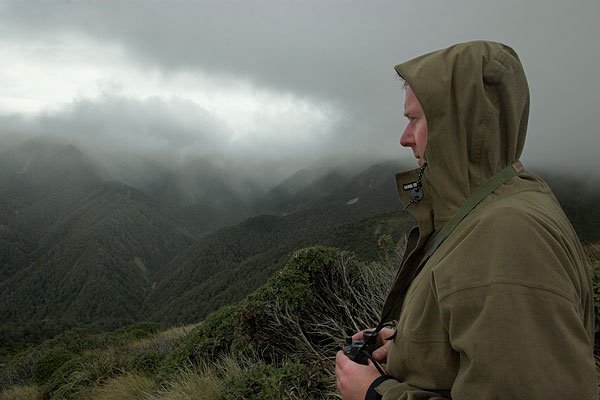
Photo 3: John looks out over the Pourangaki catchment on our way down to the hut.
Photo 4: Looking back up Pinnacle Creek.
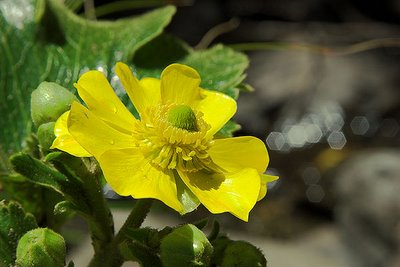
Photo 5: Ranunculus sp. in Waterfall Creek by the hut.
Photo 6: The karearea we saw on the descent to the Pourangaki on the penultimate day.
Photo 7: The Kawhatau River at its confluence with Rangi Creek.

Epilogue
I didn’t switch on the computer that evening. I wasn’t yet ready to re-enter that world. The following morning I dialled up and began finding out what had happened while we were away. Rod Donald had died. I couldn’t believe it. I thought again of those marvellous discussions John and I had enjoyed, and how, although I often felt pessimistic about how much we’re likely to lose, I was more optimistic knowing that people like Rod were working so hard to foster a brighter future. Of the few politicians I have much respect for, Rod was way out in front. I didn’t know him personally, but Wordgirl did, and, like her, I can’t think of a better way to honour him than to ensure his work continues; that his legacy will be a brighter future for all of us.


Photos and words copyright 2005 Pete McGregor


30 October 2005

What the thunder said

It’s the calm before the storm—literally. The sky begins to darken; black cloud’s building in the West, spreading towards the Valley. The sun goes out in a final struggle of stormlight, everything luminous and saturated with colour. Then it all fades into grey as thunder rolls around the hills—peal after peal, the crack and crash like the beginning of a tremendous rockfall among mountains, continuing for many seconds until finally it develops into a huge, reverberating boom. Perhaps a few seconds’ silence—or none—then the next crack and boom... it goes on and on. Occasionally I see a flash of sheet lightning, but mostly it’s just that phenomenal thunder. You hear it; you feel it shiver through you; you feel tiny; you feel as relevant as a lone ant on an endless beach. You feel full of life, like those swallows flickering over the spring field in front of the house.

Still no wind.

The rain’s moving up the valley, a grey veil so featureless it seems nothing could possibly exist behind it.

Perhaps nothing does.

From the corner of my eye, a glimpse of lightning, a jagged needle of light. Seconds pass, then the crack and roar of thunder. Leaves begin to shiver and sway. The rain’s closer now. Lost, I watch the faded distant hills, looking for nothing. Just lost. Then, right where I’m gazing, a lightning bolt connects sky and land—a shriek of light, a momentary scarring of the senses. There’s colour in it—an ultra violent ultra violet.

After the thunder, a damp gust, bringing rain1. The darkness begins to lighten, becoming a flat, insipid half-light matched by the disappointing rain. Steady; wet; neither driving nor drizzling; just monotonous, boring rain. The artwork on my verandah, chalked there just this morning by a person of great talent and potential, is getting wet and I’m hoping it won’t wash away; I’d like to enjoy it for a little while longer. In the middle of the paddock, depressed sheep stand, ears drooping, occasionally shaking a shower from a soggy fleece. For as long as I can remember, I’ve noticed the feeling of deflation when you first sense the storm weakening; when you know there’s no more wildness. Everything’s an anticlimax. I wonder why it seems so sad, and it occurs to me—just now, in fact, as I write this—that perhaps it’s because, when the storm passes, less is possible, in the sense that more is predictable. Or maybe it’s because, during a storm, what you can do is more constrained—paradoxically, because more is possible, you can do less. All you can really do is batten down the hatches, sit tight and hope it leaves you unscathed. With that inability to do much (or anything) comes a sense of freedom—if you can do nothing, no one, or nothing, expects much (or anything) of you.

It’s a fascinating paradox: the more you’re constrained, the more you’re free to enjoy just what’s happening. In The Snow Leopard, Peter Matthiessen relates his meeting with Karma Tupjuk, the incarnate lama of Shey2. Tupjuk is partially crippled, probably unable to leave his austere home, and Matthiessen enquires about his feelings towards that fact. The answer, Matthiessen says, strikes him like a blow to the chest: Tupjuk laughs out loud, indicates his crippled legs and waves his arms to his world, crying out, “Of course I am happy here! It’s wonderful! Especially when I have no choice!”

I think I’m just beginning to understand a little of what he meant.


1 pinched from T.S. Eliot’s The Waste Land. The title was too.
2 Matthiessen, P. 1979: The Snow Leopard
. London, Harvill. 312 p. ISBN 0-00-272025-6. The account of the meeting is included in the November 14 chapter

Photo 1: No, it's not Crystal Mountain/Shey, and it's not the Pohangina Valley. It's Park Stream, a major tributary of the Mungo River on the West Coast of NZ's South Island. Rob and I were there in March this year, and this was what we saw from Mungo Hut on our last morning. That dark streak across the sky is the shadow of a mountain.
Photo 2: Artist at work.

Photos and words copyright 2005 Pete McGregor


29 October 2005

Earthquake: a poem

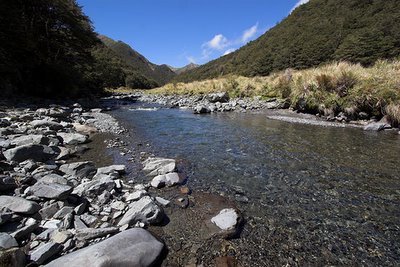
Wednesday a fortnight ago (19 October); not a big one but they're always unsettling. It unsettled me enough to prompt this. The photo is by the edge of TeAwaoteatua Stream, just upstream from the bridge.

Earthquake

Between one and two it was
with the wayward wind restless
and shifty about the house—
finding itself at a loose end
it rattled the bored walls

while I worked

unkempt cloud heaped high over hills
a range of shades grey and white
light leached like dry grass on a dusty day
the empty sky a full haze
of pollen and wind

Then the slight sway the shudder
the off balance rock and giddy tilt

and the is or isn’t it question
and should I ... still sitting
not quite still still rocking

waiting to see what developed
until the tremble in the heart
of the land waved by and headed on

down the line, leaving me
still on shaky ground; less sure

about finding fault.


Photo and words copyright 2005 Pete McGregor