24 October 2005

Work, play, and persistence

It’s Labour weekend; three days’ break from the treadmill for most people. Not for me, though. Weekends don’t have the same significance because I’m often working during them or not working during the usual Monday–Friday period. Lately, however, I’ve been working pretty much continuously. Not all of it’s paid, either; and come to think of it, some of the paid work hasn’t been, well, ... work. More like fun. Actually, a lot like fun. However, the other side of the coin—so to speak—is that some of the unpaid things I’ve been doing have been more like work.

I suppose you want examples. Well, processing the photos for last Thursday’s presentation to the PNTMC turned out to be a mission; fortunately, one I accomplished with just enough time to spare. Conversely, photographing the badminton tournament for OutsideIn last Sunday meant I got to meet up with friends from all over the world and make new friendships—Aberry informed me that there were people from at least 12 countries playing in the tournament. I’d intended spending just an hour or so there, but—of course—I stayed to the end. I’m glad I did, too, as I got to see badminton played at a level I wouldn’t have thought possible. Several of us were gathered in a group, watching the mixed doubles final; some of the rallies were so outrageous we just laughed and shook our heads in disbelief.

Now the OutsideIn exhibition is up and running. If you’re in Palmerston North, you can view it at Te Manawa until the end of the month; it then shifts to the Plaza for three days. Most of the photos are from events I photographed; they’re complemented with art works and writings by some of the students. After the opening on Thursday evening, I said goodbye to friends, most of whom I hadn’t even met a few months ago, and walked out into the night rain. I felt slightly strange, as if I’d left something behind. Perhaps I have—but I’ve gained far more.

So now it’s Labour weekend, and I’m editing and trying to take advantage of the weather. Walking this morning, down through the cutting as cold shadows pulled back into the banks and the sun began to warm the road; Te Awaoteatua Stream rushing under bright green poplar leaves, a piwakawaka1 cheeping and ranting from time to time... it was the kind of brilliant-day silence that’s accentuated, not compromised, by sounds—the calling of birds, the whingeing of a lamb separated from its mum, the passing of an occasional car—all those sounds simply draw attention to the silences between. The family of spur-winged plovers2 in the paddock past the bridge seemed less perturbed than usual, not bothering to screech at me but instead just moving a little further away. Everything seemed alive with birds; an impression I’d noticed the previous evening as I drove to meet friends for dinner. That evening, flights of swallows3 and flocks of finches filled the air; I drove past roadside magpies4 and innumerable blackbirds and thrushes. Near Ballance, I saw three swans flying, heads suspended on outstretched, flexing necks. There was something strange about them, the way they flew like omens, like pointers to some other-world destination, in formation across a grey, fading sky... Later, in the half-light, a lone, fast-flying duck. When I eventually returned home, the last thing I heard, at 8 minutes to midnight, was a ruru5 calling, loud, close, persistent. Then dreams.

Up No. 3 Line I studied a goldfinch6 through the binoculars, paying attention to its its striking colours: the blood-red face, the white, black, fawn and yellow. A few minutes later, I watched two tauhou7 (silvereyes) investigating a scrappy coprosma. Superficially and from a distance they can appear uninteresting: small, common, green and russet birds notable only for the white ring around the eye. But, through binoculars, the texture of the birds and the subtlety of their colours became apparent—the soft, fluffed-up feathers on their bellies; the clean, neat lines of wing and tail feathers; the narrow beak tapering to a needle-sharp point. As they flitted among the shrubbery, they’d sometimes shiver: small bundles of puffed-out, trembling intensity. It’s hard to think of birds—especially those as apparently insubstantial and fragile as tauhou or piwakawaka—as the heirs of dinosaurs, but that seems to be what they are. I thought about avian influenza and how it might lead to a human ‘flu pandemic, if not this time, then eventually; and I remembered the previous evening’s swans, and that solitary duck speeding into the dusk. We think dinosaurs died out millions of years ago, but maybe, even after all those aeons, they can still affect more than just our imagination.


1Rhipidura fuliginosa placabilis; North Island fantail
2Vanellus miles novaehollandiae
3Hirundo tahitica; welcome swallow
4Gymnorhina tibicen; Australian magpie
5Ninox novaeseelandiae; morepork
6Carduelis carduelis
7Zosterops lateralis lateralis

Photo 1: self evident.
Photo 2: Many Happy Returns, Kohei!
Photo 3: Kowhai and rain cloud, Pohangina Valley. I took this on a walk several weeks ago. I made it home just ahead of the rain.

Photos and words copyright 2005 Pete McGregor

15 October 2005

Weta and the wide world

Several days ago I stepped out the back door, picked up my red bands1 to put them on, and a weta fell to the ground. Only a half grown weta, but by insect standards a fairly large animal, its body roughly 5–6 cm long and about as thick as my little finger. It flipped itself upright and raised its spikey hind legs in the air, jaws open: the classic weta defensive posture. I haven't seen a live weta for quite a while, and have been keen to photograph one, so I scooped it up into a jar, added a piece crumpled paper towel for it to cling to and a disc of carrot for it to eat. I no longer have any urge to keep “bugs in jars”—I much prefer just looking at them going about their lives, or I'll try for a photo if I'm in that mood—but that evening I was leaving to meet friends and if I wanted a weta photo then this weta would have to put up with a brief stay in a jam jar with a free lunch.

That free lunch, I'm ashamed to say, turned into a free dinner, breakfast, and lunch. Then another dinner, breakfast and lunch. And another... I think the weta was in the jar for about 3 days. I checked it often; made sure it still had plenty of carrot (the disc had actually begun to sprout, so it was good tucker) and left the lid off from time to time. The weta began eating carrot the first night, and began crapping carrot the second night. I'd like to say it seemed pretty happy in its new jam-jar-and-paper-towel home with ad lib. food, but it's hard to tell whether or not a weta's happy when it's doing nothing but lying there with its palps on its food to make sure the carrot doesn't escape. Besides, exoskeletons make it hard to express emotions visibly—all you can really do is gesticulate with the articulated bits of your body. This weta wasn't waving anything, so I assumed it was perfectly contented.

That, of course, was a totally unwarranted assumption. I made it because I was feeling guilty. I'd rationalised the capture by arguing that I'd photograph my little friend the next day, then let it go. Several days later, I'd still not photographed it, and was still so consumed by all the other things I had to do that the prospect of setting up the camera and finding a natural-looking background on which to photograph the weta seemed remote.

On Thursday evening I delivered the slide show & talk to the PNTMC. I showed images of last year's overseas trip, particularly the time in Mongolia, but also Japan, China, Italy, and Switzerland, and finished with a selection of photos of climbing in Arthur's Pass and birds, insects, and spiders. Despite good feedback, I felt disappointed with the quality of the projected images—digital projection still has a long way to go to match projected film (slides)—and the deflated feeling stayed with me right through the next day. When I got home after the talk, my weta was still waiting, unphotographed, in its jar with its carrot.

Last night, worn out and affected by a feeling of low intensity incompetence, I removed the lid from the jam jar and carefully extracted the paper towel with the weta clinging to it. On being removed from the jar, the weta scuttled up the dangling paper and onto my hand. I put the jar down, dropped the paper towel and the weta ran up my arm. I cut it off with my left hand, so it ran up my left arm. After swapping arms several times, I remembered what I should've done from the outset, and held my hand upright, whereon the weta ran up to my hand and perched there. I moved over to the door, opened it and stepped out onto the verandah, said goodbye and good luck, and flicked the weta gently into the night, from where it had arrived several days ago.

When I stepped inside, my mood had lifted—substantially; the feeling was almost tangible; a kind of relief. Something about the weta's confinement had clearly oppressed me. The paradox (or is it irony?) is that if the weta had any awareness of what had happened, it would probably have been utterly pissed off with me, not for its confinement, but for being tossed out of its safe, lazy environment, where it need do nothing but eat and sleep. Now it's out in the wide world, where the risks of being eaten by something—rat, mouse, cat, ruru2, inattentive sheep—are high. It has to search for its food; it has to find somewhere to shelter during the day so it won't be eaten or shrivel up in the sunlight. It faces all the problems of moment-by-moment survival; problems it didn't face in its jam jar.

In other words, it's free.

1 Red bands are NZ-iconic, short gumboots.
2 Ninox novaeseelandiae
; the morepork; NZ's only extant native owl.

[The photos are all from Mongolia; taken with the little, long-obsolete, point-and-shoot Pentax Optio 555. We never discovered the significance of the line of standing stones, but the place had a strange feel to it—an aura that compelled respect and reflection. That's Yatga and John with the horses; the final photo is of three local men checking out my binoculars on the hill overlooking the Ider Gol where we camped and started our fortnight on horseback. Check out John's Zavkhan Trekking website if you want to find out more.]

Photos and words copyright 2005 Pete McGregor

08 October 2005

A mark that remains

After a fine, mild spell, the weather's gone mental. Industrial grade rain; lightning and thunder; wind raging straight from the bowels of some Antarctic ice god—then sunshine, a warmth you can feel right through to your bones. Range upon range of clouds piled up down south or over the Ruahine; hard shadows cast by sunlight through a blue gap in the white and grey and black; a kahu1 wheeling, tiny against that vast sky... then the sun's gone and a bitter wind brings driving rain, drops the size of raspberries. Suddenly it stops. Just like that. Later it begins to drizzle.

Several times I decide to go for a walk, only to step out the door as rain begins. I step back inside and find something useful to do, or just enjoy the sound of the deluge on the iron roof. Eventually I time it perfectly, albeit by accident. I leave the camera and binoculars at home, take nothing but my senses and thoughts down to the bridge, peer over the rough concrete railing at the flooded stream and wonder where the mallard and her 7 fluffy ducklings are. I check to see that the weathered twig is indeed still there, shimmying in the current; then walk back, stopping to pick up a kereru2 feather from the side of the road. The feather's speckled with tiny droplets, the remnants of a rain now gone. I take it home, trying to keep the droplets in place.

Shul: “a mark that remains after that which made it has passed by.”3 The rain has passed by, leaving its mark as droplets on a feather which is a mark left by the bird that passed by. I pass by the footprints I made on the muddy driveway quarter of an hour ago, wondering whether everything's a shul in some sense, whether everything's a mark of its own past. I suppose that leads to those impossible arguments about determinism—whether you can reconcile the idea of free will with the assertion that, if every effect has a cause, everything I do is caused by something so any freedom I think I have is, in fact, an illusion.

However, as I walk back to the house, I'm not much interested in wrestling with deep philosophical questions. Anyway, it's probably a misinterpretation to consider raindrops a shul—raindrops are raindrops, and they haven't passed by yet. I'm more entranced by a found feather; the beaded remains of rain clinging to it; by detail, texture and light. And besides, it's beginning to rain.


1Circus approximans; the Australasian harrier.

2Hemiphaga novaeseelandiae; the NZ wood pigeon.

3 “'Emptiness' said the Tibetan philosopher Tsongkhapa, in 1397, 'is the track on which the centered person moves.' The word he uses for track is shul. This term is defined as 'an impression': a mark that remains after that which made it has passed by—a footprint, for example. In other contexts, shul is used to describe the scarred hollow in the ground where a house once stood, the channel worn through rock where a river runs in flood, the indentation in the grass where an animal slept last night. All these are shul: the impression of something that used to be there.” [from an article by Stephen Batchelor].


Photos and words copyright 2005 Pete McGregor

02 October 2005

Home again

The first day of daylight saving. I wake as the last of the night disappears and the room fills with light. Outside, a bird calls; a distinctive, repeated whistle followed by a drawn out note, decreasing in pitch. The call draws me into full consciousness—I'm listening to the season's first pipiwharauroa; the shining cuckoo. Back from the Pacific—probably the Solomon Islands—for the summer. Long days and warmth; evenings on the verandah.

Walking along the road, down through the cutting, the poplars in Te Awaoteatua Stream coming into view, new foliage bright green and orange-red, the sound of the stream rising to meet me. Four spur-winged plovers screech and tippy-toe through the rushes, stop and chitter, stretch and peck at something in green grass.
Deep red legs, fawn backs, white underparts; the head black and white, and that bizarre, wattled, sulphur-yellow face. Something about them reminds me of Mervyn Peake's drawings. I watch them for a while, then continue down the road. Not far from the No. 3 Line junction, an eastern rosella calls. A tui, wings whirring, chases something into a kowhai, and when I put the binoculars to my eyes, I see it's the rosella. The tui hops about in the branches, shakes and fluffs itself out and begins to sing, an impossibly complex medley of clucks, bells, warbles, wheezes and whistles. The rosella's sitting not far away, almost motionless, but it responds with a trill; the tui answers and shuffles restlessly. Under the overcast sky, in the still, mild air, the calls seem very loud; there's a slight echo to the sounds as if they're bouncing back from the grey overhead. The battle continues, seemingly purely vocal, until the tui finally whirrs off to a lower tree below the clay bank.

After stopping for a quick chat with Robin, who's fixing the front door of their house, I resume my walk up No. 3 Line, but I'm arrested by Charlie, the little burmese cat who saunters over to me, casual and cool, tail up. I crouch to say hello and he does that cat thing of slipping under my shins, tail dragging over my knees, emerging with his head facing away from me as if to show he's completely relaxed about the attention I'm giving him. In any other animal it'd be arrogance, but because cats are superior to all other forms of life it's nothing to be affronted about—it's just the natural order of things. I pick him up, stand, and scratch the back of his head and under his chin; he closes his eyes and rubs against my hand. The purr gets louder. Eventually I put him back on the ground, and he feigns boredom as I walk off up the gravel road.

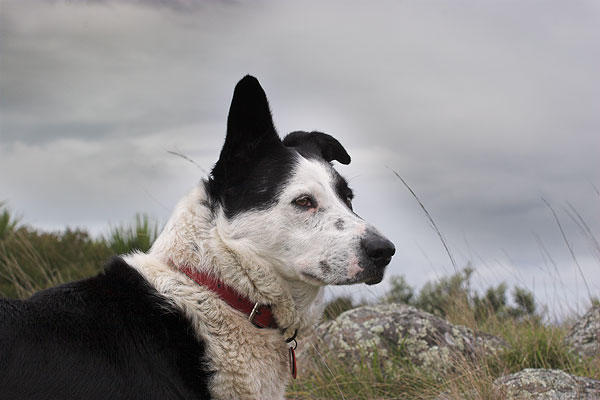
I remember another encounter, this time with someone who appeared to be a border collie but was, I suspect, a bodhisattva. In Christchurch last week, Rob and I drove to Sumner, left the car at the Whitewash Head carpark and walked the track right out to Godley Head. The track switchbacks down and up and eventually drops to the beach at Taylor's Mistake. There, just before the beach, a lone, three-legged dog came loping up the track. His lack of one front leg seemed no handicap at all, and he seemed pleased to meet us. He'd been heading up the hill, but on encountering us, turned and followed us back to the beach. I checked his tags; discovered his name was Rocky. The three of us—Rob, Rocky and me—walked the length of the beach, leaving a braid of 7 prints on the clean sand. It was Thursday; apart from one woman and a dog (who Rocky checked out, then ignored in favour of Rob and me), the beach was deserted.
At the far end, Rocky hopped up the rocky start of the Godley Head track, pretending he couldn't read the sign which said, “Dogs on leash only”. Rob and I followed—the order of things for most of the rest of the day.

We came to a small, closed gate. Rocky paced back and forth in front of it, nosing it. “We should be able to shake him off here,” Rob said, starting to ease the gate open. No sooner had he said it than Rocky had squeezed through the tiny gap and was happily trotting on up the path.

We ate lunch at the top, under a grey sky, with the remains of the weekend's snow still spattered on the peninsula hills, giving the scene a cold, Scottish highlands look. Rocky lay in the tussocks, occasionally sitting up to look around then flumping down again. He made no attempt to bludge food from us. Once or twice on the way back, he seemed a little too interested in the sheep scattered over the bleak hillside, so I growled at him and he trotted back as if he'd been intending to return anyway.

We finally shook him off shortly before reaching Taylor's Mistake. He'd been distracted by something fascinating in a clump of tussock—perhaps a mouse, or some other dog's turd—and we last saw him high up on the hill, still grubbing at the tussock.

We walked across the gleaming, wet beach, talking quietly and watching lines of clean surf rolling in, breaking, and sighing up the beach to disappear in an ephemeral pattern of white foam on dark sand. I led the way up onto a small promontory of mussel-encrusted, dark volcanic rocks; just before stepping back down onto the sand, Rocky pushed past and resumed his place at the head of the party. He waited while I photographed the bach built into a cave in the cliff, then trotted ahead of us up the track to Whitewash Head, showing us all the shortcuts, which, however, were only suitable for dogs to squeeze through. Where the track leaves the cliffs and cuts across to the carpark, a high, weathered paling fence confined an Alsatian. Rocky ran to the fence and began barking and running up and down the fenceline; the Alsatian chased him, barking furiously. Rocky raced back and forth, barking, working the Alsatian into a frenzy. When he decided the other dog was on the verge of apoplexy, he calmly trotted off towards the car park. Job done; he'd had his fun.

He looked back at us once at the carpark, then disappeared. We got in the car and drove home. I'm not sure he was really a dog—well, I'm sure he wasn't just a dog.


A big kahu flies across the small valley in front of me, behind the lone pine, over the tawa and maire, behind the poplars, above the stream to the edge of the far terrace. It begins to circle, gaining height. Through the binoculars I can see the separated primaries at its wingtips; the way the wings flex ever so slightly; the hook of the bill. As it banks away from me, it suddenly drops its legs, shakes them and retracts them, all in a moment. A flock of finches tinkles up from a field and flies off; mostly goldfinches, a few chaffinches.
A kotare dives from a fencepost to the ground, then flies back up to the powerlines. The deer are wallowing, covering themselves in mud, wriggling and threshing, competing for the hole, chasing each other. For them, this fenced paddock is home; for Charlie, a small area at the foot of No. 3 Line is home; for all the birds I've seen this morning, some part of the Pohangina Valley—earth, stream, trees, sky—is home. It's easy to think of home as a geographical location, the place where the deer, Charlie, the birds, spend their time, but there's more to it. Rocky's home, in a superficial sense, is the area around Taylor's Mistake and Godley Head, but I got the sense that his real home is wherever he is. Sometimes I feel like that, and I can't work out whether it's because I've managed to lose myself, in the figurative sense, or whether, because I feel at home wherever I am, I'm never lost. Yes, it's a paradox, but if I knew anything about zen I'd be tempted to suggest it's more like a koan. It's something to think about—if you truly lose yourself, you can never be lost.


Photos and words copyright 2005 Pete McGregor

01 October 2005

About words and light

The South Island trip was brilliant, despite the cold I'd picked up shortly before heading to Christchurch. It developed while I was down there, peaking on the weekend of the wedding, but fortunately didn't diminish my enjoyment of the events. In fact, despite having curtailed the trip because I had a contract to get back to, the trip proved one of the most enjoyable weeks I've had for some time.

I arrived in Christchurch late, after a long, trying drive from Pohangina to Wellington, across the Strait on the ferry, into the night along the Kaikoura Coast, through the Hundalees and eventually into Canterbury. The following morning, Rob asked me whether I was getting much writing done. I answered honestly—“No”. I think it's the focus on photos; I'm thinking visually, in terms of images, and I'm out of practice at translating images into words. Or—and of more concern—I seem to be less in touch with what's happening , with how it touches me. Barry Lopez recognised something similar happening to him, and he put his cameras away and never picked them up again, preferring to concentrate on writing1.

What's different about the two processes? After all, both are kinds of translation; kinds of filtering, I suppose. You take what you perceive, translate it, filter it through your own preconceptions, biases, prior experiences, desires, and so on, and you end up with something you can share—a visual image; a collection of words; a poem; an essay; a verbal sketch... so how do they differ? What prompted Barry Lopez to put aside his cameras—was it simply a preference for words over light?

To me, it seems the essential difference is timing. To capture a photo, by and large you must attend to technical details and—for want of a better phrase—artistic demands, and you must do these at the moment of experience. Not later; now. Consistently good photographers attend to technical details almost without thinking, and the best photographers, I suspect, also make artistic judgements about such things as composition and when to take the shot more as a matter of intuition than conscious decision. But those decisions must be made, or intuitions acted upon, when you experience what it is that moved you to take the photo. Two photos, one second apart, can appear completely different; even landscapes, where the scene appears superficially static, can differ hugely because of a momentary—or progressive—change in light, or because the photographer chose to frame the scene differently.

However, verbal images almost always benefit from time between the experience and the formulation. Indeed, trying to write during the experience is next to impossible—even dictating to a voice recorder must, I suspect, be utterly unsatisfactory. What is important is to attend to what's happening; to pay attention; to become caught up in it; immersed in it... anything that distracts, anything requiring decisions that are not part of the experience itself—like what shutter speed to use, or how to frame the image—diminishes the intensity of the moment, so it becomes harder to feel again the emotions of the moment when you eventually try to translate it into words. That, it seems to me, is why photography and writing are so difficult to pursue simultaneously. So, having decided why it's impossible to do justice to both forms of expression, I'd better... well, ... attempt it anyway.


1 Lopez B 1998. Learning to see. ch. 13 (Pp. 223–239) in About this life: Journeys on the threshold of memory. (Vintage Books edition 1999, ISBN: 0-679-75447-4)


Photos and words copyright 2005 Pete McGregor

20 September 2005

Depressions and highs

The election's over, but the outcome isn't clear; a deep depression hit New Zealand during the last couple of days; and I'm on the road again and feeling high. I cleared everything—the image files for printing; the editing; those last-minute odds and ends—with time to spare; time to enjoy with friends. Now I'm off to the South Island.

The depression was a weather system rather than a psychological state, although some people might feel otherwise. From my perspective, the next week or two until the special votes are counted feels less like a sense of relief and more like time out, but at least the prospect of the country's decline towards a reward-the-rich, beat-the-poor society, where anyone not “mainstream”1 must conform, emigrate or die, seems less likely. At least for the time being.

But enough ranting! Although I still had some image files left to process, I knew I'd get them done in time, so I felt no guilt about joining the celebration for Paul's 40th birthday on Sunday afternoon. A bonus was the venue—The Waterford's a lovely, Celtic cafe/bar only a few km from my place in the Pohangina Valley. I arrived to find it crammed with people and the music about to start. Guitars, fiddle, harp, bodhrain... Willy, having heard that Duncan would be playing, had brought the handmade, wooden Irish flute he'd bought years ago and still couldn't play. Later in the session, Duncan played a beautiful, haunting, piece on Willy's flute, accompanied by Tony's quiet guitar. If that doesn't inspire Willy to get his act together and start learning how to play it, nothing will.

Outside, cold rain; inside, warmth—literal and figurative. It's occasions like that; people enjoying the moment, talking, listening, laughing, sharing; that go so far towards making us human. I suspect you could have found the entire political spectrum inside the Waterford that Sunday afternoon, yet, in that environment, political differences meant nothing. As the election's outcome becomes clearer, I'll be reminding myself of that.

1 As far as I can work out, it seems to exclude women, Maori, anyone in any form of unmarried relationship, anyone receiving any State welfare benefit... well, anyone other than white, wealthy, middle-aged men. Here's Anne Else's view—highly recommended ( and entertaining in a bitter sort of way).

Photo and words copyright 2005 Pete McGregor

11 September 2005

Innocence

I was photographing the NZ Ultimate Frisbee National Championships on Saturday, on a beautiful Spring day. Unfortunately, the champs were being held in the indoor arenas... At lunchtime I wandered outside and found a rugby match in progress—it was a game between Manawatu and Taranaki, but I'm not sure of the grade.

With so much glorious sunlight
around, I decided to take a few photos, mostly for the sake of enjoying the ease of taking them: the poor and horribly-coloured light indoors had been frustrating me intensely. I got a few nice action shots, but this was my favourite—the ref had just pinged this Taranaki player for a head-high tackle. Obviously the player felt hard done by... The subsequent shot at goal was successful.

I'd like to have something more profound to say, but I don't. I seem to be in one of those periods when so much is happening, when there's so much to think about, that concentrating on one issue somehow seems like ignoring others, which may be more important. The problem is that I don't know if they're really more important because I haven't thought enough about them. Something of a conundrum, really (actually, I suspect it's not so much a conundrum as an excuse).

But maybe it's also that I have so much on right now. This is shaping up to be the week from hell: more photos to process; another OutsideIn session to photograph and process; the image files for the exhibition to select and prepare; and, I'm contract editing again. Might be some late nights coming up. Like this one.

Oh yes, as I mentioned several weeks ago, there's an election on Saturday. We get to have our say about our Government for the next three years. As is the case with most elections, the proliferation of cynicism, spin, attempted vote-buying and mendacity depresses me, but it's the refusal of most parties1 to address the really important issues that's the worst feature. For example, while the price of petrol is rocketing, both major parties are promising to build a new motorway in Auckland; moreover, they're arguing over how fast it can be built. And National's even saying they'll scrap the proposed carbon tax. Presumably their logic is that the more we use our vehicles and the less we care about global warming, the faster the planet will heat up and, consequently, the less we'll have to pay in heating bills.

I dunno. It would be easy to just switch off and pretend the whole thing was just a bad dream. But it isn't; it's real; and the only switching off I intend doing will be intended to conserve energy, not as a tacit mandate for irresponsible politicians.


1 But not all. You shouldn't have to think too hard to realise which parties have actively campaigned for human rights, peace and justice. And if you want to see how the parties stack up regarding their environmental policies, check out this site. Finally, if you're overseas, here's how you can vote.


Photo and words copyright 2005 Pete McGregor