12 August 2005

God set to win in Tasmania

The featured article on Wikipedia this morning was about one of my favourite subjects. I called up the main article and read it until I finally came to this extraordinary statement:
In May 2005 a recommendation was made to include the devil on the Tasmanian Threatened Species list as a vulnerable species".
Apparently the devil is characterised by an "...extremely loud and disturbing screech, and viciousness when feeding"; moreover, "when agitated, the devil can produce a strong odour, its pungency rivalling even the skunk".

If you haven't already guessed, the devil in question is Sarcophilus laniarius (formerly S. harrisi)—the Tasmanian devil. On a more serious note, the article's fascinating; for example, I wasn't aware that devils can "can eat up to 40% of their body weight in 30 minutes". Actually, maybe I should suggest a correction to the article—it's someone else's bodyweight they're eating.

[Note: be warned—the article includes a sad and gruesome photo of a devil killed by devil facial tumour disease. Also, despite the tongue-in-cheek title of this post (no offence intended), I'm sure any god would be just as saddened by the extinction of these great little animals as by any other. Although, given George Bush's record on environmental issues and nuclear proliferation, the god he apparently talks to might not be concerned about extinctions—including our own.]


09 August 2005

The second city

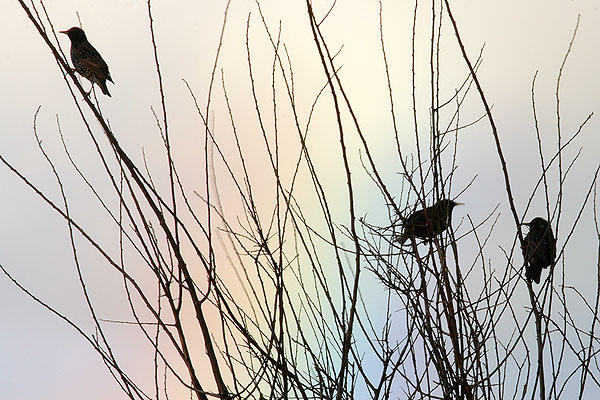
A quiet rain from a concrete-coloured sky. A swallow, perched on a protruding wire above algal-grubby guttering, ruffles and preens in the falling drops; amorphous clouds, hardly distinguishable from the grey background, drift slowly across the skyline towards the obscured range. It's not cold, not wild; the day's subdued and gentle. Maybe it was like this in Nagasaki 60 years ago, until an unlucky break in the cloud revealed the city to the USAAF bomber Bockscar carrying Fat Man and a new cloud rose in the sky; the kind of cloud seen over a city only once before. Three days before, over Hiroshima.

Let's hope it's never seen again. Ever.

Photo and words copyright 2005 Pete McGregor

05 August 2005

Landscape as playground

Five a.m. on a winter's morning and the radio blares into life. The sacrifices we make for a day in the mountains.
The early start was worth it, but we still had several hours' driving to reach the Turoa carpark by mid-morning. It was already half full, infested with SUVs and RVs and redolent with diesel fumes, overheated rubber, burnt oil and suncream. With a brilliant sun threatening to turn the climb slushy, we decided to take the chairlifts to the top of the skifield, so we walked up to a ticket counter and asked for lift passes.
That's $72 each”, she said, smiling brightly.
Um”, I said, not smiling, weakly. Fortunately, John quickly explained that we weren't skiing; just wanting the ride to the top.
It should be $16”, he said.
Ok, that's $18 each”, she said, smiling brightly.

At the top of the second lift we made our way among the the melĂ©e of skiers and snowboarders whizzing and pranging like bottled fleas. Most of them ignored us, as they did everyone else—embracing the true spirit of capitalism, they regarded other human beings as mere obstacles to be negotiated. But as we trudged up the slope towards the skifield boundary, we did receive a few cheery “hi”s and other comments and queries. Two people slid past, clinging to the tow.
Going to the top?” one asked.
Yep, all going well”.
And it was. Apprehensive about the limited amount of time I'd spent in the hills since early in the year (i.e. none), I'd been stressing to John that I was expecting to feel sluggish and slow. But instead, I felt comfortable and relaxed; the snow a good consistency for walking; the weather brilliant. I looked around at the busy field and felt my cynicism evaporating—instead of seeing spoiled rich kids and up-themselves materialists, I saw hundreds of people enjoying the day; just a heap of people having a good time. Like me.
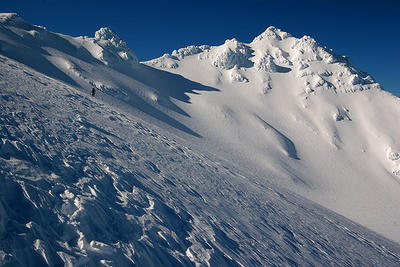
We left the crowds behind, and crossed a short section of powder-covered ice into the Mangaehuehu neve. John, a little way ahead, stopped to put crampons on before crossing a large, shaded snowfield which would presumably be icy. Meanwhile, I swapped lenses and snapped photos and eventually decided against crampons when John called back that the snow was softer than expected and that I should be ok without them. He was right; in fact, the snow was soft enough for me to leave my crampons bundled up the whole day.

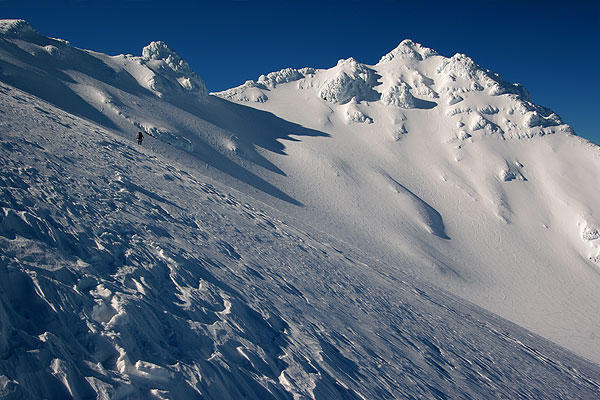
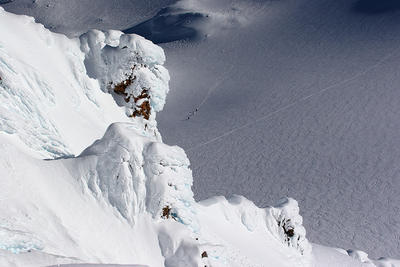
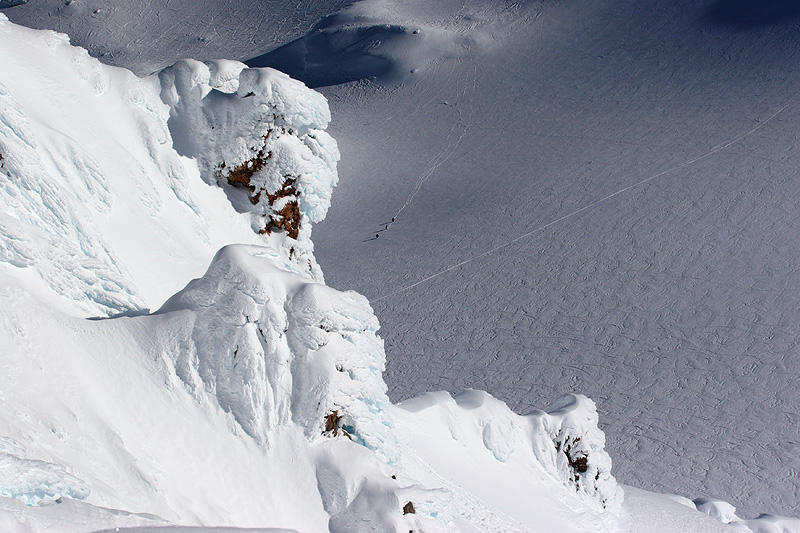
I sidle around to a small snow bench just below the summit to shelter from a wind that's not strong but bitterly cold. We sit there, perched in the sky, eating lunch, looking south, looking down the steep ridge. The architecture's complex: massive cauliflowers and chandeliers of ice hanging over a glimpse of red and brown rock; snowbanks curving soft and smooth or rising to clean lines parting the light—one side blue shadow, the other a brilliant, glaring white. Far below, sunlight skids over the Mangaehuehu Glacier, picking out texture, stretching shadows. Three people, small as ants, cross the glacier towards the foot of the ridge; they're so tiny their movement seems imperceptible. Someone else skins over towards our line of footprints; on the summit of Tahurangi two people are silhouetted. Landscape as playground...

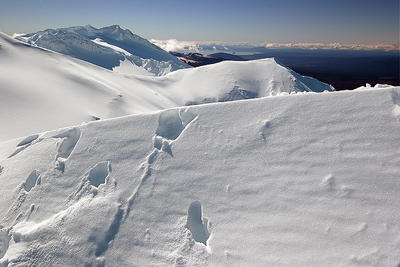
I think of Barry Lopez's words; how he points out that in the wake of the "...loss of personal and local knowledge, the knowledge from which a real geography is derived, the knowledge on which a country must ultimately stand ... has come something hard to define but...sinister and unsettling—the packaging and marketing of land as a form of entertainment."[1] Is this what has happened to Ruapehu? Undoubtedly. No one looking around from up here and seeing the snowboard trails, the tiny figures scattered over the mountain, the lines of footprints and the distant pillars of chairlifts and tows, would deny it.
But I can guess that most of the people on the mountain that day—and that's a lot of people—returned feeling exhilarated and renewed. And that's a lot of happiness and renewal. I find it hard to condemn too roundly the activities that enable so many people to gain so much enjoyment. Sure, it's unattainable for many—if you can't afford $72 for a day pass, let alone the petrol to get there and back, you might resent the rich bastards who can afford it. But even rich bastards are human beings; even they are entitled to some happiness. Besides, you can console yourself by thinking that by the time they've paid for their day on the slopes, they'll have a tiny bit less money, and maybe, because they're happy, they'll be a little more compassionate and a tiny little bit less like bastards. (Well, there might be some truth in it).

But back to the point. We took advantage of the chairlift; we used the road that wouldn't have been built if the skifield wasn't there. In some respects, if there's a finger to be pointed at those who prop up “the packaging and marketing of land as a form of entertainment”, then that finger is pointed at me, too. But, for me, there are limits—indefinite expansion of commercial activities all over the mountain is not acceptable. More importantly, I'd like to think that a fair proportion of the skiers, snowboarders and others would have left the mountain feeling the way I did: grateful for what the mountain (rather than the skifield operators) had gifted, and with a deep sense of respect for the mountain as something deeply significant and important; as something far greater than rock, ice and snow.

1. from Lopez, B. 1998: The American Geographies. Ch. 8 in: About this life. New York, Vintage Books (1999) ISBN 0-679-75447-4. 273 p. The quote is on pp. 135–6.

Photos and words copyright 2005 Pete McGregor

31 July 2005

Oops... silence = incompetence

Been wondering about the hiatus in blog entries? Well I've been wondering why I couldn't get my post to appear... I finally resorted to sending an email to the blogger help people. Of course, I'd only just sent the email when I I had a sneaking suspicion that I knew what the problem might be. I was right—I'd been fiddling with the HTML template to get it resembling the old pohanginapete-at-xanga site and had somehow copied the content of the posts into the template instead of leaving it with the code for getting the content... It's fixed now, so I guess I owe an apology to the blogger people for wasting their time. Sorry, guys.

Anyway, I hope to be posting a bit more frequently, so keep checking in! And don't be afraid to leave a comment—you just have to click on the comments counter at the bottom of the post for all the world to read... it's really not that scary. Otherwise, email me (I'll work out a way of putting a mailing link here in a form that prevents spammers finding it. Most of you should already know my address anyway...)


(Just a random photo...)

Copyright 2005 Pete McGregor

30 July 2005

The End of Tolerance?

Yesterday evening, over a magnificent dinner and in defiance of the common exhortation, several friends and I discussed politics and religion. Well, it was more like politics, the state of the environment and the issue of poverty, but a little religion did creep in at times. Despite some disagreement, we remain great friends (I hope!), proving that the common exhortation is wrong.

Much of the political discussion centred, of course, on the NZ Parliamentary election, which is to be held on 17 September. Sadly, there's a common expectation that the campaign will be ugly, and it's my fear that it may cause much, lasting damage. We've already seen Don Brash and his National Party tapping into a very unpleasant undercurrent of prejudice regarding “Maori privilege” and “the Treaty Grievance Industry”, thereby fostering those prejudices and, I suspect, leaving many (possibly most) Maori feeling victimised. I wish I could believe the approach was well-intentioned but sadly inept; however, a far more plausible analysis is to suppose it may have been initially well-intentioned but when it delivered significant results in the opinion polls, the focus changed to exploiting it to maximise political gain. What I'd like all political parties to remember is this: just because you know better than anyone else what's good for the country and how to deliver it, that does not mean you can employ any sort of political expediency to gain the power to exercise your superior abilities. Put simply: the end does not justify the means. Besides, you might be wrong (but that seems to be unthinkable for most politicians).

However, National's political expediency (or cynicism, if you're less charitable) seems petty compared to recent statements by the NZ First leader, Winston Peters. In an astonishing outburst (ironically titled "The End of Tolerance") he likened Islamic groups to “... the mythical Hydra – a serpent underbelly with multiple heads capable of striking at any time and in any direction” and accused the NZ Muslim community of being “...quick to show us their more moderate face, but [having] a militant underbelly here as well.” Typically, he refuses to disclose any details that might support his claim, and he's been well answered (more here...), but this sort of tirade can reinforce bigotry.

While this distresses me greatly, my hope is that the nett effect will be to encourage more people to demonstrate just how much we welcome people from other cultures. One of the great joys of my life recently has been the increasing contact I've had with others from overseas—for example, last Sunday I walked the Manawatu Gorge with a group of overseas students.
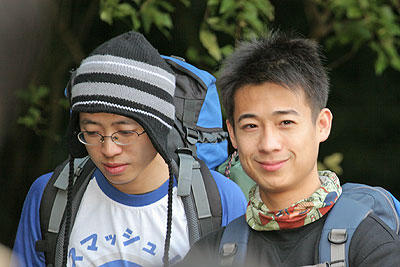
My role was to record the event in photographs, but it was hardly a job: there are few things I'd rather have done.
We had people from 15 countries; from places like Bahrain and the USA, China and Malaysia, Chile and Indonesia, Nepal and Mexico and many others. As we walked through native forest and looked down at the river far below and shared lunches, I realised how much I was receiving from these wonderful people. The thought that some of them might be denied the experience and that I might also be denied it if Winston Peters had his way is simply too much to bear. Maybe, if he'd been with us and been open to sharing the experience, he'd think long and hard before delivering a speech like last Thursday's. It's a forlorn hope, though—I'm sure he'd think of me as just another of his “...Lilly [sic] livered liberal's [sic]...” Oh well, perhaps I'll just console myself by heading off to tonight's Aotearoa Environmental Film Festival, where I'll be meeting up with friends from all over the world—despite Winston's best attempts to deny me that privilege.

Photos and words copyright 2005 Pete McGregor

22 July 2005

Pervasive doubt

In the short, sheep-cropped grass beneath the Robinias at the edge of the terrace, I notice a small skull. Just a skull, nothing else; even the lower jaw has long vanished. I pick it up. It's perfectly clean, slightly stained from its long rest; there's even a faint hint of green where algae have begun to colonise it, helping it return to the land. I check the teeth—what remains of them—and recognise it as the skull of a rabbit. This small, marvellously formed collection of interlocked, fused bones sits in the palm of my hand, the cranium now containing only the space it encloses; perhaps a few tiny beetles, maybe some mites. Once, a brain lived in there and thought and felt, and looked out at the world through nervous eyes, tested the wind with a soft nose and listened through long ears.

I'm reminded of another piece of bone; one we found at one of our campsites in Mongolia. It, too, fitted in my palm but was clearly a shard of a larger skull. Smooth and rounded; very old; stained brown where it had been partly buried, bleached and pale where it had been exposed; the cranial sutures resembling a wildly erratic ECG. When we rode away from the camp, I reached up from the saddle and placed the shard high in a tree, out of reach of the local dogs. I suppose it will eventually fall, but it seemed like the right thing to do, and I hope its owner understood.

You can dismiss these things as meaningless or as a refusal to accept the reality of reason and (the) enlightenment. You can discount this view as New Age piffle. More generously, you might accept that it can be considered metaphorical and perhaps useful from a sociological, psychological or evolutionary perspective—this kind of respect might have served to strengthen communities and so increase their members' fitness, blah blah, etc... So what do I believe? To be honest, I don't know, and at times I've believed all of these interpretations, from the arch sceptical, rationalist view to the insistent intuition that when I hold a small skull or a fragment of bone in my hand, I'm in touch with a life that still exists in a sense that's at least as literal as metaphorical. Sometimes one of these views seems more plausible than the others; later, I'll wonder how I could possibly have believed that. Faced with that sort of uncertainty—a pervasive doubt that leaves me wondering whether I can know anything at all—I'm tempted to acquiesce to the kind of relativism that says you can believe whatever you like. However, that seems simply too random—I know at least enough to know that some things are wrong. Wrong in the factual sense, but wrong in the ethical sense also.

Photo and words copyright 2005 Pete McGregor
21 July 2005

Switching from Xanga

Having just had a call from a friend encouraging me to think about sharing the xanga blog more widely, and having been thinking for quite some time about switching from the juvenile-dominated xanga with its intensely frustrating idiosyncracies (like not loading all the photos), and having checked out blogger last week, I've finally decided to set up a blogger account to see if I can replace pohanginapete at xanga with pohanginapete at blogger—i.e. this. If you've arrived here from somewhere other than the xanga site, check it out to see what you might expect here in future; if you've arrived from xanga, well, I guess you already know...

Why switch? Two main reasons: 1.) anyone can add comments here (if I choose to allow them), but at xanga you need to sign up for a xanga account; and 2.) xanga is best known for blogs **~WrItn lykE diS~**>!; blogs promoting anorexia as a lifestyle choice (it's true, but don't expect me to support it by giving you a link); and blogs by people struggling with puberty (including some over 20. Or 30. Or...). There are some exceptions, but, not unreasonably, I'd feel more of a sense of collegiality among bloggers like norightturn(to whom I'll turn for validation when the upcoming NZ Parliamentary election depresses me too much) and fuelfools (to whom I'll also turn for validation when the upcoming election ..., etc). Cheers, Wordgirl, Comfy and the rest of you :^) )

Initially, I'll copy some of the latest xanga entries here (perhaps interspersing them with new blogger posts and photos), and I'll decide later whether to stick with this and abandon xanga completely (just leaving it with a link to take readers here). However, despite my irritation with xanga, it does seem to allow more flexibility with presenting photos, so I might decide to stay there for the interim. Who knows, perhaps I'll eventually learn enough to set up my own real website?

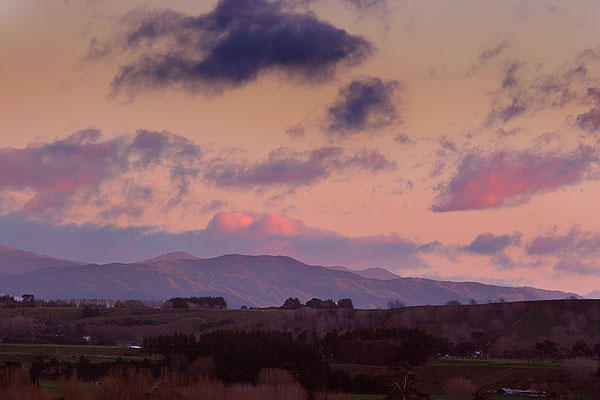
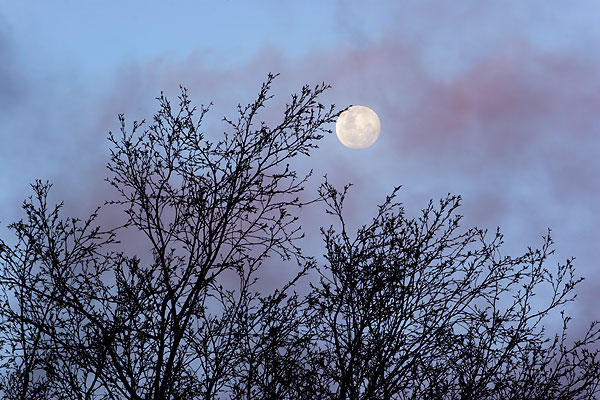
So, here we go... and here are the first photos. I stepped outside yesterday, into an elegiac evening; the darkening sky shifting with mauve clouds, the Tararua Range down south all orange-pink and violet and a big, bone-coloured moon rising... I nearly froze my tips off (that's fingertips in case you misread) enjoying it and trying to catch the light, but it was worth it. Well worth it.

Send me some thoughts about the switch, eh?

Photo and words copyright 2005 Pete McGregor