The third and final part of the Time at Flounder Bay series. [Part I; Part II].

Dawn, and the line of light on the horizon gleams a salmon colour, a thin strip between the great plane of the silver sea and the grey clouds. Higher in the sky, a little of that colour echoes the line on the horizon. The rest of the camp sleeps on, silent, unaware. Twenty minutes later the colour's faded to pale yellow with a trace of bleached brown and the clouds have lost that beautiful, subtle shading, becoming a dirty grey bordering on black, with no apparent pattern. But the sea still gleams, and the camp sleeps on.
Dawn, and the line of light on the horizon gleams a salmon colour, a thin strip between the great plane of the silver sea and the grey clouds. Higher in the sky, a little of that colour echoes the line on the horizon. The rest of the camp sleeps on, silent, unaware. Twenty minutes later the colour's faded to pale yellow with a trace of bleached brown and the clouds have lost that beautiful, subtle shading, becoming a dirty grey bordering on black, with no apparent pattern. But the sea still gleams, and the camp sleeps on.
...
The waves here break twice. Out at sea the swell rises, mounts into a luminous green wall then curls over and crashes down in a welter of white. The remains of the wave rush towards shore then begin to rise again,swelling for a second time into a wall that crashes down before racing up the beach.
 Perhaps the sea bed has some particular shape — maybe a kind of sand and shingle stationary wave — that causes this. Perhaps the waves here echo what lies beneath them, the way the present can echo the past or presage the future.
As the sun climbs higher the day seems set for a scorcher. The horizon hides somewhere in a hazy, almost indiscernible mist, a kind of heat haze or the last, fast-vanishing trace of morning mist, but by the time we reach Driftwood Cove the mist has gone completely and the heat has arrived, riding the silence of the surf: that endless, repetitive, constantly changing sound; the kind of sound with the qualities of silence — in particular, that of providing the aural space in which one can think freely. I find it exceptionally relaxing, too, but it drives others mad. This morning an elderly woman from Auckland remarked to Anne-Marie how the sound of the sea had driven her to distraction: she found it difficult to sleep, she said. Perhaps one's response to the sea depends on experience; perhaps one isn't born with the response but instead learns what to think of this sound, which to others is like a homecoming.
I look up from these thoughts to see a sudden spout of water shoot skywards, and I grab for the binoculars. But the excitement's short-lived — it's no whale surfacing, just a gannet diving. I'd missed by a moment the sight of the bird plunging into the sea with half-folded wings and had seen only the plume shooting into the sky. Out on the horizon a cruise ship waits; a helicopter roars across the cove, going north. Reminders of humans; technology.
Someone has built a small shelter at the top of the beach. A surprising effort has gone into it, so it looks like something built by a castaway with plenty of time and desperation. On the shingle, the dried leg of a crab and the remnant of a shell that looks like the flukes of a whale sounding. Earlier, I'd peered into the first rock pool I'd found after we'd left the track and crunched across the small beach, over stones and shattered shells and wrack; I watched a little blue-black cushion star gliding slowly across the bottom of the clear pool and, as I watched, I noticed a snakeskin chiton also moving, almost imperceptibly. Rock pools contain enough life and interest and questions to fascinate a person for a lifetime.
Then there are the other inhabitants of the intertidal zone — inspiration for some of the most inspirational books I know, like the early works of Rachel Carson and Steinbeck and Ricketts’ magnificent Log From the Sea of Cortez. It's easy to understand this fascination — just spend a few hours pottering along a rocky coast; ideally, take a kid with you. Not long after peering into the rock pool I'd startled a couple of Leptograpsus and my first thought was the urge to show them to someone. I can't imagine anyone, let alone a child, who wouldn't get a thrill from seeing these large colourful crabs with their impressive claws, particularly when the sighting takes place where these animals are truly at home. Anyone not moved by such a sight must surely suffer from some kind of malady: some kind of illness brought on by too much isolation from the real world, too much exposure to our own artificial environments and inventions, too little connection to the world in which we evolved.
 It's easy to understand this fascination — just spend a few hours pottering along a rocky coast; ideally, take a kid with you. Not long after peering into the rock pool I'd startled a couple of Leptograpsus and my first thought was the urge to show them to someone. I can't imagine anyone, let alone a child, who wouldn't get a thrill from seeing these large colourful crabs with their impressive claws, particularly when the sighting takes place where these animals are truly at home. Anyone not moved by such a sight must surely suffer from some kind of malady: some kind of illness brought on by too much isolation from the real world, too much exposure to our own artificial environments and inventions, too little connection to the world in which we evolved.
The sun beats down relentlessly. I drape a bandana over my head to cover my ears and neck and to shade my eyes, and hold it in place with a baseball cap. The relief from the glare and heat allows me to relax again and gaze about from my perch on a low, flat rock. Anne-Marie says I look like John the Baptist.
...
A bright green scallop shell mould lies on the beach, left behind, presumably, by a family with at least one small child. I make two scallop shells from damp sand, leaving them to dry and crumble in the sun and wind, and I place the mould above the high-water mark. With luck, other visitors to the beach will do the same, leaving small, impermanent records of their visits and leaving the mould behind. I wonder how many generations of this cycle will happen before someone's acquisitiveness brings it to an end.
In the terrific heat and humidity of the afternoon we visit the Redwood grove. Anne-Marie writes by the stream; I potter with the macro lens and tripod, photographing fungi; brightly coloured leaves on old, brown litter; bark; other details. As we leave the cool, quiet shade something alights on my hand. I look, and see a female robber fly grasping a small damselfly which isn't yet dead. Its abdomen, long and thin, curls and uncurls, back and forth.
 Anne-Marie writes by the stream; I potter with the macro lens and tripod, photographing fungi; brightly coloured leaves on old, brown litter; bark; other details. As we leave the cool, quiet shade something alights on my hand. I look, and see a female robber fly grasping a small damselfly which isn't yet dead. Its abdomen, long and thin, curls and uncurls, back and forth.
After supper Anne-Marie goes for a walk around the village and I set off alone for the Cove of Giants. Perhaps because I'm alone, or perhaps for some other reason I don't understand, the small cove feels eerie — wilder than Driftwood Cove and less welcoming but also fascinating, with a greater sense of possibility: the feeling that one might find something extraordinary cast up among the rocks or half buried along the strand line. A great pine log, bleached pale grey, lies propped up and resembling an enormous cannon pointing out to sea. I walk partway up it, enjoying the balancing act, and stop where I can look down into a narrow gap between the log and the rocks. The sea rushes in beneath me, backlighting the gap, and there in the narrow space the silhouettes of several large Leptograpsus shuffle and creep, move a few scrabbling steps and stop, then move again. They look like something in a scene from Alien.
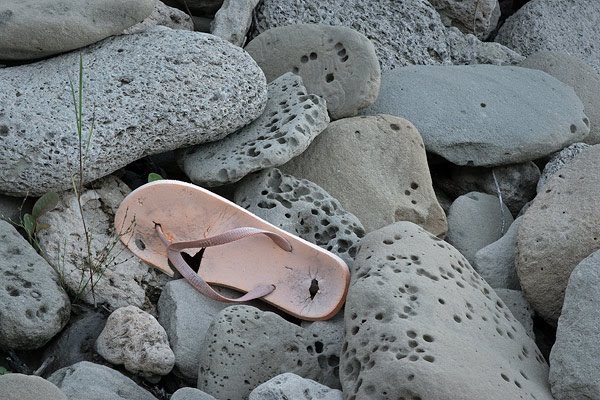
Teasel, that peculiar, distinctive plant, flowers above the high-water mark; a red jandal faded to pink lies warped among pale stones. The giant tree still lies on the shore, more bleached than when we last saw it but still resisting the sea, the storms, the scouring sand. Its branches reach out as if appealing to the evening sky. White bones of a seabird lie on a rock and, nearby, more, with the matted remains of feathers.
 The evening breeze slides over my skin, cicadas and black field crickets sing in the grass between the beach and the looming cliffs and, out at sea, a gannet cruises south. In the whole darkening world, there's no other human to be seen.
 ...
With the Mission Vineyards concert on in Napier in the evening, the camp's almost full. All the cabins are occupied and numerous tents interrupt the once-unimpeded view. Kids scream and yell, get lost, hurt themselves and bawl. Yesterday afternoon a large, dark green, excessively-polished Holden throbbed its way up the drive, circled and parked by one of the expensive cabins, and this morning we find a bulky Landcruiser Prado parked in front of our little one-room cabin: "3400 V6 Quad Cam" the beast says. It might as well have simply said "Notice my status". One can almost sense the tension between it and the Holden: the air beginning to reek with the smell of vehicular testosterone.
But when I step outside this morning into the warm dawn on the last day, no one else has woken, no one else has risen to see the spectacular light and colours over the sea and on the Nor'west clouds glowing above the valley. All the tents are zipped, the cabin curtains closed, the dusty driveway occupied only by a few sparrows — the birds are always the first up — and a dead rat, belly up, presumably a victim of the poison under every cabin.
The solitude doesn't last. Soon the kids begin to prowl, whispering at first, then talking, and so the quiet time ends. Not that they're all noisy, though: a girl, almost a teenager and wearing a T-shirt that says, "I kissed a vampire and I liked it", sits on a large rock in the sun and reads a book. Probably a book about vampires — the Twilight kind of vampires, that is — although I'm just guessing. But I doubt it was about Heidegger's concept of the uncanny; sadly, I also doubt it was anything about the real, non-vampire life living along the shores of Aotearoa.
However, at least it was a real book. In Napier I'd picked up Joe Bageant's Deer Hunting With Jesus; late in the book he comments on research showing how TV subdues the left side of the brain and stimulates the right
 (an oversimplified but useful shorthand for saying it discourages critical, analytical thinking and encourages emotional responses). Reading that, I wondered: perhaps one of the major advantages of the written word over TV, radio and other auditory/visual methods of communication is that when reading it's easy to stop and think but when watching TV it's much harder to do that. The same might be said of podcasts and videos, although it's possible in theory to pause those. But really: how often do you pause a video partway through, to think about what's been presented? In practice, pausing a video differs so greatly from the simple act of looking up from a page of writing to mull something over that listening/watching and reading amount to two utterly different forms of communication. Thus, even if my guess about the nature of vampire-girl's book was right, and the intent of the book was entirely to appeal to the emotions, at least she had the opportunity to think about what she was reading.
...
Our time at Flounder Bay has almost come to an end. Or has it? When does a journey end? And when does a journey begin? Suppose your journey involves travel overseas — to India and Nepal for five months, say, then two months in Africa, then brief stop-overs in the UK and France to visit friends on the way home (that nebulous concept that can be pinned down only by the trenchantly dogmatic). Does the journey begin when you close the door and turn the key for the last time for seven and a half months? Or does it begin when you step onto the plane, or when (looking the other way) you book your flights? What about when you first start planning when and where you'll go, or even when you get that first restless urge to move away from mundane life with its relatively regular and predictable (although not necessarily boring) pattern — that sense that there's more to this life than more of the same, and less of this life in which the opportunity to travel still remains?
Think like this and the start of your journey can extend back almost indefinitely, or at least as far back as the time you became aware of a world more extensive than that in which you spent your days playing and visiting other small friends and grandparents and, one hopes, learning. Perhaps you opened a book and saw photos of weird animals you never knew existed (rhinoceros, giraffe, condor, tapir, cassowary) in places you never knew existed (Africa, South America, New Guinea); now, more likely, perhaps you learned about these animals and places when you first saw them on TV. Perhaps this is when your journey began: when you first discovered these things and thought these were things you wanted to see for yourself. Perhaps, also, your journey never ends, at least not while it lives on in your memory, or in your desire to resume it.
We close the lock on the door and say goodbye to the little cabin, drive slowly past the crowds and out the first gate, past the kennels and the sheds and the old tractors, over the small wooden bridge and through the last gate onto the main road. It'll be a long, hot drive back to the valley and when we arrive, something will be missing. It'll be the sound of the sea.

Notes:
1. Cushion star: Patiriella sp., one of the most common starfish along the coast of Aotearoa.
2. Snakeskin chiton: Sypharochiton pelliserpentis. Abundant along our rocky coasts.
3.. "They look like something in a scene from Alien": later, the comparison strikes me as ironic — the real world compared to the fictitious, and that particular fiction drawing inspiration from the real world where parasitoids lay eggs in living creatures from which they later emerge. Life imitating art imitating life, I suppose.
1. Cushion star: Patiriella sp., one of the most common starfish along the coast of Aotearoa.
2. Snakeskin chiton: Sypharochiton pelliserpentis. Abundant along our rocky coasts.
3.. "They look like something in a scene from Alien": later, the comparison strikes me as ironic — the real world compared to the fictitious, and that particular fiction drawing inspiration from the real world where parasitoids lay eggs in living creatures from which they later emerge. Life imitating art imitating life, I suppose.
Photos (click to enlarge them):
1. Shell fragment at Driftwood Cove.
2. The edge of the sea at the Cove of Giants.
3. Writer in the redwood grove.
4. Redwood leaf on redwood leaves.
5. The Pink Jandal.
6. Beached pine at the Cove of Giants.
7. Recycling in the redwood grove.
1. Shell fragment at Driftwood Cove.
2. The edge of the sea at the Cove of Giants.
3. Writer in the redwood grove.
4. Redwood leaf on redwood leaves.
5. The Pink Jandal.
6. Beached pine at the Cove of Giants.
7. Recycling in the redwood grove.
Photos and original text © 2010 Pete McGregor


